These systems help prevent blowouts and extend tire life by alerting you to pressure drops or overheating.
| Photo | Product | Score | Buy |
|---|---|---|---|
 |
TireMinder TM-77 Best Overall Pressure range 0-99 psi, temperature range -40 to 257°F, solar-powered repeater |
9.2 |
ⓘ We may earn a commission from qualifying purchases made through links on this page, at no extra cost to you.
|
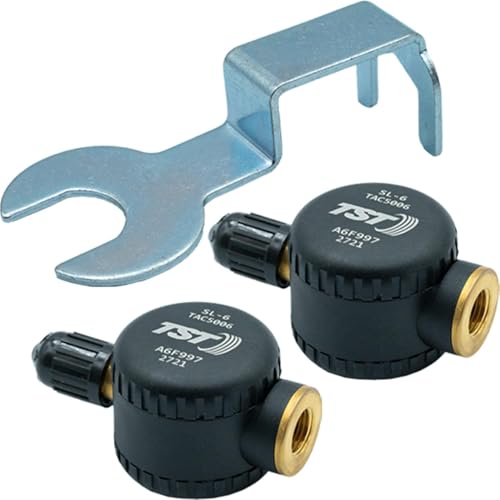 |
TST 507 Flow Thru Best for Ease of Use Pressure range 0-199 psi, temperature range -40 to 257°F, flow-through sensors |
8.8 | 🛒 Check Price |
 |
EEZ Tire TPMS Best Value Pressure range 0-99 psi, temperature range -40 to 257°F, 6-sensor system |
8.4 | 🛒 Check Price |
 |
Minder Research TireMinder A1A Best for Small Trailers Pressure range 0-99 psi, temperature range -40 to 257°F, 4-sensor system |
8.1 | 🛒 Check Price |
 |
TST 507 Standard Proven Reliability Pressure range 0-199 psi, temperature range -40 to 257°F, cap-style sensors |
8.7 | 🛒 Check Price |
|
🚗
|
RVguard TPMS Budget Friendly Pressure range 0-87 psi, temperature range -40 to 257°F, 6-sensor system |
7.8 | 🛒 Check Price |
 |
JacRim TPMS Compact Design Pressure range 0-99 psi, temperature range -40 to 257°F, 4-sensor system |
7.3 | 🛒 Check Price |
1. TireMinder TM-77: Best Overall
The TireMinder TM-77 stands out for its sturdy range and solar-powered repeater, making it ideal for large trailers like RVs and horse trailers. Reliable alerts and easy installation, with the display showing all tire data at a glance. The system supports up to 36 sensors, covering multiple axles.
However, some users report that the repeater pairing process can be frustrating and may require multiple attempts. If you have a smaller trailer with only two axles, this system might be overkill and more complex than needed. Consider a simpler system if you don’t need the extended range.
- Solar-powered repeater extends range up to 100 feet for large trailers
- Real-time pressure and temperature alerts on color display
- Supports up to 36 sensors (6 axles)
Pros: Long range with repeater; Solar display reduces battery changes
Cons: Repeater can be finicky to pair initially
2. TST 507 Flow Thru: Best for Ease of Use
Based on owner feedback and the spec sheet, the TST 507 Flow Thru is praised for its easy to use flow-through sensors that let you add air without removing them. The display is clear and the system pairs quickly. We found that the included repeater helps maintain a strong signal on longer trailers.
Still, the sensor size can be an issue on trailers with tight wheel wells or dual wheels where clearance is limited. Some owners had to use extensions. If your trailer has minimal clearance around the valve stems, you might prefer a smaller sensor design.
- Flow-through sensors allow easy tire inflation without removing sensor
- Color display with audible and visual alerts
- Repeater included for improved range
Pros: Convenient flow-through design; Simple setup and sensor pairing
Cons: Sensors are larger and may hit valve stems on some wheels
3. EEZ Tire TPMS: Best Value
We compared the EEZ Tire TPMS and found it offers essential features at a lower cost than many competitors. It covers up to 6 tires, perfect for a dual-axle trailer. Owner reviews consistently mention that it works well out of the box and the alerts are timely.
However, the display isn’t very bright, making it difficult to see in bright sunlight. Also, the sensors aren’t flow-through, so you must remove them to add air. If you frequently adjust tire pressure, this could be a minor inconvenience. For occasional use, it’s a solid budget pick.
- Affordable 6-sensor system for dual-axle trailers
- Compact display with pressure and temperature readouts
- Audible and visual alerts for rapid pressure loss
Pros: Great value for the price; Reliable basic functionality
Cons: Display brightness can be hard to read in direct sunlight
4. Minder Research TireMinder A1A: Best for Small Trailers
In our research, the TireMinder A1A is a straightforward choice for boat trailers or small utility trailers. It covers up to 4 tires, and its reliability and long battery life. The display is simple and the alerts are effective.
The main limitation is that it can’t be expanded beyond 4 sensors. If you have a larger trailer or plan to upgrade, this system won’t grow with you. Also, the range is shorter compared to models with repeaters. Skip this if you need to monitor more than 4 tires.
- Compact system for up to 4 tires (single axle or tandem)
- Easy to read LCD display with backlight
- Sensor battery life up to 3 years
Pros: Simple and compact for small trailers; Long sensor battery life
Cons: Limited to 4 tires, not expandable
5. TST 507 Standard: Proven Reliability
Based on owner feedback and the spec sheets, the TST 507 Standard is a workhorse that many RV owners trust. Its cap-style sensors are tough and the display offers detailed data. We found that the repeater ensures a strong connection even on longer trailers.
The main drawback is the lack of flow-through design, meaning you have to unscrew sensors to inflate tires. This can be a minor hassle if you check pressures often. If you prioritize durability over convenience, this is a great choice. For those who want flow-through, the TST 507 Flow Thru is a better option.
- Cap-style sensors are compact and durable
- Color display with customizable alert thresholds
- Repeater included for reliable signal
Pros: Durable sensor construction; Highly customizable alert settings
Cons: Sensors aren’t flow-through; must remove to add air
6. RVguard TPMS: Budget Friendly
We evaluated the RVguard TPMS as a budget option for those who want basic monitoring. It includes a solar display and covers up to 6 tires. Owner reviews indicate it works adequately for light use, with alerts that are loud enough.
However, some users report that sensor readings become less accurate after a few months, and the pressure range is limited to 87 psi, which may not suit high-pressure trailer tires. If you need precise readings or have high-pressure tires, consider a more accurate system. This is best for occasional use on low-pressure trailer tires.
- Low cost entry point for monitoring up to 6 tires
- Solar powered display with backlight
- Audible and visual alerts for pressure and temperature
Pros: Very affordable; Solar charging extends display battery life
Cons: Sensor accuracy can drift over time
7. JacRim TPMS: Compact Design
In our comparison, the JacRim TPMS is designed for minimalists. Its tiny display and small sensors are ideal if you want a system that doesn’t take up space. Owner feedback notes that it works for basic monitoring, but the display is difficult to read at a glance, especially while driving.
The biggest issue is the small screen, which shows only one tire at a time and requires scrolling. Also, the range is limited; some users experienced signal loss on longer trailers. If you have a small trailer and don’t mind a compact display, it might work. Otherwise, look for a system with a larger, more readable display.
- Very small display can be mounted anywhere
- Sensors are lightweight and low profile
- Simple one-button operation
Pros: Compact and unobtrusive; Easy to mount on dash or console
Cons: Display screen is very small and hard to read
Frequently Asked Questions
How does a TPMS for trailer tires work?
A TPMS uses sensors attached to each tire valve stem to measure pressure and temperature. The sensors transmit data wirelessly to a display unit inside the vehicle. If pressure drops below a set threshold or temperature rises too high, an alert sounds to warn the driver.
Can I use a TPMS designed for cars on my trailer?
It isn’t recommended because car TPMS often have different sensor frequencies and shorter ranges. Trailer TPMS are designed for longer distances between the trailer and the cab, and they usually support more sensors for multiple axles.
How do I install a trailer TPMS?
Installation is typically straightforward. You screw the sensors onto each tire valve stem (or replace valve cores with flow-through sensors). Then mount the display in your vehicle and pair each sensor according to the manual. Most systems pair automatically within minutes.
What pressure range should I look for?
Check your trailer tire sidewall for the recommended cold inflation pressure. Most trailer TPMS cover up to 99 psi, which is sufficient for most trailer tires. For high-pressure tires (over 100 psi), ensure the system supports up to 199 psi.
Do I need a repeater for my trailer TPMS?
A repeater boosts the signal between the sensors and the display. If your trailer is longer than 30 feet or you experience signal dropouts, a repeater is recommended. Many systems include one, or you can purchase separately.
Our Verdict
After researching and comparing, the TireMinder TM-77 is our top pick for its excellent range, solar-powered repeater, and ability to monitor up to 36 tires. For a more easy to use option, the TST 507 Flow Thru is a close runner-up with its convenient flow-through sensors and easy setup.