A flat tire on a travel trailer is a different problem than a flat on your car. The axle weights are higher, the ground clearance is awkward, and a tandem-axle rig changes the whole approach to lifting. The jack that lives under your truck seat is almost never the right tool for the job, and reaching for it on a soft shoulder can be genuinely dangerous.
We looked at the jacks that actually make sense for a roadside trailer tire change: heavy-duty bottle jacks with the right lift range, drive-on ramp blocks that skip the lifting entirely on tandem axles, and a couple of clever purpose-built RV jacks. Every pick below is rated for real trailer loads, stays stable on uneven ground, and fits the limited space under a loaded travel trailer frame. No prices here, just honest picks and the weaknesses we found.
| Photo | Product | Score | Buy |
|---|---|---|---|
 |
Trailer Aid Plus Tandem Tire Changing Ramp Best Overall Drive-on ramp, 5.5 inch lift, rated to 15,000 lb per axle pair |
9.5 |
ⓘ We may earn a commission from qualifying purchases made through links on this page, at no extra cost to you.
|
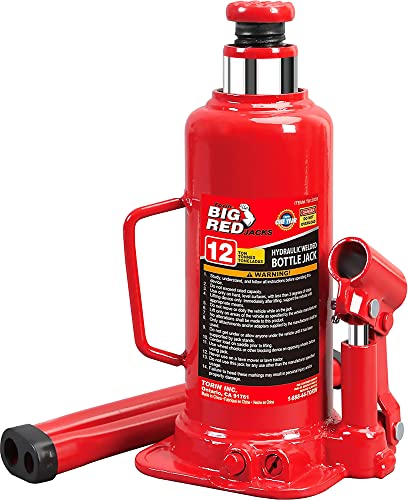 |
Torin BIG RED 12 Ton Hydraulic Bottle Jack Best Heavy-Duty Bottle Jack 12 ton capacity, 9.06 to 18.31 inch lift range |
9.3 | 🛒 Check Price |
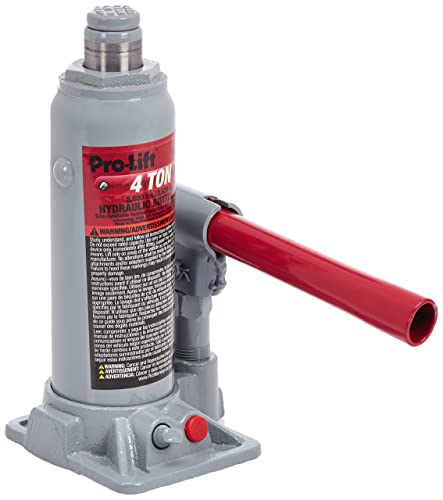 |
Pro-LifT B-004D 4 Ton Heavy Duty Bottle Jack Best Value Bottle Jack 4 ton capacity, 8.13 to 15.75 inch lift range |
9.1 | 🛒 Check Price |
 |
BAL 28050 Light Trailer Tire Leveling Scissor Jack Best Scissor Jack Screw-drive scissor jack, lifts roughly 4.5 to 11 inches |
8.8 | 🛒 Check Price |
 |
Andersen 3604 Rapid Jack Block Best Drive-On Block Curved drive-on block, lifts tandem tire, rated to 15,000 lb |
8.6 | 🛒 Check Price |
 |
Big Mike 3 Ton Trailer Tire Change Jack Block Most Compact Drive-on tandem block, 3 ton rating, lifts about 4 inches |
8.3 | 🛒 Check Price |
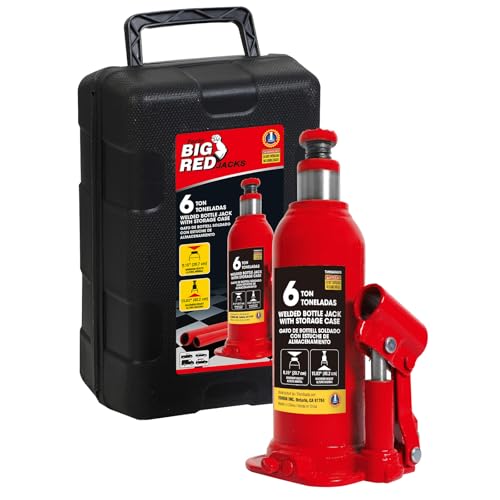 |
Torin BIG RED 6 Ton Welded Bottle Jack Best All-Around Bottle Jack 6 ton capacity, 8.27 to 15.75 inch lift range |
8.1 | 🛒 Check Price |
1. Trailer Aid Plus Tandem Tire Changing Ramp: Best Overall
For a tandem-axle travel trailer, the Trailer Aid Plus is the tool we reach for first, and it’s barely a jack at all. You position it ahead of the good tire on the same side as the flat, then pull the trailer forward a few feet so the good tire climbs the ramp. That lifts the flat tire clean off the ground with zero cranking, zero crawling under the frame, and zero guessing about a safe lift point. On the shoulder of a highway, getting the job done in under a minute matters more than almost anything.
The honest weakness is right there in the design: it’s only useful on a trailer with two or more axles on a side. If you tow a single-axle trailer, this does nothing for you and you need a bottle jack instead. The 5.5 inch lift is also just enough rather than generous, so owners running oversized off-road RV tires occasionally find the flat barely clears. For the typical tandem travel trailer, though, nothing else is this safe or this quick.
- Drive the good tire up the ramp to lift the flat off the ground, no jacking required
- 5.5 inch lift height clears most travel trailer tires for a fast swap
- Solid molded body with a chock notch and built-in handle for carrying
Pros: Fastest possible tire change on a tandem-axle trailer; No frame contact, so no risk of damaging the underbelly or axle tube; Extremely stable since the trailer weight rests on the ramp, not a single point
Cons: Only works on tandem or triple axles, useless on a single-axle trailer; Lift height can be marginal for very tall RV tires
2. Torin BIG RED 12 Ton Hydraulic Bottle Jack: Best Heavy-Duty Bottle Jack
When you want one jack that will lift anything you tow, the Torin BIG RED 12 ton is the safe answer. Trailer axles rarely carry more than a few thousand pounds at a single lift point, so a 12 ton jack is enormous overkill in the best way: the ram barely works, the lift is smooth and controlled, and you never wonder whether you’re pushing the tool past its limit on a busy roadside. The wide cast base is the real story here, because it spreads load on the soft, uneven ground you actually get on a highway shoulder.
The tradeoff for that big capacity is height. At rest the jack stands tall, and on a low travel trailer with the suspension compressed under a full water tank, you may struggle to slide it under the frame or axle. The fix is a sturdy board to start on or choosing a lift point with more clearance, but it’s worth knowing before you buy. It’s also genuinely heavy to lug around. For raw capability and margin, though, this is the bottle jack we trust most.
- 12 ton hydraulic capacity handles even the heaviest fifth-wheel and travel trailer axles
- Wide cast base resists tipping on packed gravel and dirt shoulders
- Tall lift range from roughly 9 to 18 inches reaches high trailer frames
Pros: Massive capacity gives a huge safety margin over trailer axle loads; Works on single-axle and tandem trailers alike; Compact footprint stores easily in a trailer pass-through
Cons: Tall collapsed height may not fit under a low-slung loaded frame; Heavier to handle than a smaller bottle jack
3. Pro-LifT B-004D 4 Ton Heavy Duty Bottle Jack: Best Value Bottle Jack
The Pro-LifT B-004D hits the sweet spot most travel trailer owners actually need. A single trailer tire change rarely asks more than two or three tons at the lift point, so 4 tons of capacity gives a comfortable margin while keeping the jack small, light, and most importantly low. That lower collapsed height is the practical advantage over a giant 12 ton unit: it slides under a frame rail or axle tube even when the trailer is loaded and squatting. For the average tandem or single-axle camper, this is the bottle jack that just fits.
The honest limitation is that 4 tons is the right size, not a huge cushion. If you tow a heavy triple-axle fifth wheel and want to lift in a spot that carries serious weight, step up to a bigger jack. And like every narrow bottle jack, the small base wants a wooden block under it on the dirt and gravel you find roadside, otherwise it can sink or lean. Use it within its design and pair it with a board, and it’s a hard pick to beat for everyday trailer duty.
- 4 ton capacity is well matched to typical travel trailer axle loads
- Lower collapsed height slides under loaded trailer frames more easily
- Stamped wide base and stout welded handle for steady lifting
Pros: Right-sized capacity without the bulk of a 12 ton unit; Fits under lower frames where bigger jacks won’t; Light enough to carry and store without effort
Cons: 4 ton ceiling leaves less margin for very heavy fifth wheels; Single-stage ram needs a board on soft ground
4. BAL 28050 Light Trailer Tire Leveling Scissor Jack: Best Scissor Jack
The BAL 28050 is a scissor-style jack built specifically with trailers in mind, and its appeal is that it lifts right at the tire and axle rather than up against a frame rail you have to locate and trust. You slide it into position under the axle, then crank the screw with a lug wrench or an impact driver until the flat clears the ground. Because the load path is straight up through a wide screw mechanism, it feels reassuringly planted once it’s set, and it pulls double duty for leveling the camper when you’re parked.
What you give up is speed and ceiling. Cranking a screw jack is simply slower than pumping a hydraulic ram, and on a hot shoulder you feel every turn, though a cordless drill solves most of that complaint. The capacity is also tuned for lighter travel trailers, so very heavy rigs should look to a bottle jack instead. For a midsize camper owner who wants one tool that levels at camp and changes a tire on the road, this is a smart, stable choice.
- Drives under the tire and lifts it without crawling under the frame
- Screw mechanism cranks with a standard lug wrench or drill
- Compact folded profile stows flat in a storage bay
Pros: Lifts at the tire so you avoid hunting for a frame lift point; Stable wide stance once positioned under the axle area; Doubles as a leveling aid at the campsite
Cons: Slower to crank up than a hydraulic bottle jack; Lighter duty rating than the big bottle jacks
5. Andersen 3604 Rapid Jack Block: Best Drive-On Block
The Andersen Rapid Jack works on the same principle as a drive-on ramp but uses a curved cradle that the good tire rolls into, lifting the flat next to it on a tandem axle. The clever part is that it pulls double duty: the same curved block is sold as a leveler, so it earns its storage space whether you’re changing a tire or trying to get the fridge sitting flat at a campsite. It’s hollow and light enough to toss in a bay one-handed, yet the rating comfortably covers heavy travel trailers.
The catch is the same as any drive-on solution, and it’s worth repeating: this does nothing for a single-axle trailer, since it relies on a neighboring tire bearing the load. Positioning matters too, because the tire has to roll fully up onto the curve to seat at full height, and a poorly placed block can leave the flat only partly off the ground. On a tandem rig with a careful setup, though, it’s one of the fastest and most stress-free ways to swap a tire on the shoulder.
- Curved profile cradles the good tire to raise the adjacent flat
- Hollow design is light to carry yet rated for heavy trailers
- Works as a leveler too, stacking under the tire for height
Pros: Very fast tandem-axle tire change with no jacking; Light and easy to store in a pass-through bay; Doubles as a curved tire leveler at the campsite
Cons: Tandem and triple axles only, not single-axle trailers; Tire must roll cleanly onto the curve to seat properly
6. Big Mike 3 Ton Trailer Tire Change Jack Block: Most Compact
The Big Mike block is the minimalist take on a drive-on tire changer. It’s a compact wedge you place ahead of the good tire on a tandem axle, then ease the trailer forward to lift the adjacent flat. With no hydraulics and no moving parts, there’s nothing to leak, seize, or wear out, which is exactly what you want from a tool that might sit unused in a storage bay for a year between flats. Its small size means it actually fits in a real roadside kit rather than hogging a whole bin.
That compactness costs you lift height. The block raises the tire less than a full-size ramp does, so on a trailer with tall tires or a worn, squatting suspension, the flat may barely clear the pavement. As with every drive-on option, it’s also strictly for tandem or triple axles. If you understand those limits and tow a tandem with normal-height tires, it’s a genuinely handy, set-and-forget piece of insurance.
- Small drive-on block raises a tandem trailer tire in seconds
- Compact enough to live in a road-side emergency kit
- No moving parts means nothing to fail or maintain
Pros: Tiny footprint stores anywhere in the trailer; Dead simple and reliable with nothing to break; Quick tandem tire change without crawling under the rig
Cons: Lower lift height than full-size ramps; Tandem axles only, and tight clearance for big tires
7. Torin BIG RED 6 Ton Welded Bottle Jack: Best All-Around Bottle Jack
The 6 ton Torin BIG RED splits the difference between the right-sized 4 ton jacks and the overkill 12 ton monsters, and for a lot of travel trailer owners that middle ground is exactly right. It carries enough capacity to lift a heavier camper with a real safety margin, while staying more manageable in size and weight than the biggest units. The welded steel build inspires confidence when you’re setting it on a gritty shoulder and trusting it with thousands of pounds of trailer hanging overhead.
It shares the standard bottle-jack weaknesses, and you should plan around them. The base is narrow, so a flat wooden block underneath isn’t optional on dirt or gravel, it’s the difference between a stable lift and a jack that tips. The collapsed height also runs tall enough that the lowest loaded frames can be tight to fit. Treat it as the do-everything jack for a mid-to-heavy trailer, carry a board, and it won’t let you down.
- 6 ton capacity covers heavier travel trailers with margin to spare
- Welded steel base and cylinder for durability on rough ground
- Mid-size lift range reaches typical trailer frames and axles
Pros: Strong middle-ground capacity between 4 and 12 ton jacks; Sturdy welded construction holds up to roadside abuse; Works on single-axle and tandem trailers
Cons: Narrow base needs a board on soft shoulders; Collapsed height too tall for the lowest frames
Frequently Asked Questions
What size jack do I need to change a travel trailer tire?
For a bottle jack, a 4 to 6 ton unit covers the vast majority of travel trailers with a healthy safety margin, since a single tire lift point usually carries only two to three tons. Lighter campers can use a 4 ton jack, while heavier fifth wheels and triple-axle rigs are better served by a 6 or 12 ton jack. Drive-on ramps and blocks are rated differently, often to 15,000 pounds per axle pair, which is plenty for almost any trailer. The key is to check your trailer’s gross axle weight rating and pick a jack that exceeds the load at a single lift point with room to spare.
Can I use a drive-on ramp on a single-axle trailer?
No, and this is the single most important thing to understand before buying. Drive-on ramps like the Trailer Aid and curved blocks like the Andersen Rapid Jack work by having you pull the good tire up onto the ramp so the flat tire next to it lifts off the ground. That only happens on a tandem or triple axle where there’s a neighboring tire on the same side. A single-axle trailer has nothing to climb the ramp while the flat is being changed, so for those rigs you need a hydraulic bottle jack or a scissor jack placed under the axle or frame instead.
Where is the safe place to put a jack under a travel trailer?
The safest lift points are directly under the axle tube near the spring perch, or under a reinforced section of the main frame rail, never against the thin underbelly, plumbing, or the axle’s center. Lifting close to the wheel keeps the load path short and stable. Consult your owner’s manual, because some manufacturers mark approved jacking points. Whatever spot you choose, set the jack on a solid base, lift slowly, and never put any part of your body under the trailer while it’s supported only by a jack. Use a jack stand or the spare tire as a backup whenever possible.
Should I carry a jack stand along with the jack?
Yes, a jack stand or a sturdy backup support is strongly recommended for any trailer tire change. A hydraulic bottle jack can lose pressure, and a narrow base can shift on soft ground, so relying on the jack alone is a real risk. Once you have lifted the trailer, slide a rated jack stand or even a stack of leveling blocks under the frame as a safety catch before you remove the wheel. Drive-on ramps are inherently safer here because the trailer’s weight rests broadly on the ramp rather than balancing on a single point, which is a big part of why they’re so popular for roadside changes.
Why not just use the jack that came with my tow vehicle?
The scissor jack stashed under your truck or SUV seat is sized for that vehicle’s lighter weight and its low, flat lift points, not for a loaded trailer. It often lacks the capacity for trailer axle loads, the lift range to reach a high trailer frame, and the base stability you need on a highway shoulder. Pushing a small vehicle jack past its rating is how you end up with a tipped jack and a damaged trailer. A purpose-chosen bottle jack, scissor jack, or drive-on ramp is rated and shaped for the job, which is why every pick on this list beats your factory jack for trailer duty.
Our Verdict
For most travel trailer owners, the Trailer Aid Plus Tandem Tire Changing Ramp is our top pick, because on a tandem axle it turns a stressful roadside change into a one-minute, no-crawling job with the trailer resting safely on a broad ramp instead of a single point. The catch is that it only works on tandem and triple axles, so if you tow a single-axle camper or want one tool that lifts anything, our runner up is the Torin BIG RED 12 ton bottle jack, which gives you enormous capacity, a wide stable base, and the versatility to lift any trailer you own as long as you carry a board for soft ground.


