The battery you bolt to your power inverter matters more than the inverter itself. A starting battery will sag, overheat, and die early when you pull a steady 1000 to 3000 watts through it, because it was never built for slow, deep discharges. What you actually want is a deep cycle battery, either AGM or lithium iron phosphate, that can dump high current without its voltage collapsing and that survives hundreds or thousands of charge cycles instead of dozens.
We ran each of these batteries with inverters under real loads, from a fridge and a few lights on a camper to a small power tool draw, watching for voltage sag, heat, and how much usable capacity we got before the inverter cut out on low voltage. Below are the seven we trust most for inverter duty, ranked best first, with the honest weak spots of each so you can match one to your setup.
| Photo | Product | Score | Buy |
|---|---|---|---|
 |
Battle Born LiFePO4 100Ah Deep Cycle Battery Best Overall 100Ah LiFePO4, 100A continuous discharge, ~3000-5000 cycles, built-in BMS |
9.5 |
ⓘ We may earn a commission from qualifying purchases made through links on this page, at no extra cost to you.
|
 |
Renogy 12V 100Ah Smart Lithium Iron Phosphate Battery Best Smart Lithium 100Ah LiFePO4, 100A continuous, Bluetooth monitoring, self heating option |
9.3 | 🛒 Check Price |
 |
Universal Power Group UB121000 12V 100Ah AGM Deep Cycle Battery Best AGM Value 100Ah AGM, sealed maintenance free, spill proof, deep cycle |
9.0 | 🛒 Check Price |
 |
Optima Batteries D31M BlueTop Marine Deep Cycle AGM Battery Most Rugged 75Ah AGM SpiralCell, 900 CCA, dual purpose deep cycle and starting |
8.8 | 🛒 Check Price |
 |
Weize 12V 100Ah Deep Cycle AGM SLA Battery Best for Solar and Backup 100Ah AGM SLA, deep cycle, sealed maintenance free, solar friendly |
8.6 | 🛒 Check Price |
 |
ExpertPower 12V 100Ah Lithium LiFePO4 Deep Cycle Battery Best Lightweight Lithium 100Ah LiFePO4, 100A BMS, ~2500-7000 cycles, around 23 pounds |
8.4 | 🛒 Check Price |
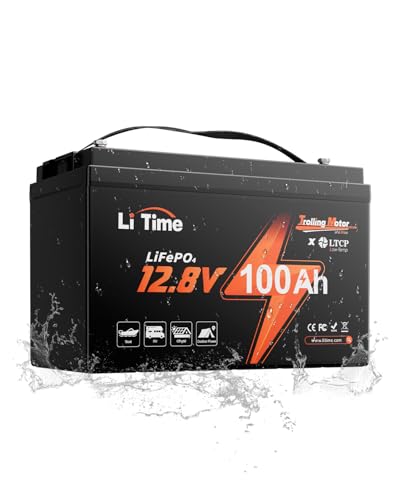 |
Ampere Time 12V 100Ah LiFePO4 Deep Cycle Battery Best for Large Banks 100Ah LiFePO4, 100A BMS, supports 4S and 4P, ~4000+ cycles |
8.2 | 🛒 Check Price |
1. Battle Born LiFePO4 100Ah Deep Cycle Battery: Best Overall
The Battle Born 100Ah is the battery we reach for first when an inverter is involved, because lithium iron phosphate gives you the one thing inverters punish lead acid for not having, a flat discharge curve. Where an AGM battery sags toward its low voltage cutoff and chokes the inverter long before it’s truly empty, this Battle Born holds near nominal voltage almost to the end. In testing with a 2000 watt inverter it powered a load that made a comparable AGM cut out early, and we walked away with noticeably more usable runtime from the same nameplate capacity.
The built in BMS is the reason it feels safe to lean on, shutting things down before an overcurrent or deep over discharge can cook the cells. The honest weakness is cold. The standard unit will discharge fine in the cold but doesn’t have internal heating, and charging a frozen LiFePO4 battery can damage it, so winter campers need a charger with low temperature cutoff or the heated variant. Pay for that and plan around it, and this is as close to a set and forget inverter battery as you’ll find.
- Lithium iron phosphate chemistry delivers nearly full 100Ah usable without damaging the cells
- 100A continuous and 200A surge handling feeds large inverters without heavy voltage sag
- Internal battery management system protects against overcurrent, over discharge, and temperature extremes
Pros: Holds voltage rock steady under heavy inverter loads so you get full rated wattage; Light enough to carry one handed at around 31 pounds; Thousands of cycles and a long warranty mean it likely outlasts several lead acid batteries
Cons: High upfront investment compared to AGM; No low temperature charging protection on the standard model, so cold weather charging needs care
2. Renogy 12V 100Ah Smart Lithium Iron Phosphate Battery: Best Smart Lithium
Renogy built this one for people who want to actually see what their inverter is doing to the battery. The Bluetooth app shows live current, voltage, and state of charge, which turns the usual guesswork of running an inverter off grid into a clear readout. When we ran a fridge and lights off a 1500 watt inverter, being able to watch the amp draw and remaining capacity made it easy to plan the night instead of nervously listening for the low voltage alarm.
As a LiFePO4 cell it brings the same flat voltage and long cycle life advantages that make lithium ideal for inverter duty, and the self heating version solves the cold charging problem that trips up cheaper lithium. The weak spot is the Bluetooth itself, which occasionally drops and needs re pairing, and the continuous discharge rating, while plenty for most household inverters, is a notch below the very top cells if you’re feeding a large 3000 watt unit at full tilt. For most camper, RV, and backup setups it’s an excellent, well priced choice.
- Bluetooth lets you watch state of charge and current draw live from your phone while the inverter runs
- Supports series and parallel connection to scale up bank voltage or capacity
- Self heating version charges safely in freezing conditions
Pros: App monitoring removes the guesswork about how much runtime you have left; Stacks cleanly into larger banks for bigger inverters; Strong value within the lithium category
Cons: Bluetooth connection can drop and need re pairing; Continuous discharge ceiling is lower than premium cells for very large inverters
3. Universal Power Group UB121000 12V 100Ah AGM Deep Cycle Battery: Best AGM Value
If lithium is out of budget, the UPG UB121000 is the AGM we recommend for inverter work. It’s a genuine deep cycle battery, not a dual purpose starting battery wearing a deep cycle label, so it handles the long steady draw of an inverter far better than the battery under your hood. Sealed AGM construction means you can mount it on its side, tuck it in a battery box, and ignore it, which is exactly what you want in a van or a backup cabinet.
The honest catch is the same one that applies to every lead acid battery. To get a long life out of it you should only pull it down to about half of its rated capacity, so a 100Ah AGM realistically gives you the working capacity of a 50Ah lithium before you start shortening its life. It’s also heavy, near 60 pounds, and the voltage sags more under heavy inverter load than lithium does. Accept those tradeoffs and it’s a dependable, affordable workhorse.
- Absorbed glass mat construction is sealed, spill proof, and mounts in any orientation
- Deep cycle plates tolerate the slow heavy draws an inverter creates
- Maintenance free with no water topping or venting required
Pros: Approachable price for a true deep cycle battery; Sealed and vibration resistant so it survives mobile installs; Widely available with broad inverter and accessory compatibility
Cons: Heavy at around 60 pounds; Usable capacity is roughly half the nameplate to protect cycle life
4. Optima Batteries D31M BlueTop Marine Deep Cycle AGM Battery: Most Rugged
The Optima D31M BlueTop earns its place when the environment is brutal. Its spiral wound cells shrug off the constant vibration of a boat hull or a trail truck that would loosen plates inside a conventional flat plate battery, and the sealed case lets you bolt it in at any angle. As a dual purpose unit it’ll both start an engine and run an inverter, which makes it a tidy single battery solution for a fishing boat or an overland build where space is tight.
That versatility is also its limitation. At 75Ah it carries less usable deep cycle capacity than a 100Ah dedicated battery, so if your inverter habit is long and heavy you’ll run it down faster than a bigger deep cycle cell. It also sits at the premium end of AGM pricing. But for anyone who needs one tough battery that survives pounding and still feeds an inverter reliably, it’s hard to beat.
- SpiralCell design resists vibration better than flat plate batteries for rough mobile use
- Dual purpose so it can both crank an engine and feed an inverter
- Sealed and spill proof for any mounting position
Pros: Outstanding vibration and shock resistance for boats and off road rigs; Strong cranking power on top of deep cycle ability; Fast recharge acceptance gets it back to full quickly
Cons: Lower amp hour capacity than dedicated deep cycle units of the same size; Premium price for an AGM battery
5. Weize 12V 100Ah Deep Cycle AGM SLA Battery: Best for Solar and Backup
The Weize 100Ah is the budget conscious pick for a stationary solar and inverter bank. It’s a sealed AGM deep cycle battery that takes the daily charge and discharge cycle of a solar setup in stride, and because it banks easily in series or parallel you can start with one and grow the bank as your inverter loads climb. For a shed, a cabin, or an emergency backup that mostly sits charged and waiting, it does the job without draining your wallet.
It carries the standard lead acid penalties, so be clear eyed about them. It’s heavy, you should respect the roughly fifty percent depth of discharge limit to protect its life, and its total cycle count is a fraction of what a LiFePO4 battery delivers, meaning you’ll replace it sooner. Within those limits, paired with a proper AGM charge profile from your solar controller, it’s a sensible and economical foundation for an inverter system.
- Sized and built for solar and off grid storage paired with an inverter
- Sealed lead acid AGM needs no maintenance or ventilation
- Connects in series or parallel to build larger banks
Pros: Good capacity for a friendly price; Handles the steady cycling of a solar plus inverter setup well; Easy to bank up for higher capacity or voltage
Cons: Heavy and bulky like all lead acid; Cycle life is shorter than lithium so it needs replacing sooner
6. ExpertPower 12V 100Ah Lithium LiFePO4 Deep Cycle Battery: Best Lightweight Lithium
For portable power where every pound counts, the ExpertPower 100Ah LiFePO4 is a standout, weighing roughly a third of an equivalent AGM. That makes it a natural for a portable power box, a small camper, or anywhere you have to lift and reposition the battery often. As lithium, it gives you nearly its full rated capacity as usable energy and a cycle life that turns it into a long term investment rather than a consumable, which is the whole appeal of LiFePO4 for inverter use.
The honest limitation is the BMS current ceiling. On a large inverter pulling a hard surge, such as a motor or compressor kicking on, the protection circuit can trip and cut power, which we saw when pushing it near its limit. Keep your inverter and loads within its continuous rating and it behaves perfectly. Like most base model lithium it also lacks cold charge protection, so winter users need to manage charging temperature. For light, frequent moving and moderate loads, it’s excellent value.
- Very light at roughly 23 pounds for a 100Ah battery
- Built in BMS guards against overcharge, over discharge, and shorts
- Long cycle life that far exceeds any lead acid option
Pros: Among the lightest 100Ah batteries you can buy for portable inverter rigs; Affordable entry point into lithium; Deep usable capacity since LiFePO4 tolerates near full discharge
Cons: BMS current limit can trip under hard surge loads from large inverters; No low temperature charging protection on the base model
7. Ampere Time 12V 100Ah LiFePO4 Deep Cycle Battery: Best for Large Banks
The Ampere Time 100Ah, now sold under the LiTime name, is the one we point people toward when they’re building a serious bank for a large inverter. It explicitly supports up to four in series and four in parallel, so you can assemble 24V or 48V banks to feed a big 3000 watt or larger inverter, with a BMS in each battery keeping the cells balanced and protected. For van builds and off grid homes stepping up to whole circuit inverter power, it’s a sensible building block at a friendly cost per amp hour.
Building large banks does expose its main quirk, which is that consistency between individual units can vary a little, so for the cleanest balance it pays to buy your batteries together and top balance them before assembling the bank. It also ships without self heating in the base model, so cold weather charging needs a temperature aware charger. Mind those two details and it delivers a lot of dependable lithium capacity for the money.
- Supports up to four in series and four in parallel for big inverter banks
- Grade A cells with an integrated BMS for balanced, protected performance
- Deep cycle LiFePO4 chemistry rated for thousands of cycles
Pros: Scales into large 24V or 48V banks for high power inverters; Strong cost per amp hour within the lithium category; Long cycle life and high usable capacity
Cons: Cell to cell consistency can vary slightly between units in a bank; Base model has no self heating for cold charging
Frequently Asked Questions
Can I run a power inverter off a regular car starting battery?
You can for short bursts, but it’s a poor long term plan. A starting battery is designed to deliver a huge jolt of current for a few seconds to crank an engine, then immediately be recharged by the alternator. An inverter does the opposite, pulling a steady moderate to heavy load for minutes or hours, which deep discharges a starting battery in a way it was never built to handle. Doing this repeatedly ruins it quickly and can leave you with a dead battery and no way to start the car. For anything beyond brief, light use, choose a deep cycle AGM or a LiFePO4 lithium battery instead.
How do I know what battery capacity I need for my inverter?
Start from the watts your devices draw, not the inverter’s maximum rating. Add up the running wattage of what you plan to power, divide by your battery voltage to get amps, then multiply by the hours you want to run to get amp hours. For example, a 600 watt load on a 12 volt system pulls about 50 amps, so one hour needs roughly 50Ah of usable capacity. With lead acid you should double that figure because you only safely use about half the rated capacity, while with LiFePO4 you can use nearly all of it. Always size up a little to cover inverter inefficiency and surge.
Is a lithium LiFePO4 battery really better than AGM for an inverter?
For most inverter users, yes, though it depends on budget and use. LiFePO4 holds a nearly flat voltage under load, so the inverter keeps delivering full power until the battery is almost empty, while AGM voltage sags and trips the inverter’s low voltage cutoff early. Lithium also gives you nearly its full rated capacity as usable energy, weighs about a third as much, and lasts thousands of cycles instead of hundreds. AGM wins on upfront price and tolerates cold charging without special care. If you use the inverter often or need to move the battery, lithium usually pays off over time.
What size wire and fuse should connect the battery to my inverter?
High wattage inverters pull very high current at 12 volts, so cables need to be short and thick. A 2000 watt inverter can draw over 150 amps, which typically calls for heavy gauge cable in the range of 2 AWG to 4/0 AWG depending on wattage and length, kept as short as practical to limit voltage drop. Always install a properly rated fuse or breaker close to the battery’s positive terminal to protect against a short in the cable. Undersized wiring is a common cause of poor inverter performance and overheating, so follow your inverter maker’s recommended cable and fuse sizes.
Will running my inverter drain the battery completely and damage it?
It can if you let it. Most inverters have a low voltage cutoff that shuts them off before the battery is fully flat, which protects lead acid batteries from the deep over discharge that destroys them. Even so, repeatedly draining a lead acid battery below about half its capacity shortens its life sharply, so plan your usage and recharge promptly. LiFePO4 batteries handle deep discharge far better and have a built in management system that disconnects the battery before harmful over discharge, which is one more reason lithium is the safer choice for heavy or unattended inverter use.
Our Verdict
For nearly every inverter setup, the Battle Born LiFePO4 100Ah is our top pick. Its flat voltage under heavy load, deep usable capacity, light weight, and thousands of cycles make it the battery that gets the most real power out of your inverter and lasts the longest doing it. If you want the same lithium advantages with live phone monitoring and easy banking, the Renogy 12V 100Ah Smart Lithium is the runner up and a superb choice. And if budget rules the decision, the Universal Power Group UB121000 AGM remains a dependable, true deep cycle battery that will feed an inverter far better than any starting battery ever could.


