An accurate tire pressure gauge is the cheapest insurance you can keep in your glovebox. Underinflated tires wear out faster, hurt your fuel economy, and handle worse in an emergency, yet most of the gauges built into gas station air pumps are wildly off. A dedicated gauge you trust takes ten seconds to use and tells you exactly where each tire stands before you adjust anything.
We put seven popular gauges through repeated readings against a calibrated reference, checked how steady they held a reading, and looked at the things that matter day to day: backlit displays, bleed valves, hose reach, and how well they survive being tossed in a door pocket. Below are the picks that earned their spot, ranked best first, with an honest weakness called out for every one.
| Photo | Product | Score | Buy |
|---|---|---|---|
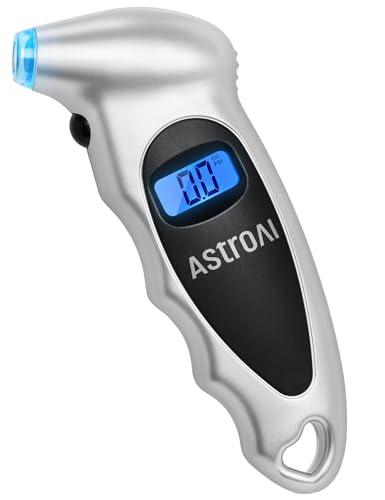 |
AstroAI Digital Tire Pressure Gauge 150 PSI Best Overall Digital, 0-150 PSI, backlit LCD, lighted nozzle, 4 units |
9.5 |
ⓘ We may earn a commission from qualifying purchases made through links on this page, at no extra cost to you.
|
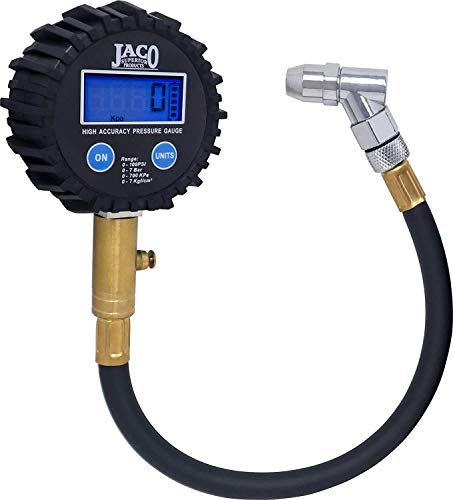 |
JACO ElitePro Tire Pressure Gauge 100 PSI Best Analog Dial Mechanical dial, 0-100 PSI, no battery, built-in bleed valve |
9.3 | 🛒 Check Price |
 |
Milton S-921 Pencil Tire Pressure Gauge Best Pocket Pencil Pencil style, 5-50 PSI, white nylon bar, dual chuck |
9.1 | 🛒 Check Price |
 |
TEKTON 5941 Digital Tire Gauge 100 PSI Best Value Digital Digital, 0-100 PSI, lighted tip, auto off, 4 units |
8.9 | 🛒 Check Price |
 |
Rhino USA Heavy Duty Tire Pressure Gauge Best for Trucks and Off-Road Mechanical dial, 0-75 PSI, glow dial, leak-proof hose, bleed valve |
8.7 | 🛒 Check Price |
 |
Accutire MS-4021B Digital Tire Gauge Best Simple Digital Digital, 5-150 PSI, single button, angled rubber grip |
8.4 | 🛒 Check Price |
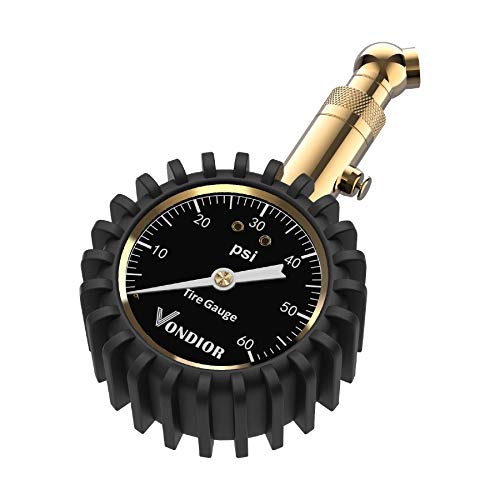 |
Vondior Tire Pressure Gauge 60 PSI Best No-Battery Backup Mechanical dial, 0-60 PSI, heavy duty steel, no battery |
8.0 | 🛒 Check Price |
1. AstroAI Digital Tire Pressure Gauge 150 PSI: Best Overall
The AstroAI digital gauge is the one we reach for first because it nails the two things that matter most: it’s accurate and it’s easy to read. Across dozens of checks it tracked our calibrated reference closely, and the large backlit LCD shows a clear three-digit reading without squinting. The lighted nozzle tip is the small touch that wins people over, since checking a rear tire in a dark driveway no longer means holding a phone in your teeth.
Its honest weakness is that it only measures. There’s no bleed button to let air out, so if a tire is over by a couple of PSI you still walk back to the pump. For most drivers that’s a fair trade for the accuracy and the build quality, and the auto-shutoff means the battery is almost always ready when you grab it. If you want a single do-everything gauge for a normal car or SUV, this is the safe pick.
- Reads in PSI, KPA, BAR, and KG/CM2 at the press of a button
- Backlit screen plus a lighted nozzle tip for night and low-light checks
- Ergonomic non-slip grip with auto shutoff to save the battery
Pros: Consistent readings that matched our reference within a fraction of a PSI; Lighted nozzle makes finding the valve stem in the dark genuinely easy; Comfortable to hold and simple one-button operation
Cons: No built-in air bleed valve, so you adjust at the pump; Reads pressure only and can’t inflate
2. JACO ElitePro Tire Pressure Gauge 100 PSI: Best Analog Dial
If you distrust electronics in your tools, the JACO ElitePro is the analog gauge that changes minds. The 2 inch dial sits behind a glow face and a rubber boot, the swivel chuck snaps cleanly onto the valve, and the included bleed valve means you can let out a little air and re-read in one motion. It’s the kind of tool that feels like it belongs in a real shop rather than a checkout aisle.
The honest limitation is resolution. A needle on a dial gets you to within a PSI or so, which is fine for setting daily driver pressures but less ideal if you chase exact track numbers. The 100 PSI ceiling also leaves out a few heavy trailer setups. For the vast majority of cars, trucks, and bikes, though, this dial gauge is accurate, tough, and genuinely satisfying to use.
- Glow dial and a protective gauge boot for shop-grade durability
- Swivel chuck and a flexible no-leak hose reach awkward valve stems
- Mechanical movement needs no battery and never powers off mid-check
Pros: Rugged feel that holds up to daily garage abuse; Bleed valve lets you fine tune pressure without removing the gauge; No battery to die at the worst moment
Cons: Analog dial is slightly harder to read precisely than a digital screen; Tops out at 100 PSI
3. Milton S-921 Pencil Tire Pressure Gauge: Best Pocket Pencil
The Milton S-921 is the classic pencil gauge that has lived in mechanics’ shirt pockets for decades, and it’s still one of the smartest backups you can own. It’s brass, it’s small, and the white nylon indicator bar pops out with a reading you can trust right in the range most passenger tires live. There’s nothing to charge and nothing to break, which is exactly why so many pros keep one as a sanity check on their fancier gauges.
What it gives up is range and readability. The 5 to 50 PSI scale leaves out high-pressure trailer and commercial tires, and the slim bar is tougher to read at dusk than a backlit screen. As a primary gauge for a daily car it’s excellent, and as a no-fuss spare it’s hard to beat. Just keep a flashlight handy for night checks.
- Compact pencil body fits any glovebox, pocket, or toolbox tray
- Single bar reading scale in 1 PSI increments that wipes clean easily
- Made in the USA with a corrosion resistant brass body
Pros: Tiny, indestructible, and needs no battery; Trusted shop-standard accuracy in the common car pressure range; Costs almost nothing in space or upkeep
Cons: Narrow 5 to 50 PSI range skips high pressure applications; Sliding bar can be hard to read in dim light
4. TEKTON 5941 Digital Tire Gauge 100 PSI: Best Value Digital
TEKTON’s 5941 is the gauge we recommend when someone wants a clean digital reading without overthinking it. The angled head seats firmly on the valve, the backlit screen is easy to read, and the lighted tip handles the dark-driveway problem. It switches units with a button and shuts itself off to protect the battery, covering the basics that most drivers actually need.
Its quirk is a slight settle time. On a couple of tires the number drifted for half a second before locking in, so it pays to hold steady and wait for it to stabilize rather than yanking it off early. That tiny habit aside, it has been dependable and accurate in our checks, and it’s a very sensible all-rounders for a family with a couple of cars to keep topped up.
- Lighted nozzle and a backlit display for checks in the dark
- Switches between PSI, KPA, BAR, and KG/CM2 instantly
- Angled head and long tip reach inset and dual rear valves
Pros: Reliable, repeatable digital readings; Lighted tip and screen make night use painless; Compact body that still feels solid in hand
Cons: Some readings settle a moment after engagement; No bleed valve for letting air out
5. Rhino USA Heavy Duty Tire Pressure Gauge: Best for Trucks and Off-Road
The Rhino USA dial gauge is purpose-built for people who actually use their trucks. The casing shrugs off drops, the swivel chuck grabs stubborn dual-wheel valves, and the bleed valve makes airing down for sand or trails and topping back up afterward a one-handed job. The glow dial reads clearly when you’re kneeling in the dirt at dawn, and the whole thing feels like it’ll outlast the truck.
It’s, predictably, chunkier than a slim digital or pencil gauge, so it lives in a center console rather than a shirt pocket. The 75 PSI range covers light trucks, SUVs, and most trailers comfortably, though it isn’t meant for commercial high-pressure setups. If you tow or wheel and want one gauge that takes abuse and lets you dump and add air on the fly, this is the one to grab.
- Shock resistant glow dial built for trail and overland use
- Solid brass and stainless internals with a protective rubber casing
- Swivel air chuck and bleeder valve for airing down on the spot
Pros: Tough enough for daily off-road and towing duty; Bleed valve is a real asset for airing down and back up; Easy-to-read glow dial in low light
Cons: Bulkier than a pocket gauge; 75 PSI range is plenty for trucks but not extreme high-pressure tires
6. Accutire MS-4021B Digital Tire Gauge: Best Simple Digital
The Accutire MS-4021B is the gauge you hand to someone who just wants a number and no learning curve. Press it onto the valve, read the LCD, done. The angled rubber grip seats nicely, the range stretches from 5 all the way to 150 PSI so it handles trailers as well as the family sedan, and it has earned a long-standing reputation for giving honest, repeatable readings.
Where it falls short is darkness. There’s no backlight and no lighted nozzle, so night checks mean bringing your own light. The screen is also strictly utilitarian, with none of the polish of pricier units. But if your priority is a trustworthy, no-nonsense digital reading across a wide pressure range, the Accutire delivers exactly that and nothing you don’t need.
- One-button operation with a large, plain LCD readout
- Angled, ergonomic rubber grip that seats easily on the valve
- Wide 5 to 150 PSI range covers cars, trucks, and trailers
Pros: Dead simple for anyone to pick up and use; Broad pressure range in one compact tool; Solidly accurate for everyday checks
Cons: No backlight or lighted tip for night use; Display is functional rather than fancy
7. Vondior Tire Pressure Gauge 60 PSI: Best No-Battery Backup
The Vondior is a back-to-basics mechanical gauge that earns a spot as the spare you never have to think about. The steel body feels reassuring, the large analog dial is easy to read in daylight, and because there’s no battery it’s always ready in the door pocket. For drivers who just want a reliable second opinion on the gas station pump, it does the job without complication.
It’s deliberately bare. There’s no hose, no bleed valve, and no light, so you press it straight onto the valve and read it, and that’s the whole feature set. The 60 PSI range and the inherent limits of a dial mean it isn’t the tool for chasing exact numbers or high-pressure tires. As an affordable, dependable, no-battery backup, though, it’s a sensible thing to keep on hand.
- Mechanical dial requires no battery and no calibration fuss
- Heavy duty steel build with a clear, large analog face
- Single swivel chuck designed to seat without leaking air
Pros: Always ready with no battery to manage; Large dial face is easy to read at a glance; Simple, durable, and inexpensive to keep as a spare
Cons: No bleed valve, hose, or backlight; 60 PSI ceiling and dial resolution limit precision uses
Frequently Asked Questions
How accurate are tire pressure gauges, and do I need a calibrated one?
Most quality consumer gauges, whether digital or dial, read within about one to two PSI of the true pressure, which is plenty accurate for setting everyday tire pressures. The bigger problem is usually the gauge built into a gas station air pump, which can be off by several PSI from heavy use. For normal driving you don’t need a lab-calibrated gauge, just a dedicated one you trust and use consistently. If you do precision work like track days, buy a single good gauge and use it for every tire so your readings are at least consistent with each other.
Is a digital or analog tire pressure gauge better?
Both can be very accurate, so it comes down to how you like to read and what you value. Digital gauges give you an exact number, often with a backlit screen and a lighted tip that make night checks easy, but they rely on a battery. Analog dial and pencil gauges never need a battery and tend to survive abuse better, though you read them off a needle or bar that resolves to roughly a PSI. Many people keep one of each: a digital for precise everyday checks and a mechanical gauge as a no-battery backup.
When should I check my tire pressure for the most accurate reading?
Check your tires cold, meaning before you have driven or after the car has sat for at least three hours. Driving heats the air inside the tire and temporarily raises the pressure, so a reading taken right after a trip will look higher than the true cold pressure your door sticker specifies. Check first thing in the morning when possible, and remember that cold weather drops pressure, so you may need to add air as the seasons change even if nothing is wrong with the tires.
What is the right tire pressure for my car?
Use the pressure listed on the sticker inside the driver’s door jamb or in your owner’s manual, not the maximum number printed on the tire sidewall. The sidewall figure is the tire’s maximum rating, while the door sticker gives the pressure the carmaker engineered for your vehicle’s ride, handling, and load. Set all four tires to that figure when they’re cold, and adjust for heavy loads only if your manual gives a separate towing or full-load pressure.
What does a bleed valve on a tire gauge do?
A bleed valve, found on many dial and truck-oriented gauges, lets you release a small amount of air from the tire without taking the gauge off the valve, then re-read the new pressure instantly. It’s genuinely useful when you tend to overshoot at the pump or when you air down for off-road traction and want to dial in an exact lower number. Gauges without a bleed valve only measure, so you make any downward adjustments back at the air source and re-check.
Our Verdict
For most drivers the AstroAI Digital Tire Pressure Gauge is our top pick, combining reading-to-reading accuracy, a clear backlit display, and a lighted nozzle that makes dark driveway checks painless. If you prefer a rugged tool with no battery to manage, the JACO ElitePro is the runner up, pairing a durable glow dial with a handy bleed valve. Whichever you choose, a dedicated gauge you actually trust will keep your tires safer and longer-lasting than any gas station pump ever will.