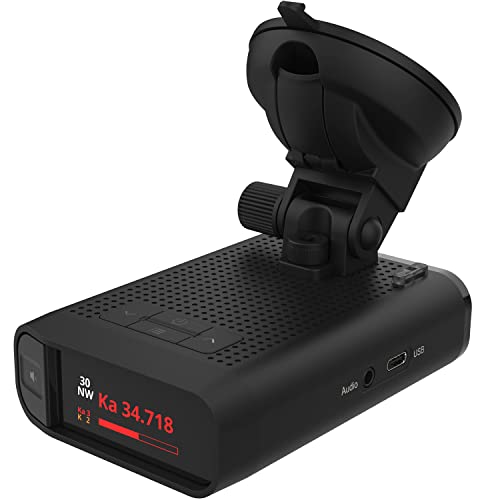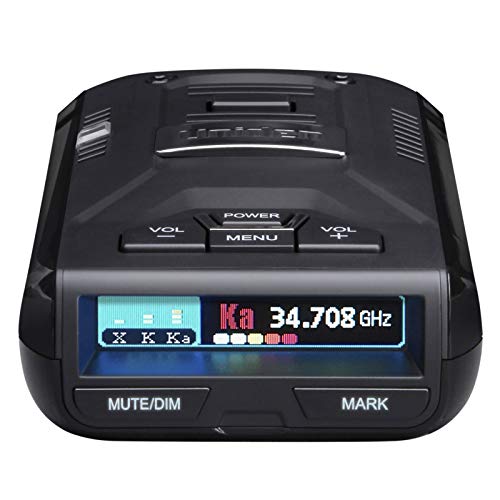
Speed enforcement technology has evolved significantly, leading to confusion among drivers regarding the capabilities of consumer detection devices. Understanding the physics behind police speed measurement is essential for selecting the right equipment and using it legally. This guide explores the fundamental differences between radar and lidar, how detectors interact with these signals, and the limitations that every driver must understand to stay safe on the road.
Uniden R3 Extreme Long Range Radar Detector
Understanding Police Radar Technology
Police radar operates by bouncing radio waves off moving vehicles to calculate speed using the Doppler shift. According to the National Highway Traffic Safety Administration (NHTSA), radar guns remain the most common form of speed enforcement due to their ability to monitor traffic from a moving vehicle. Radar signals scatter widely, meaning a detector can often pick up these waves before the officer has a clear reading on your specific vehicle.
- X-Band: Rarely used today due to low frequency and high interference.
- K-Band: Common but prone to false alerts from automatic door openers.
- Ka-Band: The most widely used police band, offering wide bandwidth and low false alerts.
The Mechanics of Police Lidar Guns
Lidar, or Light Detection and Ranging, uses pulsed laser light to measure the time it takes for a beam to return from the target. The Society of Automotive Engineers (SAE) notes that lidar provides pinpoint accuracy because the beam is extremely narrow, often less than three feet in diameter at a distance of 1,000 feet. Unlike radar, lidar doesn’t scatter significantly. This means by the time your device receives the signal, the officer has likely already recorded your speed.
Capabilities of Radar Detectors
Radar detectors function as radio receivers tuned to specific frequencies. Their primary strength lies in detecting scatter, which is stray radar energy bouncing off other vehicles or objects. When a police officer targets a car ahead of you, a high-quality detector can alert you to the presence of enforcement. However, the NHTSA warns that instant-on tactics allow officers to keep the radar in standby mode, emitting no signal until a vehicle is in range, which can shorten warning distances significantly.
The Limitations of Lidar Detectors
Laser detectors function differently than radar detectors because they rely on receiving a direct hit from the gun’s beam. Since the beam is so narrow, the laser sensor on your detector must be hit directly to trigger an alert. Consequently, a laser detector often serves only as a notification that you have been clocked rather than a preemptive warning tool. To effectively counter lidar, drivers often look to laser jamming systems, though these are heavily regulated.
Managing False Alerts and Sensitivity
One of the biggest challenges for modern detectors is the proliferation of radar-based safety systems in consumer vehicles. Blind Spot Monitoring (BSM) and Lane Keep Assist systems often use K-band radar, which triggers false alerts on older detectors. The Department of Transportation (DOT) and NHTSA encourage these safety technologies, making it essential for detector manufacturers to implement GPS filtering to mute known false signal locations.
Legal Status and Usage Regulations
The legality of using radar and laser detectors varies significantly across the United States. While radar detectors are legal in most private vehicles, they’re strictly prohibited in Virginia and Washington D.C. Also, federal law prohibits the use of radar jammers nationwide under the Communications Act of 1934, as enforced by the FCC. Laser jammers are regulated by the Food and Drug Administration (FDA) and are illegal in many states, including California, Texas, and New York.
Frequently Asked Questions
Can a standard radar detector detect police laser?
While many modern radar detectors include built-in laser sensors, they’re often ineffective at providing advanced warning. Because a police lidar beam is extremely narrow and doesn’t scatter, the detector usually only alerts when the officer has already targeted your vehicle.
Why does my detector go off when there are no police nearby?
False alerts are commonly caused by collision avoidance systems in other vehicles, automatic door openers at retail stores, and traffic flow sensors. These devices operate on the same X-band and K-band frequencies used by law enforcement.
Are radar and laser jammers legal to use?
Federal law prohibits the use of radar jammers nationwide. Laser jammers are federally regulated by the FDA and are illegal in many states, though regulations vary. It’s important to check state and local laws before operating any jamming device.
What is instant-on radar and how does it work?
Instant-on radar, also known as RF-hold, allows an officer to keep the radar gun in standby mode so it emits no signal. The officer activates it only when a vehicle is within range to measure speed. This makes it difficult for detectors to provide early warning unless the officer is targeting traffic ahead of you.
Do police still use X-band radar?
X-band radar is largely obsolete in the United States due to its susceptibility to interference and false alerts. Most modern speed enforcement utilizes K-band and Ka-band frequencies, though some rural areas may still operate older X-band equipment.
The Bottom Line
While radar and lidar detectors offer advanced awareness, they aren’t foolproof shields against speeding tickets. Lidar provides almost no warning time due to its narrow beam, while radar requires sophisticated filtering to ignore vehicle safety systems. Ultimately, the most effective way to avoid enforcement is to maintain awareness of speed limits and driving conditions. Technology serves as an aid, but responsible driving remains the primary safety mechanism.