Dash cams have become invaluable tools for motorists, offering a reliable witness in accidents, deterring theft, and even capturing unexpected moments on the road. Their ability to record events as they unfold can be crucial for insurance claims, legal disputes, and personal safety.
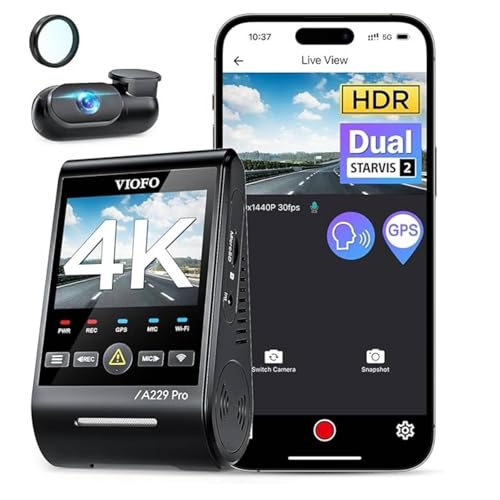
VIOFO A129 Pro Duo
However, the legality of owning and operating a dash cam isn’t uniform across the United States. State-specific laws govern everything from where a dash cam can be mounted on your windshield to whether it can record audio without consent. This guide will help you understand the key legal considerations to ensure your dash cam use is compliant and effective.
Understanding Dash Cam Legality: Federal & State Overview
There’s no specific federal law in the United States that prohibits the use of dash cameras in private vehicles. Instead, the legality of dash cams is primarily determined by individual state laws, which address various aspects such as driver visibility, audio recording consent, and privacy expectations. While the National Highway Traffic Safety Administration (NHTSA) and the Department of Transportation (DOT) issue guidelines for vehicle safety and equipment, these generally don’t specifically regulate aftermarket dash cam placement beyond general principles of driver visibility.
The primary legal concerns for dash cam users revolve around:
- **Windshield Obstruction Laws:** Regulations on where devices can be mounted on a vehicle’s windshield.
- **Audio Recording Consent Laws:** Rules dictating whether all parties in a conversation must consent to being recorded.
- **Privacy Expectations:** The legal concept of privacy in public versus private spaces.
Windshield Mounting Restrictions: Maintaining Driver Visibility
A very common legal pitfalls for dash cam users involves state laws regarding windshield obstruction. Many states have statutes designed to ensure a driver’s clear field of vision remains unobstructed. While these laws are often broadly worded, they can apply directly to dash cams mounted on the windshield.
Common restrictions include:
- **Placement Zones:** Some states specify permitted areas, such as a small square in the lower corner of the windshield (e.g., California allows a 7-inch square in the lower passenger side or a 5-inch square in the lower driver side).
- **Area of Windshield:** Many states prohibit mounting devices within the area swept by the windshield wipers, or directly in the driver’s primary line of sight.
- **Size Limitations:** Certain states may have limits on the physical size of devices mounted on the windshield.
It’s crucial to consult your state’s specific vehicle code or Department of Motor Vehicles (DMV) regulations to understand precise mounting requirements. Incorrect placement can result in fines or even nullify dash cam footage as evidence if deemed illegally mounted.
Audio Recording Laws: One-Party vs. Two-Party Consent
The most significant legal distinction for dash cam users, especially those recording inside the vehicle, pertains to audio recording consent laws. These laws determine whether you can legally record conversations without the explicit knowledge and permission of all parties involved.
- **One-Party Consent States:** In these states, only one party to a conversation needs to be aware of and consent to the recording for it to be legal. Since you, as the dash cam owner, are typically a party to any conversation within your vehicle, your consent is generally sufficient. Most U.S. States operate under one-party consent laws.
- **Two-Party Consent States (All-Party Consent):** In these states, every individual participating in a conversation must be informed that they’re being recorded and must provide their consent for the recording to be legal. Recording conversations with passengers, law enforcement, or others in these states without their explicit consent can lead to severe legal penalties, including civil lawsuits or criminal charges. Examples of states typically requiring two-party consent include California, Florida, Illinois, Maryland, Massachusetts, Michigan, Montana, Nevada, New Hampshire, Oregon, Pennsylvania, and Washington.
Given the strict nature of two-party consent laws, it’s highly advisable to disable audio recording on your dash cam if you live in or frequently travel through such states, or to prominently display a notice and verbally inform all passengers that audio is being recorded.
Privacy Expectations and Public Recordings
Understanding the concept of ‘expectation of privacy’ is key to legal dash cam use. Generally, there’s a lower expectation of privacy in public spaces, such as public roads, sidewalks, and parks, compared to private spaces like someone’s home or private property.
- **Public Spaces:** Dash cams recording video of public roads and areas typically don’t violate privacy laws, as individuals in public generally have no reasonable expectation of privacy from being seen or recorded. This principle is often supported by legal interpretations from the American Law Institute (ALI) on torts and privacy.
- **Private Property:** Recording individuals on private property without their consent (e.g., pointing a dash cam into someone’s yard or home) can potentially lead to legal issues such as invasion of privacy or trespassing, depending on the specific circumstances and state laws.
- **Audio vs. Video:** While video recording in public is generally permissible, audio recording, even in public, is subject to the one-party or two-party consent laws discussed previously, as conversations are often afforded a higher expectation of privacy than visual presence.
Always exercise caution and consider ethical implications when recording, especially if footage captures identifiable individuals or private residences.
Legal Considerations for Dash Cam Footage: Evidence and Sharing
Dash cam footage is increasingly accepted as valuable evidence in legal proceedings, including traffic court, insurance claims, and criminal investigations. Its objective nature can provide crucial context and facts that eyewitness accounts might miss or distort.
- **Admissibility in Court:** For footage to be admissible, it generally must be relevant to the case, authentic (unaltered), and obtained legally (e.g., not violating consent laws or mounting regulations).
- **Subpoenas:** Law enforcement or legal teams can subpoena dash cam footage if it’s deemed relevant to an ongoing investigation or court case. Users should be aware that their footage isn’t entirely private and may be legally compelled to be disclosed.
- **Sharing Footage:** While sharing interesting or critical footage online can seem harmless, it carries legal and ethical implications. Publicly sharing footage that identifies individuals without their consent, especially if it portrays them in a negative light or captures sensitive moments, could potentially lead to defamation claims or privacy lawsuits, particularly in two-party consent states if audio is included. It’s advisable to redact identifiable information or blur faces if sharing publicly.
Navigating State-Specific Regulations: Best Practices for Compliance
Given the patchwork of state laws, a proactive approach to dash cam use is essential. While specific state statutes vary, a few common themes and best practices emerge to ensure compliance and effective use:
- **Consult Your State’s Laws:** This is the most critical step. Check your state’s Department of Motor Vehicles (DMV) website, vehicle code, or traffic laws for specific regulations on windshield mounting, electronic device placement, and audio recording consent. Laws can change, so periodic review is recommended.
- **Mount Legally and Safely:** Always mount your dash cam securely in a location that doesn’t obstruct your view of the road, mirrors, or dashboard indicators. Avoid placing it within the sweep of your wipers unless explicitly permitted. Many dash cams offer suction cup or adhesive mounts that allow for discrete placement in legal zones.
- **Be Mindful of Audio Recording:** If your dash cam records audio, understand your state’s consent laws. In two-party consent states, disable the audio recording function or inform all occupants that they’re being recorded. A small, clear sign inside the vehicle can serve as a legal notice.
- **Respect Privacy:** While recording in public is generally permissible, be aware of contexts where an expectation of privacy might still exist. Use discretion when sharing footage, especially if it involves private individuals or sensitive situations.
- **Maintain and Understand Your Device:** Ensure your dash cam is properly configured, especially regarding loop recording, storage, and audio settings, to maximize its utility and minimize legal risks.
Frequently Asked Questions
Is it legal to record police officers with a dash cam?
Generally, yes. In most U.S. States, you have a First Amendment right to record police officers performing their duties in public spaces, provided you don’t interfere with their actions. However, audio recording is still subject to state-specific one-party or two-party consent laws. If your state requires two-party consent, recording audio of a conversation with an officer without their knowledge and consent could be problematic.
Can I get a ticket for having a dash cam?
Yes, you can. If your dash cam is mounted in a way that violates your state’s windshield obstruction laws (e.g., blocking your view, placed in a prohibited zone), you could receive a traffic citation or fine. It’s crucial to ensure your dash cam is mounted legally and safely according to your state’s specific vehicle code.
Do I need to inform passengers that I'm recording them with my dash cam?
It depends on your state’s audio recording consent laws. In ‘one-party consent’ states, your knowledge and consent are usually sufficient, meaning you don’t legally have to inform passengers. However, in ‘two-party consent’ states, you must inform all passengers that they’re being recorded and obtain their consent (explicitly or implicitly) for the audio recording to be legal. Even in one-party states, informing passengers is often considered good practice and respectful.
Can dash cam footage be used as evidence in court or for insurance claims?
Yes, dash cam footage is frequently used as evidence in court cases, traffic disputes, and for insurance claims. It can provide objective proof of events, accident circumstances, and liability. For footage to be admissible, it typically needs to be relevant, authentic (unaltered), and obtained legally (i.e., not violating privacy or recording consent laws). Many insurance companies welcome dash cam footage as it can expedite claims processing.
What is the main difference between one-party and two-party consent laws for audio recording?
The main difference lies in how many individuals need to be aware of and agree to an audio recording. In a ‘one-party consent’ state, only one person involved in the conversation needs to know and consent to the recording (which can be the person operating the dash cam). In a ‘two-party consent’ (or ‘all-party consent’) state, every single person participating in the conversation must be informed of the recording and provide their consent for it to be legal. Failing to obtain consent in a two-party state can lead to legal penalties.
The Bottom Line
Dash cams offer significant benefits for safety, security, and accountability on the road. However, their legal use in the United States is nuanced, varying significantly from state to state. By understanding and adhering to local laws regarding windshield mounting, audio recording consent, and privacy expectations, drivers can confidently utilize their dash cams as powerful tools. Always prioritize legal compliance and responsible usage to ensure your dash cam serves its purpose effectively without inadvertently creating legal liabilities.