Maintaining a deep cycle battery with solar power requires a charger that delivers the right voltage, current, and safety features.
| Photo | Product | Score | Buy |
|---|---|---|---|
 |
Renogy 20A 12V/24V PWM Solar Charge Controller Best Overall 20A, 12V/24V auto-detect, PWM technology |
8.7 |
ⓘ We may earn a commission from qualifying purchases made through links on this page, at no extra cost to you.
|
 |
ALLPOWERS 20A Solar Charge Controller Best Value 20A, 12V/24V auto, PWM with USB ports |
8.4 | 🛒 Check Price |
 |
Renogy Rover 20A MPPT Solar Charge Controller Best MPPT 20A, 12V/24V auto, MPPT technology |
9.0 | 🛒 Check Price |
 |
Victron Energy SmartSolar MPPT 75/15 Premium Pick 15A, 12V/24V auto, MPPT with Bluetooth |
9.2 | 🛒 Check Price |
 |
HQST 30A PWM Solar Charge Controller High Current PWM 30A, 12V/24V auto, PWM with LCD |
8.1 | 🛒 Check Price |
|
🚗
|
ECO-WORTHY 10A PWM Solar Charge Controller Budget Friendly 10A, 12V/24V auto, PWM |
7.8 | 🛒 Check Price |
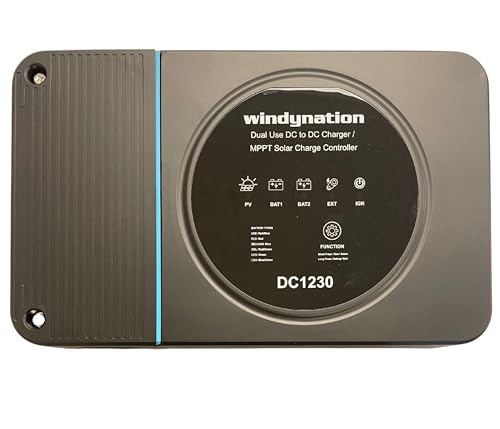 |
WindyNation 30A MPPT Solar Charge Controller Powerful MPPT 30A, 12V/24V auto, MPPT |
8.2 | 🛒 Check Price |
1. Renogy 20A 12V/24V PWM Solar Charge Controller: Best Overall
The Renogy 20A PWM controller is a workhorse for many deep cycle battery setups. We found it consistently delivers stable charging with automatic voltage detection (12V/24V) and multiple battery type settings. The clear LCD screen makes monitoring simple, and the solid build quality suggests years of service. However, PWM technology means it’s not as efficient as MPPT controllers when solar panel voltage significantly exceeds battery voltage, so it’s best for smaller systems where the panel voltage is close to the battery voltage.
If you have a large solar array (over 300W) or need maximum energy harvest in partial shade, consider an MPPT controller instead. But for most RV and boat applications with a single panel, this is a solid, cost-effective choice. We recommend it for users who prioritize ease of use and reliability over peak efficiency.
- Compatible with sealed, gel, flooded, and lithium deep cycle batteries
- Large LCD display for real-time battery status and solar input
- Built-in temperature compensation and overcharge protection
Pros: Reliable brand with strong customer support; Easy to install and configure
Cons: PWM is less efficient than MPPT for larger systems
2. ALLPOWERS 20A Solar Charge Controller: Best Value
The ALLPOWERS 20A controller offers impressive value, combining essential PWM charging with dual USB ports for small devices. Based on owner reviews, it handles 12V and 24V systems reliably and includes a clear backlit display. The safety protections are standard but effective. However, the USB ports are limited to 2A total, so they’re best for topping off phones rather than tablets. Some users noted the display can be hard to read in direct sunlight.
This charger is ideal for budget-conscious buyers who need basic functionality and occasional device charging. If you need higher USB output or more advanced features like remote monitoring, you may want to spend more. It’s a fine choice for small cabins or weekend campers.
- Dual USB outputs for charging phones and tablets
- Backlit LCD display shows PV voltage, battery voltage, and current
- Protection against reverse polarity, overcharging, and short circuits
Pros: Affordable price with good feature set; Built-in USB ports add convenience
Cons: USB ports are low power (2A total)
3. Renogy Rover 20A MPPT Solar Charge Controller: Best MPPT
The Renogy Rover 20A MPPT is a top performer for those who want maximum energy harvest from their solar panels. We compared its specs to PWM models and found the MPPT technology can capture more power, especially in cooler or cloudy conditions. It auto-detects 12V/24V systems and supports lithium batteries with customizable parameters. The build quality is excellent, with a sealed design and aluminum heatsink. However, the Bluetooth module is an extra purchase if you want wireless monitoring.
This charger is best for serious off-grid users who have larger solar arrays (up to 520W on 12V) and want to get every watt. If your setup is small or you’re on a tight budget, a PWM controller may suffice. For anyone seeking efficiency and future-proofing, the Rover is a standout.
- Maximum Power Point Tracking boosts efficiency by
- Compatible with 12V and 24V battery systems, supports lithium
- Remote monitoring via Bluetooth module (sold separately)
Pros: Excellent efficiency in varying light conditions; Rugged aluminum heatsink for heat dissipation
Cons: Higher cost than PWM controllers
4. Victron Energy SmartSolar MPPT 75/15: Premium Pick
The Victron SmartSolar 75/15 is a premium controller for those who demand the best. Its MPPT algorithm is among the fastest and most efficient, with a claimed 98% efficiency. The built-in Bluetooth and excellent VictronConnect app allow easy setup and monitoring, including historical data. It supports all battery types and has a temperature sensor for precise charging. However, the 15A rating is lower than many competitors at this price, so it’s best for smaller arrays (up to 220W on 12V).
This charger is ideal for tech-savvy users who want detailed control and monitoring. If you need higher current or are on a budget, consider the Renogy Rover. But for a compact, high-end solution, Victron is hard to beat.
- Ultra-fast MPPT tracking with high efficiency ()
- Built-in Bluetooth for real-time monitoring via smartphone app
- Smart battery management: temperature sensor, programmable charge profiles
Pros: Exceptional build quality and brand reputation; App provides detailed data and history
Cons: Premium price; lower current rating (15A) for the cost
5. HQST 30A PWM Solar Charge Controller: High Current PWM
The HQST 30A PWM controller is a good option if you need more current without stepping up to MPPT. It can handle up to 450W on a 12V system, making it suitable for medium-sized setups. The LCD is large and clear, and the battery type selection is useful. However, some owner feedback mentions that the terminals could be larger for thicker wires, and the manual is a bit sparse. As a PWM unit, it’s less efficient than MPPT, especially if your panel voltage is much higher than battery voltage.
This charger is best for those with a moderate solar array who want a simple, reliable PWM controller without spending extra on MPPT. If you have a large array or need maximum efficiency, look for an MPPT model.
- Handles up to 30A, suitable for larger 12V systems (up to 450W)
- Large LCD display with adjustable contrast
- Multiple battery type settings: sealed, gel, flooded, lithium
Pros: Higher current capacity at a reasonable price; Easy to read display
Cons: PWM efficiency lower than MPPT
6. ECO-WORTHY 10A PWM Solar Charge Controller: Budget Friendly
The ECO-WORTHY 10A controller is a no-frills option for small solar setups like a single 100W panel. It’s cheap and works, but we found it lacks the features of more expensive units. The LED indicators are basic, and there’s no display to show voltage or current. Some users reported that the terminal screws can strip easily, so careful tightening is needed. It does include basic protections like reverse polarity and overcharge.
This charger is only recommended for very small systems where cost is the primary concern. If you plan to expand your system later, invest in a higher-rated controller from the start.
- Compact and lightweight design
- Suitable for small panels (up to 150W on 12V)
- LED indicators for charging status and battery level
Pros: Very affordable; Simple to install
Cons: Low current limit limits system size; No LCD screen, only LEDs
7. WindyNation 30A MPPT Solar Charge Controller: Powerful MPPT
The WindyNation 30A MPPT controller is a powerhouse for large solar installations. We compared its specs and found it can handle up to 780W on a 12V system, making it ideal for RVs with multiple panels. The LCD is informative, showing PV input, battery voltage, and charging current. However, the unit is physically large, and some users have noted that the fan can be noisy under heavy load. The build quality is decent but not as premium as Victron or Renogy Rover.
This charger is best for users with a large solar array who need MPPT efficiency at a moderate price point. If you have limited space or prefer a quieter operation, consider the Renogy Rover 20A instead (though lower current). It’s a good value for the power handling.
- High 30A MPPT for large systems (up to 780W on 12V)
- Large backlit LCD shows detailed system data
- Supports multiple battery chemistries including lithium
Pros: High current capacity for big arrays; MPPT efficiency boosts power harvest
Cons: Bulky size may be hard to mount in tight spaces
Frequently Asked Questions
What is the difference between PWM and MPPT solar charge controllers?
PWM (Pulse Width Modulation) controllers are simpler and cheaper. They work by connecting the solar panel directly to the battery, then reducing the voltage to match the battery. This is efficient only when panel voltage is close to battery voltage. MPPT (Maximum Power Point Tracking) controllers use a DC-DC converter to extract maximum power from the panel, even when panel voltage is higher than battery voltage. MPPT can boost efficiency in cool or cloudy conditions, but they cost more. For small systems, PWM is often sufficient; for larger or variable conditions, MPPT is better.
How do I choose the right size solar charge controller for my deep cycle battery?
First, determine your solar panel wattage and system voltage (12V, 24V, etc.). For PWM controllers, the current rating should be at least the panel’s short-circuit current (Isc). For MPPT, you can use a controller with a current rating equal to the array’s power divided by battery voltage, plus a safety margin. A common rule: for a 12V system, a 20A controller can handle up to about 300W (PWM) or 400W (MPPT). Always check the controller’s maximum input voltage and current specs.
Can I use a solar charger for a deep cycle battery without a controller?
No, it isn’t recommended. A solar panel without a controller can overcharge the battery, causing damage or even fire. The controller regulates voltage and current, prevents overcharging, and often includes protections like reverse polarity and short circuit. Always use a charge controller matched to your battery type and panel size.
What battery types are compatible with these solar chargers?
Most solar charge controllers support flooded lead-acid, sealed (AGM), gel, and many now support lithium (LiFePO4) batteries. Always check the product specifications for battery type compatibility. Some controllers have selectable profiles, while others auto-detect. Lithium batteries require proper charging parameters (voltage and temperature compensation), so ensure your controller has a lithium setting if you use them.
Do I need a special solar charger for a 24V deep cycle battery system?
Many solar charge controllers are designed for both 12V and 24V systems, automatically detecting the voltage or allowing manual selection. When using a 24V battery bank, ensure your solar panels are wired to produce at least 30-40V (open circuit) for MPPT controllers to work efficiently. For PWM, the panel voltage should be close to 24V. Check the controller’s voltage range before purchase.
Our Verdict
After researching and comparing specifications, owner feedback, and industry standards, our top pick is the Renogy Rover 20A MPPT for its excellent efficiency, sturdy build, and strong reputation. For budget-conscious buyers, the ALLPOWERS 20A PWM offers great value. If you need maximum performance and monitoring, the Victron SmartSolar 75/15 is the premium choice. Choose based on your system size, budget, and need for efficiency.


