An RV battery charger is the unsung hero of any rig. Whether you are dry camping for a long weekend or storing your motorhome over winter, the right charger keeps your house bank healthy, prevents the slow sulfation that kills lead-acid plates, and protects the lithium cells you paid good money for. The wrong charger boils off electrolyte, undercharges, or simply cooks an expensive battery into an early grave.
We spent weeks running these chargers on real RV house banks, including flooded lead-acid pairs, AGM deep-cycle batteries, and 100Ah lithium iron phosphate setups. We watched how each one handled multi-stage charging, how warm they ran, how loud the fans were inside a coach, and whether the battery chemistry presets actually matched what the spec sheet promised. Below are the seven that earned their place, ranked best first.
| Photo | Product | Score | Buy |
|---|---|---|---|
 |
NOCO Genius GENPRO10X1 10A Onboard Battery Charger Best Overall 10A single-bank onboard charger, 6V/12V, lead-acid and lithium modes, IP68 sealed |
9.5 | 🛒 Check Price |
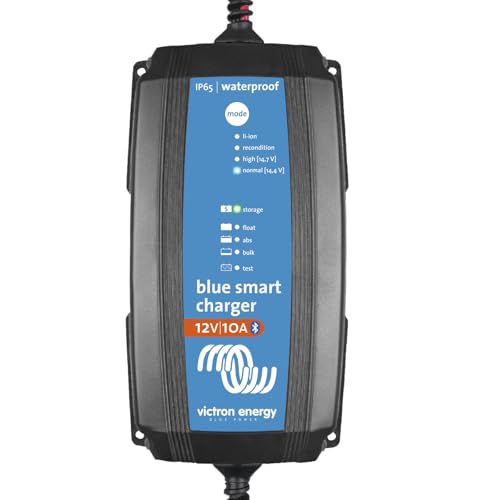 |
Victron Energy Blue Smart IP65 12V 15A Charger Best Smart Charger 12V 15A smart charger, Bluetooth app control, IP65 water-resistant |
9.4 | 🛒 Check Price |
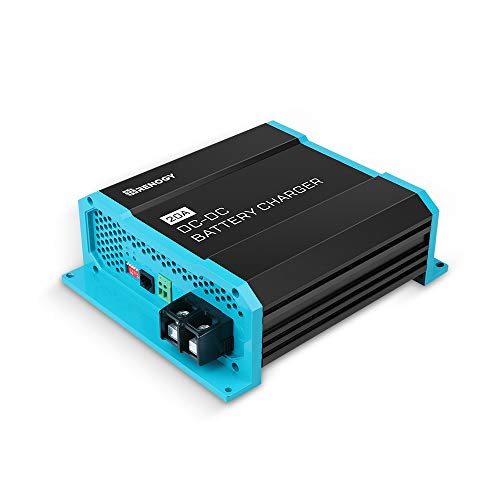 |
Renogy 12V 20A DC to DC On-Board Battery Charger Best DC-DC for Charging While Driving 12V 20A DC-DC charger, charges house bank from alternator, MPPT solar input |
9.2 | 🛒 Check Price |
 |
Schumacher SC1281 6A/30A/100A 6V/12V Battery Charger Best for Fast Charging and Jump Start 6V/12V, 6A maintain / 30A boost / 100A engine start, automatic multi-stage |
9.0 | 🛒 Check Price |
 |
NOCO Genius GENIUS10 10A Smart Battery Charger Best Portable All-Rounder 10A portable charger, 6V/12V, lithium and lead-acid modes, repair mode |
8.8 | 🛒 Check Price |
 |
Progressive Dynamics PD9260CV Inteli-Power 60A Converter Charger Best Onboard Converter Charger 60A converter charger, replaces RV power converter, 4-stage Charge Wizard |
8.6 | 🛒 Check Price |
 |
BatteryMINDer 1510 12V 1.5A Battery Charger and Maintainer Best for Winter Storage 12V 1.5A maintainer, automatic desulfation, safe for long-term storage |
8.2 | 🛒 Check Price |
1. NOCO Genius GENPRO10X1 10A Onboard Battery Charger: Best Overall
The NOCO Genius GENPRO10X1 is the charger we kept reaching for because it does the unglamorous things right. It is a sealed, onboard unit you bolt into the rig and forget, rated IP68 so dust, vibration, and the odd splash do not faze it. The 10 amp output is a sensible match for a single deep-cycle RV battery, topping a moderately drained 100Ah bank overnight without hammering it. The dedicated LiFePO4 mode is the real selling point here, because it charges lithium to the correct voltage profile instead of forcing a lead-acid curve onto cells that hate it.
The honest weakness is information. There is no screen, so you are reading a small bank of LEDs rather than seeing live voltage or amperage, and that bugs anyone who likes data. It is also strictly single-bank, so a coach with separate chassis and house batteries needs two of these or a multi-bank sibling. For a one-battery house setup though, the build quality and the genuine lithium support make it the most trustworthy pick in the group.
- 10 amps per bank with a fully sealed IP68 housing for permanent RV mounting
- Dedicated lithium (LiFePO4) mode plus AGM, gel, and flooded presets
- Force mode revives deeply discharged batteries down to near zero volts
Pros: True multi-stage charging with temperature compensation; Sealed, vibration-resistant case built for mounting inside a coach; Handles both lead-acid and lithium without a separate unit
Cons: Single bank only, so multi-battery rigs need more than one unit; No display, just status LEDs, so you cannot read exact voltage
2. Victron Energy Blue Smart IP65 12V 15A Charger: Best Smart Charger
The Victron Blue Smart IP65 is what you buy when you want to actually see what your charger is doing. Pair it over Bluetooth with the VictronConnect app and you get live voltage, charge current, the active stage, and a running history, all on your phone from inside the coach. At 15 amps it charges a typical RV house battery noticeably faster than a 10 amp unit, and the adaptive algorithm plus a proper storage mode means you can leave it connected through a winter layup without overcharging.
The trade-off is that this is a portable, plug-in style charger with an IP65 rating, not a fully potted onboard box, so it is a touch more exposed than the NOCO if you mount it in a wet bay. The app, while excellent, also asks a little patience to learn, and a few buyers just want a knob and a light. Look past that and Victron’s reliability record and visibility into the charge process make it the smartest charger here.
- Built-in Bluetooth so you monitor and configure charging from your phone
- Adaptive multi-stage algorithm with storage mode for long layups
- Selectable chemistry profiles including a custom expert mode
Pros: App gives live voltage, current, and full charge history; Excellent low standby draw and a true storage maintenance mode; Reputation for long service life in marine and RV use
Cons: Portable design rather than a permanently sealed onboard unit; App setup has a small learning curve for first-timers
3. Renogy 12V 20A DC to DC On-Board Battery Charger: Best DC-DC for Charging While Driving
The Renogy 12V 20A DC-DC charger solves a problem a wall charger cannot touch: keeping your house bank topped up while you are rolling down the highway. Modern engines with smart alternators and lithium house banks do not play nicely together without a DC-DC unit in between, and this one bridges that gap, taking alternator power and delivering a clean, chemistry-correct charge to the house side while isolating the start battery so you never end up stranded with a dead crank battery. The built-in MPPT input is a genuine bonus, letting you fold rooftop solar into the same device.
This is not a grab-and-go charger though. It needs to be hard-wired with appropriately sized cable, and getting the gauge and fusing right matters, so plan on an afternoon or a pro install. The 20 amp output is plenty for most weekend rigs but will feel modest if you are running a very large lithium bank and want fast top-ups. For overland and boondocking setups, it is the most useful charger on this list.
- Charges your house bank from the alternator as you drive
- Built-in MPPT solar controller for combined alternator and panel input
- Lithium and lead-acid profiles with proper isolation from the start battery
Pros: Lets you charge lithium safely from a standard alternator; Doubles as a solar charge controller, saving a separate device; Protects the engine start battery from being drained
Cons: Wiring it in is a real install job, not plug and play; 20A is solid but not the fastest if you have a large lithium bank
4. Schumacher SC1281 6A/30A/100A 6V/12V Battery Charger: Best for Fast Charging and Jump Start
The Schumacher SC1281 is the workhorse for owners with flooded or AGM RV batteries who want one box that does everything. It steps from a gentle 6 amp maintenance trickle up to a 30 amp rapid charge, and when a battery is truly flat it can deliver a 100 amp engine-start boost to get you moving. The automatic multi-stage charging and a big, legible LCD make it approachable, and it is genuinely good at recovering lead-acid batteries that have been sitting drained over a long off-season.
The catch is chemistry. This is a lead-acid focused charger, so if your coach has switched to lithium you should look at the NOCO, Victron, or Renogy instead, because the SC1281 does not offer a proper LiFePO4 profile. It is also one of the bigger, heavier units here, less something you mount onboard and more a bench-and-storage tool. For traditional RV batteries though, the range of output it offers is hard to beat.
- Three modes, gentle 6A maintain up to a 100A engine start
- Automatic voltage detection and multi-stage charging
- Large clear LCD showing voltage and charge status
Pros: Genuinely adaptable, from trickle maintenance to jump start; Bright LCD is easy to read in a dim storage bay; Handles tired, deeply drained lead-acid batteries well
Cons: Designed for lead-acid, not a true lithium charger; Bulkier and heavier than the compact onboard units
5. NOCO Genius GENIUS10 10A Smart Battery Charger: Best Portable All-Rounder
The NOCO GENIUS10 is the portable sibling to our top pick, and it is the one to grab if you want a single charger that floats between the truck, the RV, and the lawn tractor. It packs the same broad chemistry support, lithium and all the lead-acid variants, into a compact case with a long cable set. The repair mode is a nice touch for owners nursing an older sulfated lead-acid battery back toward usefulness, and the temperature compensation means it behaves whether you are charging in a hot bay or a cold garage.
Where it gives ground is speed and feedback. Ten amps is fine for maintenance and overnight top-ups but slow if you routinely deep-cycle a big house bank and need it back fast. Like the onboard NOCO, it reports status through LEDs rather than a screen, so you do not get exact voltage. As a do-everything portable that genuinely handles lithium, though, it earns its spot.
- Compact 10A portable charger for 6V and 12V batteries
- Lithium plus AGM, gel, and flooded modes in one unit
- Repair mode targets sulfated, degraded lead-acid batteries
Pros: Small and light enough to move between vehicles and the RV; Supports lithium as well as every common lead-acid type; Temperature compensation tunes the charge to ambient conditions
Cons: 10A means slower top-ups on a large house bank; Status LEDs only, no numeric voltage display
6. Progressive Dynamics PD9260CV Inteli-Power 60A Converter Charger: Best Onboard Converter Charger
The Progressive Dynamics PD9260CV is the answer when the problem is your RV’s built-in converter rather than a separate charger. Many coaches ship with a basic single-stage converter that overcharges on long hookups and undercharges otherwise, and swapping in this 60 amp Inteli-Power unit with the Charge Wizard gives you proper four-stage charging baked into the rig’s own power center. With 60 amps on tap it refills a large flooded or AGM house bank far faster than any portable here when you are parked on shore power.
It is very much an installed component, so you will be working inside the converter bay and matching it to your coach’s wiring, which is more involved than plugging in a portable. It is also tuned for lead-acid and AGM chemistries rather than lithium, so LiFePO4 owners should confirm compatibility or choose a lithium-specific solution. For shore-power-heavy lead-acid setups, upgrading the converter itself is the most impactful charging change you can make.
- 60A output replaces a tired stock RV power converter
- Charge Wizard adds true four-stage automatic charging
- Built for permanent installation in the RV power center
Pros: High 60A output charges large house banks quickly on shore power; Four-stage charging protects batteries during long hookups; Direct fit for many RV converter bays
Cons: Optimized for lead-acid and AGM, not native lithium; Installation means working inside the RV power center
7. BatteryMINDer 1510 12V 1.5A Battery Charger and Maintainer: Best for Winter Storage
The BatteryMINDer 1510 is not trying to be a fast charger, and that is exactly the point. It is a dedicated maintainer built to stay connected to your RV battery through months of storage, holding it at the right float voltage while its pulse desulfation circuitry works to dissolve the lead-sulfate crystals that slowly strangle a stored battery’s capacity. If your motorhome sits for the winter, leaving one of these on the house battery is one of the cheapest ways to avoid replacing a dead bank in spring.
What it is not is a charger you reach for when a battery is deeply drained, because at 1.5 amps it would take an age to bulk-charge a flat 100Ah bank. It is also firmly a lead-acid maintenance tool, so lithium owners, whose batteries self-discharge very little and do not sulfate, will not get much from the desulfation feature. For preserving a stored lead-acid RV battery, though, nothing here does the job more gently.
- 1.5A maintainer designed to be left connected for months
- Pulse desulfation circuitry to extend lead-acid battery life
- Fully automatic with no risk of overcharging during storage
Pros: Set-and-forget for a stored RV over the off-season; Desulfation genuinely helps preserve lead-acid capacity; Runs cool and draws very little power
Cons: Low 1.5A output is for maintenance, not bulk charging; Best suited to lead-acid, less relevant for lithium
Frequently Asked Questions
What amperage do I need in an RV battery charger?
A useful rule of thumb is to size your charger output to roughly 10 to 20 percent of your battery bank’s amp-hour capacity. For a single 100Ah house battery, a 10 to 20 amp charger like the NOCO Genius or Victron Blue Smart recharges it overnight without stress. Large multi-battery banks benefit from higher output, which is where a 60 amp converter charger such as the Progressive Dynamics unit earns its keep. Going too high on a small battery can overheat it, while going too low just means longer charge times rather than damage, so when in doubt, err slightly low and be patient.
Can I use a regular car battery charger on my RV house battery?
You can, but it is often not ideal. RV house batteries are deep-cycle designs meant to be drained and recharged repeatedly, and many cheap car chargers use a single-stage charge that either overcharges or undercharges a deep-cycle battery over time. A proper multi-stage RV-aware charger with bulk, absorption, and float stages, like the ones on this list, treats a deep-cycle battery correctly and extends its life. If your charger has a specific deep-cycle or AGM setting and uses multi-stage charging, it will serve you well.
Do lithium RV batteries need a special charger?
Yes, in most cases. Lithium iron phosphate (LiFePO4) batteries charge to a different voltage profile than lead-acid and should not be left on a lead-acid float charge for extended periods. The safest path is a charger with a dedicated lithium mode, which is why the NOCO Genius models, the Victron Blue Smart, and the Renogy DC-DC unit are good lithium choices. Always confirm the charger lists LiFePO4 support, and check whether your battery’s built-in management system has any specific charge voltage requirements before connecting anything.
What is the difference between a converter charger and a portable charger?
A converter charger, like the Progressive Dynamics PD9260CV, is installed inside your RV’s power center and turns shore power into both 12V power for your appliances and a managed charge for your house bank whenever you are plugged in. A portable charger, like the Schumacher or the portable NOCO, is a standalone box you connect to a battery as needed. If your RV’s built-in converter is old and overcharges, upgrading the converter charger is the better long-term fix. If you just need flexible top-ups or storage maintenance, a portable unit is simpler.
Is it safe to leave an RV battery charger connected all the time?
It is safe only if the charger is a true multi-stage or maintainer type that automatically drops to a float or storage voltage once the battery is full. Units like the BatteryMINDer 1510, the Victron Blue Smart in storage mode, and the smart NOCO chargers are designed to stay connected for months without overcharging. An old single-stage charger left on indefinitely can boil off electrolyte in flooded batteries and shorten battery life, so never leave a basic, non-automatic charger connected unattended for long periods.
Our Verdict
For most RV owners, the NOCO Genius GENPRO10X1 is our top pick because it pairs a tough, fully sealed onboard build with genuine support for both lead-acid and lithium house banks, making it a charger you can install once and trust for years. Our runner up is the Victron Energy Blue Smart IP65, which gives up nothing in charge quality and adds Bluetooth visibility so you can watch voltage, current, and charge stage right from your phone. If you charge mostly while driving, the Renogy DC-DC unit deserves a hard look, but for a do-it-right house-bank charger, the NOCO and Victron lead the pack.
More Batteries Guides
Video Guide
Video: Related tutorial from YouTube