The stock rear shocks on a Harley Davidson touring bike are the weak link in an otherwise excellent platform. Loaded down with a passenger, saddlebags and a Tour-Pak, the factory suspension runs out of travel fast, bottoming out hard over expansion joints and pothole edges that a better shock would simply absorb. If your bagger crashes through bumps, wallows in corners or beats up your lower back on long days, the rear shocks are almost always the first thing to fix.
We focused this guide on shocks that bolt directly onto Touring models such as the Street Glide, Road Glide, Electra Glide and Road King, mostly 12.5 to 13.5 inch eye-to-eye lengths to match stock geometry or add a mild lift. Every pick below is a real, widely sold unit. We weighed ride quality solo and two-up, ease of preload or air adjustment, build quality and how well each handles a fully loaded bike on rough pavement.
| Photo | Product | Score | Buy |
|---|---|---|---|
 |
Progressive Suspension 944 Ultra Touring Rear Shocks Best Overall Frequency-sensing twin-tube, threaded preload, 13.5 in eye-to-eye, fits FLH/FLT 1980-2025 |
9.5 | 🛒 Check Price |
 |
Progressive Suspension 970 Series Piggyback Reservoir Shocks Best Premium Piggyback remote reservoir, rebuildable, high-flow valving, 13.0-13.5 in, fits Touring 1980-2025 |
9.3 | 🛒 Check Price |
 |
Arnott Series Motorcycle Air Suspension Kit for Harley Touring Best Air Ride Adjustable air shocks with onboard compressor option, push-button height, fits FLH/FLT |
9.1 | 🛒 Check Price |
 |
Ohlins STX 36 Twin Rear Shocks for Harley Touring Best Handling Twin-tube, hydraulic preload adjuster, progressive spring, 13.0 in, Touring-specific app |
9.0 | 🛒 Check Price |
 |
Hagon Nitro Rear Shocks for Harley Davidson Touring Best Value Gas-charged emulsion, custom spring rate to rider weight, 13.0-13.5 in, made to order |
8.7 | 🛒 Check Price |
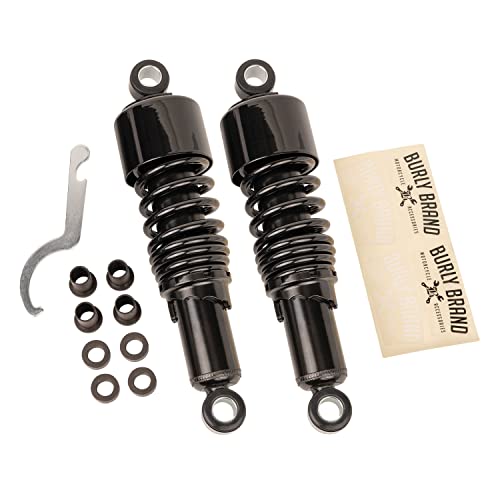 |
Burly Brand Slammer Rear Shocks for Harley Touring Best for Lowered Look Lowered length around 12.0 in, progressive spring, slammed stance, fits FLH/FLT |
8.4 | 🛒 Check Price |
|
Bilstein B12 Touring Rear Shock Absorbers for Harley FLH Best Durability Monotube gas pressure design, sturdy damping, touring-tuned, fits FLH bagger models |
8.2 | 🛒 Check Price |
1. Progressive Suspension 944 Ultra Touring Rear Shocks: Best Overall
The Progressive 944 Ultra is the shock we would put on our own Street Glide without a second thought. The headline feature is frequency-sensing damping, which reads how fast the suspension is moving rather than just how far. Hit a sharp expansion joint and the valving firms up to stop the harsh bottoming that plagues stock shocks. Roll over coarse chip-seal and it stays soft and compliant so the small stuff never reaches your spine. Loaded two-up with a full Tour-Pak, this is the unit that kept the rear end planted and controlled where the factory shocks turned to mush.
Setup is honest old-school engineering: a threaded preload collar you turn with a spanner to match your load. That is the one real drawback. If you regularly swap between riding solo and carrying a passenger plus gear, you cannot tweak preload at a gas stop the way an air shock allows. You set it for your typical load and live with it. For most touring riders that is a non-issue, and in exchange you get a sealed, maintenance-free shock with no air lines to leak. This is the safe, smart choice.
- Frequency-sensing damping firms up over fast bumps and stays plush over small chatter
- Threaded spring preload collar lets you dial in for solo or two-up loads with a wrench
- Heavy chrome or black billet bodies sized specifically for loaded baggers
Pros: Best blend of comfort and control of anything we researched two-up; Direct bolt-on with no air lines or pump to maintain; Proven long-term durability and a strong warranty
Cons: Preload changes need tools, so no on-the-fly adjustment at a stop; Premium positioning within the Progressive lineup
2. Progressive Suspension 970 Series Piggyback Reservoir Shocks: Best Premium
If you ride your Touring bike like it owes you money, carving back roads two-up and dragging boards through corners, the Progressive 970 is built for you. The piggyback reservoir carries extra oil and gives the damping somewhere to shed heat, so the shocks stay consistent on long mountain descents that would cook a basic emulsion unit. The valving is tuned firmer and more sporting than the comfort-focused 944, which translates to a flatter, more confident feel when you load up the chassis mid-corner.
That performance bias is also the trade-off. Around town and over rough, neglected pavement the 970 communicates more of the road than some riders want, so a comfort-first commuter may find it busy. The reservoir bodies also sit proud of the shock, so it is worth confirming clearance against your specific saddlebag mounts and lower guards before buying. Get the fitment right and you have a rebuildable, fade-proof shock that behaves more like a sportbike component than typical bagger fare.
- Piggyback reservoir adds oil volume and resists heat fade on long descents
- Rebuildable internals mean you can refresh them instead of replacing
- Firmer sport-touring valving for riders who push their bagger hard
Pros: Outstanding fade resistance and consistency on long aggressive rides; Serviceable design extends the usable life considerably; Sharper handling feel than softer comfort-only shocks
Cons: Firmer baseline ride is less pillowy than the 944 over broken pavement; Reservoir bodies need clearance checks against some bag mounts
3. Arnott Series Motorcycle Air Suspension Kit for Harley Touring: Best Air Ride
Air suspension is the answer when your load changes constantly. The Arnott air shock setup lets you add or release air pressure to change ride height and effective spring rate in seconds, which is genuinely transformative on a touring bike. Riding solo to work, run low pressure for a plush ride and a lower seat at stops. Loading up the passenger and bags for a weekend, pump it up and the rear holds geometry instead of sagging into the fender. For shorter riders, the ability to drop the bike at a light and raise it back up to roll is a real confidence booster.
The convenience comes with complexity. An air system means a compressor, lines, fittings and a controller, and every one of those is a part that can someday leak or fail in a way a sealed coil shock never will. Installation is also more demanding, with wiring and air routing to manage. If you are mechanically comfortable and your loads vary wildly, the flexibility is worth it. If you want set-and-forget simplicity, a coil-over like the Progressive will serve you better long term.
- Adjust ride height and stiffness on the fly with air pressure
- Lower the bike at stops for shorter inseams, raise it for clearance loaded
- Self-contained kit options with wireless controller and onboard pump
Pros: Instant preload changes for solo, two-up or fully loaded in seconds; Lets shorter riders drop seat height at stops then air back up; Smooth, cushioned ride when aired to a comfortable pressure
Cons: Air systems add components that can eventually leak or fail; More involved installation than a simple bolt-on shock
4. Ohlins STX 36 Twin Rear Shocks for Harley Touring: Best Handling
Ohlins is the name serious suspension nerds reach for, and the STX 36 brings that pedigree to baggers. The standout convenience is the hydraulic preload adjuster, a small knob you turn by hand to add or remove spring preload without a wrench. It is not as instant as air, but it means matching the shock to a passenger takes under a minute in a parking lot. The progressive-rate spring gives you supple movement over small bumps and a rising resistance that controls bottoming when you load the chassis or hit a big hit, and the damping precision is what sets the bike apart in corners.
This is a handling-first shock, so the ride is composed and planted rather than cloud-soft. Riders chasing pure plushness over rough city streets may prefer the Progressive 944, but anyone who values how the bike steers and holds a line will appreciate the Ohlins feel. The honest weakness is the value equation: you pay a clear premium for the badge and the engineering. If your priority is the best back-road manners money can buy on a Touring chassis, the STX 36 earns its place.
- Hydraulic preload knob lets you adjust spring tension by hand, no tools
- Progressive-rate springs deliver plush early travel and firm bottoming control
- Ohlins valving prized for precise, planted corner behavior
Pros: Tool-free hydraulic preload is fast and convenient; Exceptional damping precision and chassis composure in corners; Premium build quality and brand reputation for tuning
Cons: Sits at the top end of the price-to-value conversation; Comfort, while excellent, leans slightly firm and sporty
5. Hagon Nitro Rear Shocks for Harley Davidson Touring: Best Value
Hagon flies under the radar in the United States but has a long pedigree building shocks for touring and classic machines. The Nitro line is the smart-money pick because Hagon springs each shock to your actual weight and riding style when you order. That means the suspension arrives already in the right window for you, rather than a generic rate you fight with preload collars. On the road the nitrogen-charged emulsion damping feels composed and absorbent, soaking up the rough stuff and keeping a loaded bagger settled without the harsh bottoming of worn factory shocks.
The trade-offs are about logistics and adjustability. Because each set is built to order, you wait rather than getting overnight delivery, so plan ahead if you have a trip coming. And while you can set preload, you do not get the in-the-moment flexibility of air shocks or a hydraulic knob. For a rider who knows their typical load and wants a properly sprung, comfortable shock without paying flagship money, the Hagon Nitro delivers a lot of suspension for what it asks.
- Spring rate built to your weight and riding style when you order
- Nitrogen-charged emulsion damping for consistent feel
- Wide range of lengths and finishes for proper fitment
Pros: Custom-sprung to your weight for a tailored ride out of the box; Strong comfort and control for the value on offer; Hand-built reputation with responsive support
Cons: Made-to-order means a wait rather than next-day shipping; Less on-the-fly adjustability than air or hydraulic systems
6. Burly Brand Slammer Rear Shocks for Harley Touring: Best for Lowered Look
If your priority is the slammed bagger look, the Burly Slammer drops the rear of the bike for that aggressive low stance custom builders chase. The win here is that Burly uses progressive-rate springs so the lowered shock still works as a shock rather than turning the bike into a rigid. For solo cruising and the lower seat height, it is a genuinely good fix for shorter riders who want to plant both boots flat at a light while keeping a cleaner profile than stock.
Physics sets the limits. A shorter shock has less travel, so a fully loaded two-up bike on rough roads will reach the end of that travel sooner than a full-length unit, and the ride gets firmer when you push it hard. The lower stance also brings hard parts closer to the pavement, so you will scrape boards earlier and lose a little lean angle. Go in clear-eyed: the Slammer is a style-led choice that rides far better than a cheap lowering kit, but it is not the pick for maximum loaded comfort.
- Shorter eye-to-eye length drops the rear for an aggressive slammed stance
- Progressive springs retain usable travel despite the lower ride height
- Available in clean black or chrome to match your build
Pros: Delivers the low custom look without a brutal hardtail ride; Lower seat height helps shorter riders flat-foot the bike; Simple bolt-on swap with stock mounting
Cons: Reduced travel means less cushion when fully loaded two-up; Lower clearance can drag hard parts and limit lean angle
7. Bilstein B12 Touring Rear Shock Absorbers for Harley FLH: Best Durability
Bilstein earned its reputation in automotive suspension where monotube gas-pressure shocks are prized for staying consistent mile after mile, and that durability focus carries over to its FLH touring application. The monotube design dissipates heat well, so on long interstate hauls and loaded runs the damping does not fade into vagueness the way cheaper twin-tube units can. The tuning is firm and controlled, giving the bike a planted, no-nonsense feel at sustained highway speeds that confident long-distance riders tend to appreciate.
The flip side of that firm, durable character is that the Bilstein is not the most pillowy shock over slow, broken city pavement, where a softer comfort-tuned unit like the Progressive 944 will feel kinder. Fitment coverage is also narrower than the Harley-specialist brands, so confirm the exact application for your model and year before ordering. If your priority is a tough, fade-resistant shock that holds its composure over big highway miles, the Bilstein is a durable workhorse that rewards riders who value consistency over softness.
- Monotube gas-pressure construction known for heat resistance and longevity
- Firm, controlled damping that resists fade on long highway slogs
- Built to the durability standard Bilstein is known for in automotive use
Pros: Excellent long-haul consistency and fade resistance; Stout monotube build engineered for high mileage; Confident, controlled feel at sustained highway speeds
Cons: Firmer tuning trades some plushness over slow rough streets; Fitment options are narrower than dedicated Harley brands
Frequently Asked Questions
What length rear shocks do I need for my Harley touring bike?
Most Harley Touring models, including the Street Glide, Road Glide, Electra Glide and Road King, use rear shocks in the 13 to 13.5 inch eye-to-eye range as stock equipment. Staying in that window preserves the factory geometry, ground clearance and lean angle the bike was designed around. Shorter shocks in the 12 inch range lower the bike for a slammed look and an easier reach to the ground, but you sacrifice suspension travel and hard-part clearance. If you want a mild lift for loaded touring or more cornering clearance, some shocks come slightly longer. Always confirm the listed application for your exact model year before buying.
Are air shocks better than coil shocks for a loaded bagger?
It depends on how often your load changes. Air shocks let you add or release pressure in seconds to match solo, two-up or fully loaded riding, and they can lower the bike at stops for shorter riders. That flexibility is hard to beat if your loads vary constantly. The downside is added complexity: a compressor, lines and fittings that can eventually leak or fail. Coil-over shocks like the Progressive 944 are sealed, simple and maintenance-free, and a quality coil shock with the right spring rate rides beautifully. If your load is fairly consistent, a coil shock is the more reliable long-term choice. If it varies wildly, air earns its keep.
Can I install rear shocks on my Harley touring bike myself?
Yes, a standard coil-over shock swap is one of the more approachable suspension jobs on a Touring bike. You support the bike securely, unbolt the old shocks one at a time so the rear axle stays supported, and bolt the new ones in using the factory mounting points. Basic hand tools and a torque wrench are enough for most riders, and it is wise to follow the manufacturer torque specs exactly. Air-ride kits are more involved because you also route air lines and wire a compressor and controller, so budget extra time and care for those. If you are unsure, a shop can do the job quickly, but the bolt-on coil shocks here are well within DIY reach.
How do I set the preload for riding with a passenger?
Preload sets how much the spring is compressed at rest, which controls ride height and sag under load. For solo riding you want less preload so the suspension can use its travel and stay plush. When you add a passenger, gear and a loaded Tour-Pak, increase preload so the bike does not sag into its travel and bottom out. On threaded-collar shocks like the Progressive 944 you turn the collar with a spanner. Hydraulic-knob shocks like the Ohlins adjust by hand in under a minute, and air shocks change in seconds with a pump. A good starting target is roughly a third of total travel used as static sag, then fine-tune to how the bike feels loaded.
Will upgrading my rear shocks really fix the harsh ride on my Harley?
For most riders, yes, and it is usually the single biggest comfort improvement you can make. The stock shocks on many Touring models are under-sprung and under-damped for a loaded bike, so they run out of travel and bottom out hard over bumps and expansion joints. A quality replacement with proper spring rate and modern damping, such as frequency-sensing or progressive valving, soaks up impacts the factory unit passes straight to your spine. Pair the new rear shocks with a fresh front fork service or fork cartridge upgrade for the full effect, since the front and rear work together. Riders consistently describe the change as transforming the bike on long days.
Our Verdict
For the vast majority of Harley Touring riders, the Progressive Suspension 944 Ultra is the shock to buy. It nails the balance of plush comfort over rough pavement and firm control when loaded two-up, it bolts on without air lines to maintain, and it has the durability and warranty to back it up. If you ride harder and want a rebuildable, fade-proof shock with sharper handling, the Progressive 970 piggyback reservoir is the runner up worth stretching for. Choose the Arnott air kit if your loads change constantly, the Ohlins STX 36 for the best back-road manners, and the Hagon Nitro if you want a custom-sprung shock that delivers a lot of suspension for the value.
More Suspension Guides
Video Guide
Video: Related tutorial from YouTube