RV tires are not car tires. Class A motorhomes, fifth wheels, and travel trailers often run pressures of 80 to 110 PSI or higher, and a cheap car inflator simply cannot push that much air without overheating or stalling out. If you have ever stood at a gas station watching a tiny pump struggle against an 80 PSI rear dual, you already know why a dedicated, high-pressure portable compressor belongs in your rig.
We focused on units that reach genuine high-PSI territory, run long enough to fill multiple large tires without cooking themselves, and clamp securely onto valve stems behind dual wheels. Below are the seven portable air compressors we trust most for RV tires, ranked best first, with honest notes on where each one falls short.
| Photo | Product | Score | Buy |
|---|---|---|---|
 |
VIAIR 400P-RV Automatic Portable Compressor Kit Best Overall 150 PSI max, 33% duty cycle, 30-ft hose, alligator clamps |
9.5 | 🛒 Check Price |
 |
VIAIR 88P Portable Air Compressor Best for Travel Trailers 120 PSI max, direct battery clamps, sealed-lead-acid friendly |
9.2 | 🛒 Check Price |
 |
ARB CKMP12 Portable High Output Air Compressor Most Durable 150 PSI max, sealed motor, IP55 dust and moisture rating |
9.0 | 🛒 Check Price |
 |
TIREWELL 12V Heavy Duty Dual Cylinder Air Compressor Fastest Fill 150 PSI max, dual-cylinder pump, high airflow, LED work light |
8.8 | 🛒 Check Price |
 |
AstroAI Tire Inflator Portable Air Compressor Best Cordless 150 PSI max, rechargeable battery, preset auto shut-off |
8.5 | 🛒 Check Price |
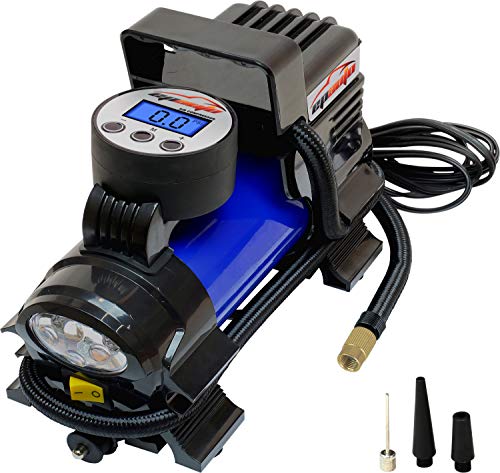 |
EPAuto 12V DC Portable Air Compressor Pump Best Value 100 PSI max, 12V socket plug, digital auto shut-off gauge |
8.3 | 🛒 Check Price |
|
🚗
|
Q Industries MV50 SuperFlow Air Compressor High Airflow Pick 100 PSI working, high CFM airflow, direct battery clamps, 24-ft hose |
8.1 | 🛒 Check Price |
1. VIAIR 400P-RV Automatic Portable Compressor Kit: Best Overall
The VIAIR 400P-RV is the unit we kept reaching for when filling large duals. It is purpose-built for recreational vehicles, so the 150 PSI ceiling gives real headroom over the 80 to 100 PSI most motorhomes need. The 30-foot coil hose is the standout feature here, because it lets you park the compressor once and walk the chuck around to every tire, including the inner dual that other pumps can never reach. The included inline deflator gauge also makes setting cold pressures precise rather than a guessing game.
The honest weakness is portability. This is a true workhorse, and it weighs and stows like one. It connects with alligator clamps directly to the battery rather than a plug, so you cannot just grab it and top off a tire in thirty seconds the way you can with a small handheld. If you want a glovebox gadget, look elsewhere. If you want one tool that confidently airs up every tire on a heavy rig, this is it.
- Reaches 150 PSI, comfortably covers 80 to 110 PSI motorhome tires
- 30-foot coil hose reaches all duals and rear axles without moving the unit
- Heavy-duty alligator battery clamps run straight off the chassis battery
Pros: Built specifically for big RV and motorhome tire pressures; Long hose and inline gauge make filling dual rears genuinely easy; Sturdy metal construction and a sand tray for stable footing
Cons: Bulky and heavier than handheld inflators; Must connect to the battery, not a 12V cigarette socket
2. VIAIR 88P Portable Air Compressor: Best for Travel Trailers
The VIAIR 88P is the right-sized choice for travel trailers and smaller motorhomes that live in the 65 to 80 PSI range. It reaches 120 PSI, so it is not strained at typical trailer pressures, and the compact case slips into a basement compartment without eating your whole storage bay. Like its bigger siblings, it clamps to the battery, which gives it steadier power than any socket-powered pump and lets it run without tripping a fuse.
Where it shows its limits is on the largest Class A duals. The smaller motor takes noticeably longer to move a heavy tire from low to full, and the shorter supply hose means more repositioning around a wide rig. For a single-axle or tandem-axle trailer, none of that matters much. For a 40-foot diesel pusher, step up to the 400P-RV.
- 120 PSI rating handles most travel trailer and lighter RV tires
- Compact case stows easily in a basement bay or under a dinette
- Clamps to the battery for stronger, more stable power delivery
Pros: Small footprint that still hits true trailer pressures; Simple, durable design with few parts to fail; Good value for owners who do not need 150 PSI
Cons: Slower to fill very large Class A tires; Shorter hose than the RV-specific 400P model
3. ARB CKMP12 Portable High Output Air Compressor: Most Durable
ARB earned its reputation in the overlanding world, and the CKMP12 brings that toughness to RV duty. The sealed IP55 motor shrugs off the dust and damp that kill cheaper compressors, which matters if you boondock or dry-camp where the unit lives in grit. It hits 150 PSI, so big rig pressures are no obstacle, and it holds its output steady through long fills rather than fading as it heats. If your RV doubles as a basecamp for off-road trips, this one tool covers both jobs.
The compromise is the accessories. The pump itself is excellent, but the supplied hose and tire chuck feel ordinary next to the motor, and many owners upgrade to a longer coil hose for dual-wheel access. It is also on the heavy and loud side. You are paying for a near-indestructible core, not a polished accessory bundle, so budget for a better chuck if you run inner duals.
- Sealed IP55 motor resists dust, mud, and trail moisture
- 150 PSI output covers heavy RV and off-grid tire pressures
- Built by an off-road brand known for long service life
Pros: Exceptional build quality and weather sealing; Doubles as an off-road and overlanding inflator; Consistent output even after extended runs
Cons: Hose and chuck feel basic for the quality of the pump; Heavier and louder than budget inflators
4. TIREWELL 12V Heavy Duty Dual Cylinder Air Compressor: Fastest Fill
If your main frustration is waiting, the TIREWELL dual-cylinder pump is the answer. Two cylinders move far more air per stroke than a single-piston unit, so it drops fill times dramatically on the big tires that take forever with smaller pumps. It reaches 150 PSI and does not bog down on tall, wide RV rubber, and the integrated LED light is a genuinely useful touch when you are fishing for a valve stem behind a dual in low light.
That speed comes from a big, heavy mechanism. This is one of the bulkier units here, and lifting it in and out of a storage bay is a two-hand job. It also runs warm and noisy when you fill several tires in a row, so plan brief pauses between large tires. For a tow vehicle plus a heavy trailer, though, the time saved on every fill is hard to argue with.
- Twin-cylinder design moves a large volume of air quickly
- 150 PSI ceiling suits big motorhome and dually truck tires
- Built-in LED light helps with valve stems in the dark
Pros: Very fast inflation thanks to dual cylinders; Handles large-diameter RV tires without bogging down; Sturdy metal base and battery clamps
Cons: Large and heavy to store and lift; Runs warm and loud during back-to-back fills
5. AstroAI Tire Inflator Portable Air Compressor: Best Cordless
The AstroAI cordless inflator is the convenience pick. There are no clamps and no cord, just a rechargeable pack, so you can walk up to any tire and top it off even when the RV is parked and shut down. The preset-and-shut-off feature is the best part for RV owners: dial in your target PSI, squeeze, and it stops itself at exactly the right pressure, which is ideal when you are setting four or six tires to the same number. The digital gauge and built-in light round out a genuinely handy package.
Its limitation is the battery. Filling several large, high-pressure RV tires from low will drain a charge, and it inflates more slowly than the clamp-on workhorses once you climb past 80 PSI. We see it less as the only compressor for a big rig and more as the always-ready companion for top-offs, the tow vehicle, and the bikes on the back. For that role it is excellent.
- Cordless rechargeable design needs no battery clamps or socket
- Preset pressure with auto shut-off prevents overinflation
- Digital gauge and LED light built into a compact body
Pros: Truly portable, top off a tire anywhere without the rig running; Set-and-forget preset shut-off is convenient and accurate; Great backup to keep in a tow car or scooter rack
Cons: Battery limits how many large tires you can fill per charge; Slower on very high-PSI motorhome tires
6. EPAuto 12V DC Portable Air Compressor Pump: Best Value
The EPAuto is the friendly all-rounder that has earned a huge following for good reason. It plugs into a 12V socket, shows a clear digital readout, and shuts off automatically at your preset pressure, so it is about as easy as a tire pump gets. For a tow vehicle, a small travel trailer, or topping off bikes and a spare, it is light, tidy, and dependable. The included carry bag keeps it neat in a door pocket or storage bin.
The catch for RV use is its 100 PSI ceiling. That is fine for many trailer tires but leaves no margin for Class A motorhomes that want 100 to 110 PSI, and socket power means it is not built for filling several big tires back to back. Treat it as a capable secondary inflator and pressure checker rather than the primary pump for a heavy rig, and it delivers.
- Plugs into a standard 12V socket for grab-and-go simplicity
- Digital display with preset auto shut-off for accurate pressure
- Compact carry bag stores easily in any vehicle
Pros: Extremely easy to use with a clear digital gauge; Light and compact for a tow vehicle or smaller trailer; Solid value for occasional top-offs
Cons: 100 PSI ceiling is marginal for high-pressure Class A tires; Socket power limits sustained high-PSI runs
7. Q Industries MV50 SuperFlow Air Compressor: High Airflow Pick
The Q Industries MV50 SuperFlow is the airflow specialist of the group. It moves a lot of air for its footprint, so it fills large-diameter tires faster than most single-piston pumps in its class, and the 24-foot hose paired with battery clamps means you can reach inner duals and rear axles without dragging the unit around. For owners of mid-pressure trailers and lighter motorhomes who want quick fills without a huge dual-cylinder unit, it hits a nice balance.
It is happiest in the mid-pressure range rather than at the very top of the scale, so the heaviest high-PSI Class A tires are not its ideal job. The analog gauge is also less precise than the digital preset units here, which means you will want a quality standalone tire gauge to verify your final pressures. As a fast, no-frills inflator for the bulk of RV tire work, it earns its place.
- High-airflow design fills large tires noticeably faster
- 24-foot hose reaches duals and rear axles on bigger rigs
- Direct battery clamps for strong, sustained power
Pros: Strong airflow for the size and weight; Long hose helps with hard-to-reach dual valve stems; Simple, proven mechanical design
Cons: Working pressure is best suited to mid-range RV tires; Basic gauge is less precise than digital units
Frequently Asked Questions
What PSI does a portable air compressor need for RV tires?
It depends on your rig, but RV tires run far higher pressures than passenger cars. Travel trailers commonly need 50 to 80 PSI, while large Class A motorhomes and dual rear axles often call for 90 to 110 PSI or more. Always set the cold pressure printed on the tire placard or sidewall, not just the maximum on the tire. To leave yourself headroom, choose a compressor rated to at least 120 PSI for trailers and 150 PSI for big motorhomes, since pumps work harder and last longer when they are not running at their absolute ceiling.
Can a regular car tire inflator fill RV tires?
Usually not well. Small car and bicycle inflators are designed for 30 to 50 PSI and often stall, overheat, or take a very long time once you push past 70 PSI. They also tend to have short duty cycles, meaning they need to cool down before they can keep working, which makes filling several large RV tires painfully slow. For anything beyond a small single-axle trailer, a dedicated high-pressure compressor with battery clamps and a longer duty cycle is the safer and faster choice.
Should the compressor clamp to the battery or plug into a 12V socket?
For serious RV tire work, battery clamps are better. A standard 12V cigarette-lighter socket is typically fused for around 10 to 15 amps, and a powerful high-pressure compressor can draw more than that, blowing the fuse or limiting performance. Clamping directly to the chassis battery delivers full, steady power so the pump can reach high PSI and run longer without interruption. Socket-powered units are fine for top-offs and lighter trailer tires, but the workhorse models on this list connect to the battery for a reason.
Why does the hose length matter for RV tires?
RV wheels, especially dual rear axles, put valve stems in awkward, hard-to-reach spots, and the inner dual can be nearly impossible to access from outside. A short hose forces you to keep repositioning the compressor around a long, wide rig. A 25 to 30 foot hose lets you park the unit once near the battery and walk the chuck to every tire, including the inner duals, which saves real time and frustration. If you buy a great pump with a short hose, adding a longer coil hose is a worthwhile upgrade.
How do I keep all my RV tires at the correct, even pressure?
Always check and set pressure when the tires are cold, before driving, since heat from rolling raises pressure and gives a false reading. Use a compressor with a preset auto shut-off or a precise digital gauge so every tire lands on the same target number, and verify with a separate quality tire gauge because built-in analog gauges can drift. Setting matched pressures across an axle improves handling and tire wear. Many RV owners also run a tire pressure monitoring system so they can spot a slow leak before it becomes a roadside problem.
Our Verdict
For most RV owners, the VIAIR 400P-RV is the compressor to buy. It is built for the high pressures big rigs demand, its long hose reaches every dual, and it fills confidently without straining. If you run a travel trailer or smaller motorhome and want a more compact, easier-to-store option, the VIAIR 88P is our runner up and covers typical trailer pressures with the same dependable, battery-clamp design. Match the pump to your tires and pressures, keep a good standalone gauge on hand, and you will never dread a low RV tire again.
More Tires Guides
Video Guide
Video: Related tutorial from YouTube