A dead battery on a motorcycle is its own special kind of misery. You cannot push start a heavy cruiser alone, you rarely have a second vehicle parked beside you on a trailhead, and bump starting a fuel injected bike is often a non starter. A pocket sized lithium jump pack solves all of that. The right one slips into a tail bag, holds its charge for months, and cranks a small displacement battery back to life in seconds.
We focused this guide on units that actually suit motorcycles rather than big trucks. That means compact size, clamps that fit small motorcycle terminals, low peak amp ratings that match smaller batteries, and reverse polarity protection so a tired rider at the side of the road cannot fry anything. Below are seven jump starters we rate highly for two wheels, ranked best first, with honest weaknesses for each.
| Photo | Product | Score | Buy |
|---|---|---|---|
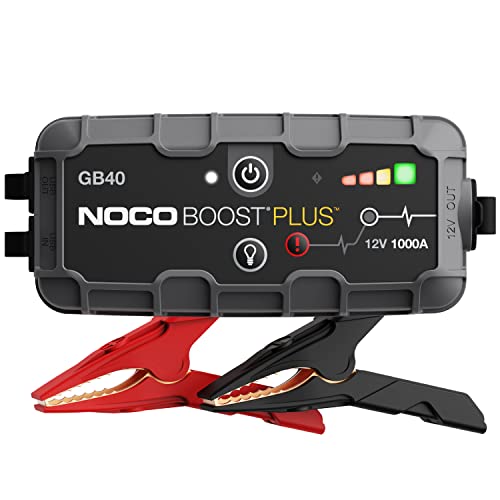 |
NOCO Boost Plus GB40 Best Overall 1000 peak amps, 12V lithium, jump starts up to 6L gas engines, IP65 rated |
9.5 | 🛒 Check Price |
 |
NOCO Boost HD GB70 Most Powerful 2000 peak amps, 12V lithium, jump starts up to 8L gas and 6L diesel engines |
9.3 | 🛒 Check Price |
 |
HULKMAN Alpha85 Best Smart Display 2000 peak amps, 20000mAh, color LCD screen, USB C in and out |
9.1 | 🛒 Check Price |
 |
GOOLOO GP4000 Best Value Power 4000 peak amps, 26800mAh, USB C PD fast charge, built in LED light |
8.9 | 🛒 Check Price |
 |
Antigravity XP-1 Micro-Start Best Compact Pick 300 cranking amps, ultra compact lithium, multi device charging kit |
8.7 | 🛒 Check Price |
 |
DBPOWER 800A Portable Jump Starter Best Everyday Carry 800 peak amps, 18000mAh, dual USB output, three mode LED flashlight |
8.4 | 🛒 Check Price |
 |
Beatit BT-D11 800A Best Safety Clamps 800 peak amps, 18000mAh, smart spark proof clamps, compass and LED |
8.1 | 🛒 Check Price |
1. NOCO Boost Plus GB40: Best Overall
The GB40 is the jump pack we reach for first because it nails the things that matter on a bike. It is small enough to ride along in a tank bag, the clamps are slim enough to grab tight motorcycle terminals, and 1000 peak amps is plenty for anything from a 250cc commuter up to a big twin. Reverse polarity protection and spark proof clamps mean you can connect it in the dark without sweating a mistake, and the IP65 shell handles the grime that comes with real riding.
Its one real weakness is the charging port. NOCO stuck with micro USB on this generation, so topping it up is slower than a modern USB C pack and you have to keep the right cable handy. It is also more capable than a small scooter strictly needs, which means you pay for headroom you may never use. Neither flaw changes the verdict: for most riders this is the most trustworthy choice.
- 1000 amps of peak current that crank small and mid size motorcycle batteries with ease
- Spark proof clamps with reverse polarity protection so a wrong connection does no harm
- Built in 100 lumen LED with seven modes including SOS and emergency strobe
Pros: Rugged IP65 housing shrugs off dust and splashes on the road; Clamps fit tight motorcycle terminals better than most rivals; Doubles as a power bank and a genuinely bright work light
Cons: Recharges over slow micro USB rather than USB C; Overkill on power for very small scooter batteries
2. NOCO Boost HD GB70: Most Powerful
If your garage holds a motorcycle plus a car, a boat, or a tractor, the GB70 lets one device cover all of them. With 2000 peak amps and a big internal cell, it cranks hard and keeps cranking, which is reassuring when a battery is badly drained and the first attempt does not catch. The clamps and cabling are noticeably heavier duty than the GB40, and the same reverse polarity and spark protection carries over, so the safety story stays strong.
The catch is size and weight. This is a brick compared with a true motorcycle specific pack, and strapping it to a bike for daily carry is awkward. For a bike that lives in town it is far more unit than you need. Buy it because it is your whole household jump starter, not because it is the ideal pocket companion for two wheels.
- 2000 peak amps for riders who also need to crank a car, truck, or boat
- Heavy gauge clamps and cables rated for repeated high current starts
- Large internal cell holds many jumps between recharges
Pros: Massive reserve so it rarely needs a recharge on a trip; Same proven NOCO safety system as the smaller GB40; Handles a stranded car or boat as well as the bike
Cons: Bulky and heavy for a motorcycle tail bag; More capacity than a single bike battery will ever use
3. HULKMAN Alpha85: Best Smart Display
The Alpha85 stands out for one simple reason: it tells you exactly what is happening. The color LCD shows precise battery percentage, voltage, and whether the clamps are connected correctly, which takes the anxiety out of a roadside jump. With 2000 peak amps it has no trouble with motorcycle batteries, and USB C input means you can refill it fast from the same charger you already carry for your phone.
The trade off is that it is chunkier than a stripped down motorcycle pack, so it eats more room in a tail bag. The active display and smart electronics also sip a touch of standby current, so after months untouched it may need a top up before a ride. If you value information and convenience over absolute minimum size, it is an easy unit to live with.
- Bright color LCD shows charge level, voltage, and jump status at a glance
- USB C input recharges the pack quickly compared with micro USB rivals
- Smart clamps adjust output and guide you through a safe connection
Pros: The LCD removes guesswork about state of charge and readiness; Fast USB C recharging gets it back in service quickly; Strong cranking power with a clear safety workflow
Cons: Larger footprint than minimalist bike packs; Screen and electronics draw a little standby power over long storage
4. GOOLOO GP4000: Best Value Power
GOOLOO has built a reputation for packing a lot of capability into one device, and the GP4000 is a strong example. The high peak amp figure means a deeply discharged battery is no obstacle, and the big 26800mAh cell delivers many jumps and plenty of phone charges between recharges. USB C Power Delivery handles both refilling the pack and fast charging your devices, which keeps your cable kit simple.
For a motorcycle, the headroom is the honest weakness. A small bike battery never asks for 4000 amps, so you are carrying capability you will not tap. The clamps are also slightly bulky, which can make grabbing closely spaced motorcycle terminals a bit fiddly. Look past that and you get among the most capable all round packs for the size.
- High peak amp rating crings even badly drained batteries quickly
- USB C Power Delivery charges the pack and fast charges your phone
- Large capacity gives dozens of jumps before a recharge
Pros: Generous capacity and output for a unit this size; Useful as a serious power bank for phones and tablets; Bright LED light with multiple emergency modes
Cons: High amp rating is well beyond a small bike battery's needs; Clamps are a little chunky for very tight motorcycle terminals
5. Antigravity XP-1 Micro-Start: Best Compact Pick
Antigravity comes from the powersports world, and the XP-1 Micro-Start shows it. This is the unit to choose if size is your top priority, because it disappears into a jacket pocket or a small tail bag and still delivers enough cranking power for the great majority of motorcycle batteries. The included adapter kit is a nice touch for riders who want one device to revive a bike and top up a phone or laptop on a long trip.
Its limit is raw power. With 300 cranking amps it is sized for bikes and small engines, so a big, badly drained battery on a large twin can leave it working hard or coming up short. The smaller cell also means fewer jumps before you need to recharge. For a commuter, a sport bike, or a small cruiser, though, it is a near perfect fit.
- Genuinely pocket sized and built specifically with powersports in mind
- Sized clamps and output tuned for motorcycle and small engine batteries
- Comes with a tidy kit of adapters for charging laptops and phones
Pros: Smallest and lightest unit here for true tail bag carry; Output matched to bikes rather than oversized for trucks; Trusted name among motorcycle and powersports riders
Cons: Lower cranking power struggles with larger displacement twins; Smaller cell means fewer jumps before a recharge
6. DBPOWER 800A Portable Jump Starter: Best Everyday Carry
The DBPOWER 800A is a sensible, no drama choice that suits motorcycles well. Its 800 peak amps line up nicely with the smaller batteries bikes use, so it is not carrying pointless excess, and the dual USB outputs plus a capable LED flashlight make it a genuinely useful pack to keep under the seat or in a bag. Operation is straightforward, which matters when you are tired and stranded.
It shows its price point in two places. The charging port is older micro USB, so refills are slower and you need the right cable, and the plastic housing does not feel as tough as the IP rated shells on premium units. Treat it gently and it is a dependable everyday companion that covers the essentials without fuss.
- 800 peak amps comfortably handle typical motorcycle batteries
- Dual USB outputs charge two devices alongside jump duty
- Three mode LED flashlight with strobe and SOS for roadside use
Pros: Right sized power for motorcycles without unnecessary bulk; Reliable everyday performer that is simple to operate; Doubles as a dependable phone power bank
Cons: Charges over older micro USB rather than USB C; Plastic housing feels less rugged than premium rivals
7. Beatit BT-D11 800A: Best Safety Clamps
The Beatit BT-D11 earns its place on clamp safety. Its smart cable protects against reverse polarity, short circuits, and sparks, and walks you through a safe connection with clear indicator lights, which is exactly what a first time user wants when a clamp is about to touch a live terminal. With 800 peak amps it is well matched to motorcycle batteries, and the built in compass and bright light are genuinely handy on a trip.
It is an older design, and you can feel it. Charging is slower than current USB C packs, the electronics lack the polish of newer rivals, and the case is bulkier than the most compact bike specific units. None of that undermines its core job. If safe, foolproof clamping is your main concern, it remains a reassuring pick.
- Smart clamps with multiple protections against sparks and wrong connections
- 800 peak amps suited to motorcycle and small car batteries
- Handy extras including a built in compass and bright emergency light
Pros: Excellent clamp safety system for nervous first time users; Well matched output for two wheel batteries; Thoughtful extras make it a useful trip companion
Cons: Charging and electronics feel a generation behind newer packs; Bulkier case than the most compact motorcycle units
Frequently Asked Questions
How many amps do I need to jump start a motorcycle?
Motorcycle batteries are far smaller than car batteries, so you do not need a huge amp rating. Most bikes start happily with a jump pack rated around 300 to 800 peak amps. Anything in the 1000 amp range, like the NOCO GB40, gives you comfortable headroom for a badly drained battery or a colder start. The very high 2000 to 4000 amp units are designed for cars, trucks, and boats, so they work on a bike but carry far more power than two wheels will ever use.
Will a jump starter damage my motorcycle's electronics?
A quality lithium jump starter with reverse polarity protection and spark proof clamps is safe for modern fuel injected motorcycles when used correctly. The protection circuitry refuses to deliver current until the clamps are connected the right way, which guards your ECU and sensitive electronics. Always clamp positive to positive and negative to a solid ground or the negative terminal, follow the indicator lights, and disconnect promptly once the engine catches. Avoid cheap units with no protection, since those are the ones that put your wiring at risk.
Can I leave a jump starter on my motorcycle all the time?
It is fine to store one in a tail bag or under the seat, but you should not leave it connected to the battery. Lithium jump packs hold their charge well, often for several months, yet they do slowly self discharge, especially units with an active display like the HULKMAN Alpha85. The practical habit is to check the charge level every couple of months and top it up before any long ride. Keep it out of extreme heat, since high temperatures shorten lithium cell life.
Lithium or lead acid jump starter for a motorcycle?
For a motorcycle, lithium is the clear choice. Lithium jump packs are dramatically smaller and lighter, which matters when storage space on a bike is tight, and they hold their charge far longer in storage. Old style lead acid booster boxes are heavy, bulky, and self discharge quickly, making them impractical to carry on two wheels. Every pack in this guide is lithium for exactly these reasons, giving you real cranking power in something that fits in a jacket pocket.
How do I jump start a motorcycle with a portable jump starter?
First make sure the jump pack is charged and the bike’s ignition is off. Connect the red clamp to the positive battery terminal, then the black clamp to the negative terminal or a clean metal ground on the frame. Wait for the unit to confirm a correct connection through its indicator lights. Turn the key and start the bike as normal, then remove the black clamp first and the red clamp second once it is running. Let the engine run or ride for a while afterward so the charging system can recover the battery.
Our Verdict
For most riders the NOCO Boost Plus GB40 is the jump starter to buy. It pairs slim clamps that fit motorcycle terminals with rugged IP65 protection, smart reverse polarity safety, and 1000 amps of cranking power that suits everything from a commuter to a big twin. If you want one device that also revives a car or boat, the NOCO Boost HD GB70 is the runner up, trading pocket size for a much larger reserve. Either way, choose lithium, match the amps to your bike, and you will never be stranded by a flat battery again.
More Batteries Guides
Video Guide
Video: Related tutorial from YouTube