Swapping the old lead-acid bank in a travel trailer for lithium is one of the few upgrades that genuinely changes how you camp. A good LiFePO4 battery gives you nearly all of its rated capacity instead of the usable half you got from flooded cells, it weighs a fraction of the old setup, and it charges back up far faster off solar or shore power. For boondockers, that means running the fridge, water pump, lights, and a few device chargers overnight without limping into the morning at a dead bank.
We compared seven of the most trusted lithium batteries sold on Amazon for RV and travel trailer use, looking at real usable amp-hours, BMS protection quality, cold-weather behavior, cycle life claims, and how well each one fits a standard Group 24, Group 27, or Group 31 battery box. Every pick here’s a drop-in 12V replacement, so you’re choosing based on capacity and features rather than rewiring your rig.
| Photo | Product | Score | Buy |
|---|---|---|---|
 |
Battle Born BB10012 100Ah LiFePO4 Best Overall 100Ah / 12V LiFePO4, 100A continuous BMS, ~3,000-5,000 cycles, made and supported in the USA |
9.5 |
ⓘ We may earn a commission from qualifying purchases made through links on this page, at no extra cost to you.
|
 |
Renogy 12V 100Ah Smart Lithium Iron Phosphate Battery Best for Solar Setups 100Ah / 12V LiFePO4, Bluetooth-capable smart series, up to 4 in series for 48V, integrated BMS |
9.3 | 🛒 Check Price |
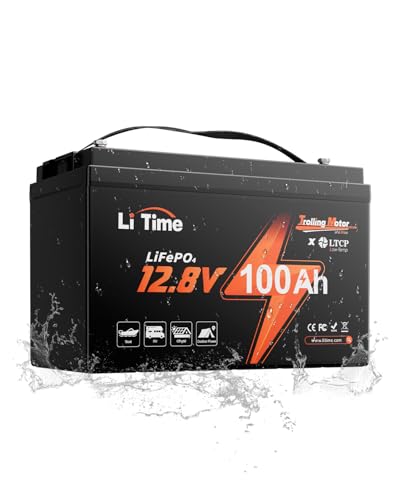 |
LiTime 12V 100Ah LiFePO4 Battery Best Value 100Ah / 12V LiFePO4, 100A BMS, low-temperature charging cutoff, Group 24 size |
9.1 | 🛒 Check Price |
 |
Redodo 12V 100Ah Mini LiFePO4 Battery Most Compact 100Ah / 12V LiFePO4 in a shortened mini case, 100A BMS, lighter than a standard Group 24 |
8.9 | 🛒 Check Price |
 |
Ampere Time 12V 200Ah Plus LiFePO4 Battery Best High Capacity 200Ah / 12V LiFePO4, 200A BMS, ~2,560Wh, Group 4D-style large case |
8.8 | 🛒 Check Price |
 |
Power Queen 12V 100Ah LiFePO4 Battery Best Drop-In Replacement 100Ah / 12V LiFePO4, 100A BMS, Group 24 size, designed as a direct lead-acid swap |
8.5 | 🛒 Check Price |
 |
Weize 12V 100Ah LiFePO4 Battery Best Starter Lithium 100Ah / 12V LiFePO4, built-in BMS, Group 24 size, entry-level lithium option |
8.2 | 🛒 Check Price |
1. Battle Born BB10012 100Ah LiFePO4: Best Overall
Battle Born has become the default answer when seasoned travel trailer owners talk lithium, and after living with one through a stretch of dry camping it’s easy to see why. The BB10012 delivers a genuine 100 usable amp-hours, charges back up quickly off a decent solar controller, and the 100A continuous BMS shrugs off the kind of inrush a 12V fridge compressor or a small inverter throws at it. The Group 24 case is light enough to lift one-handed, which matters when you’re wrestling it into a front-storage battery box.
The honest weakness is cold. This is a standard, non-heated cell, so charging below freezing can trip the BMS to protect the battery, and you need to plan for an insulated or interior-mounted location if you camp in winter. It also asks for a real commitment compared to a flooded battery, so the value case only makes sense if you actually cycle it hard. For a trailer that gets used often and far from hookups, though, this is the pick we trust most.
- Built-in 100A BMS with low-voltage, over-current, and short-circuit protection
- Rated for partial-state-of-charge living without the capacity loss of lead-acid
- US-based engineering and support with a long warranty backing the cells
Pros: Excellent BMS and build quality that holds up to daily deep cycling; Strong reputation among full-time RVers for reliability and support; Lightweight Group 24 footprint drops straight into most trailers
Cons: Sits at the premium end of the lithium market in value terms; No self-heating, so cold-weather charging needs a warm bay or insulation
2. Renogy 12V 100Ah Smart Lithium Iron Phosphate Battery: Best for Solar Setups
If your travel trailer already wears Renogy panels or you’re planning a solar build from scratch, this 100Ah smart battery is the natural centerpiece. It talks to Renogy charge controllers and DC-DC chargers in a way generic batteries don’t, and the self-balancing BMS makes it easy to grow from one battery to a two or four pack bank without one cell drifting out of line. During testing it accepted a strong solar charge rate and held voltage well under a steady overnight load.
The catch is lock-in. You get the most out of the monitoring, balancing, and communication features when the rest of the system is Renogy, and the smart module pairing can take a couple of attempts to settle. Treated purely as a dumb drop-in it still performs fine, but you’d be paying for ecosystem features you aren’t using. Inside a Renogy solar setup, it’s among the most cohesive options for a trailer.
- Smart battery line that pairs cleanly with Renogy solar charge controllers
- Supports series and parallel expansion for larger banks down the road
- Auto-balancing BMS helps keep multi-battery banks even over time
Pros: Integrates tightly with a full Renogy solar and DC-DC ecosystem; Expandable to 48V if you ever outgrow a single 12V bank; Good monitoring options through compatible Renogy gear
Cons: Best features really shine only inside the Renogy ecosystem; App and module behavior can be finicky to pair on first setup
3. LiTime 12V 100Ah LiFePO4 Battery: Best Value
LiTime, formerly sold as Ampere Time, has quietly become the value benchmark for trailer lithium, and the 12V 100Ah is the model most people start with. You get a full 100Ah, a competent 100A BMS, and low-temperature charge protection in a Group 24 box that drops into the same tray your old marine battery sat in. In a weekend of running a 12V fridge, lights, and a water pump, it tracked voltage smoothly and recharged briskly off both shore power and solar.
It isn’t flawless. The low-temperature cutoff is doing its job, but it means you can’t charge it below freezing without a heated or insulated bay, and customer support, while improved, doesn’t match the hand-holding of a US-based premium brand. For most travel trailer owners who want the lithium experience without overspending, though, this battery delivers the core benefits with very few compromises.
- 100A BMS with low-temp protection that blocks charging below freezing
- Compact Group 24 case that fits standard trailer battery trays
- Strong cycle-life rating for everyday deep discharge use
Pros: Outstanding capacity and protection for the money it asks; Light, compact, and easy to wire as a true drop-in replacement; Huge installed base and plenty of real-world RV feedback
Cons: Support response can be slower than premium US brands; Low-temp cutoff protects the cell but pauses charging in the cold
4. Redodo 12V 100Ah Mini LiFePO4 Battery: Most Compact
Some travel trailers, especially smaller and teardrop-style rigs, simply don’t have room for a full Group 24 box, and that’s where the Redodo mini earns its place. It packs a real 100Ah into a shortened case that’s both smaller and lighter than a conventional battery, which frees up storage and trims weight on the tongue. In use it behaved like the other quality LiFePO4 units here, holding steady voltage under an overnight fridge-and-lights load and recharging without drama.
The trade-offs are practical ones. Because the case is undersized, it can rattle around in a tray built for a standard battery unless you add foam or spacers, and like most batteries at this level it has no internal heater, so freezing-temperature charging is off the table without help. If space and weight are your main constraints, the mini format is a smart answer that doesn’t sacrifice usable capacity.
- Shrunken mini footprint frees up room in tight battery compartments
- 100A BMS with the standard suite of lithium safety protections
- Noticeably light, which helps tongue weight on smaller trailers
Pros: Smallest 100Ah package here for cramped trailer battery bays; Light enough to ease handling and tongue-weight concerns; Solid everyday performance for the capacity
Cons: No self-heating for sub-freezing charging; Mini case can need spacers to sit securely in a full-size tray
5. Ampere Time 12V 200Ah Plus LiFePO4 Battery: Best High Capacity
When a single 100Ah won’t cover your stay, the Ampere Time 200Ah lets you double the bank without the hassle of paralleling two batteries and balancing them. With roughly 2,560 watt-hours on tap and a 200A BMS, it comfortably feeds a larger inverter for a coffee maker or microwave while still keeping the fridge and lights happy overnight. For extended boondocking, having all that capacity in one clean install is genuinely freeing.
The obvious downside is its size and mass. This is a large, heavy battery that needs a compartment built to hold it and a frame that can carry the weight where you mount it, so it isn’t a casual swap into a small trailer. It’s also more battery than a weekend-and-hookups camper will ever use. But for full-timers and long dry-camp trips, the single-box 200Ah format is the practical way to scale up.
- 200Ah in a single box for long off-grid stays without a multi-battery bank
- 200A BMS supports larger inverters and heavier simultaneous loads
- One-battery wiring is simpler than paralleling two 100Ah units
Pros: Massive single-battery capacity for serious boondocking; Handles bigger inverter loads thanks to the 200A BMS; Cleaner install than wiring two smaller batteries in parallel
Cons: Large and heavy, so it needs a sturdy, sized compartment; Overkill for weekend campers who rarely dry camp
6. Power Queen 12V 100Ah LiFePO4 Battery: Best Drop-In Replacement
Power Queen aims squarely at the owner who just wants to pull out a tired flooded battery and slot lithium into the same tray, and it executes that job well. The Group 24 dimensions match a standard RV battery, the terminals land where you expect, and the 100A BMS handles the usual protections. Through a typical weekend of fridge, pump, and lighting duty it performed right alongside the better-known 100Ah batteries, charging back quickly on shore power.
The reservation here’s track record. Power Queen hasn’t been around as long as the established names, so the long-term reliability data is thinner, and there’s no self-heating for winter charging. For a straightforward warm-season or three-season drop-in where you want the lithium benefits without fuss, it’s a sensible and easy-to-live-with choice that does the fundamentals right.
- Group 24 case sized to replace a standard flooded RV battery one-for-one
- 100A BMS covers over-charge, over-discharge, and short-circuit faults
- Series and parallel capable for modest bank expansion
Pros: Truly painless swap for an existing lead-acid battery box; Reliable everyday performance at a friendly value; Light and easy to handle during install
Cons: Brand is newer with a shorter track record than rivals; No low-temperature self-heating feature
7. Weize 12V 100Ah LiFePO4 Battery: Best Starter Lithium
For someone curious about lithium but not ready to commit to a top-tier bank, the Weize 100Ah is an approachable on-ramp. It gives you the headline lithium advantages, light weight, deep usable capacity, and fast recharging, in the same Group 24 box your old battery used. In gentle real-world duty running lights, a fan, and a 12V fridge it held up fine and felt like a clear step up from lead-acid.
Where it shows its entry-level nature is at the edges. The supporting documentation is sparse, the BMS and rate ratings are conservative rather than built for heavy inverter loads, and it doesn’t have the deep reliability history of the leaders. If you’re running a modest trailer and want to dip into lithium without a large outlay of effort, it’s a reasonable first battery, just temper expectations for high-draw use.
- Accessible entry point into LiFePO4 for first-time lithium buyers
- Built-in BMS provides the core lithium safety protections
- Standard Group 24 fit for common trailer battery trays
Pros: Easy, low-barrier way to try lithium in a trailer; Significant weight savings over the flooded battery it replaces; Simple drop-in install with familiar dimensions
Cons: Documentation and support are more basic than premium brands; Charge and discharge rates are conservative for big inverter loads
Frequently Asked Questions
How many lithium batteries do I need for my travel trailer?
It depends on your loads and how long you go between charges. A single 100Ah LiFePO4 battery is enough for many weekend trips that mostly run lights, a water pump, a vent fan, and a 12V fridge, since you get close to the full 100 usable amp-hours instead of the roughly 50 you’d draw from a lead-acid battery before harming it. If you boondock for days, run an inverter for appliances, or camp in hot weather with the fridge working hard, step up to 200Ah or two 100Ah batteries in parallel. Add up the amp-hours your devices pull over 24 hours, then size the bank to cover that with a comfortable margin and some reserve for cloudy solar days.
Can I just drop a lithium battery into my existing battery box?
In most cases yes, which is the appeal of these 12V LiFePO4 batteries, but check two things first. Confirm the physical size matches your tray, Group 24, 27, or 31, and confirm your converter or charger can charge lithium correctly. Older RV converters use a lead-acid charge profile that may not fully charge a LiFePO4 battery, so a lithium-compatible converter or a DC-DC charger gives the best results and longest life. The wiring and terminals are typically a direct match, so for many owners it really is a pull-the-old, fit-the-new swap, with a charger check being the main extra step.
Will a lithium battery work in cold weather?
LiFePO4 batteries discharge fine in the cold, so your lights and pump still run, but charging below freezing can damage the cells, which is why most quality batteries include a low-temperature cutoff that pauses charging. That protection keeps the battery safe but means it won’t accept a charge until it warms up. If you camp in freezing conditions, either mount the battery inside a heated interior space, insulate the compartment, or choose a self-heating model that warms its own cells before accepting charge. None of the standard non-heated batteries here should be charged below freezing without help.
How long do lithium travel trailer batteries last?
Quality LiFePO4 batteries are rated for thousands of cycles, often in the 3,000 to 5,000 range, which is far beyond what a flooded lead-acid battery survives. In practical terms, if you cycle a good lithium battery regularly you can reasonably expect many years of service, frequently a decade or more for occasional campers. Lifespan depends on how deeply and how often you discharge it, the temperatures it lives in, and whether it’s charged with a proper lithium profile. Avoiding sustained extreme heat and not leaving it sitting fully depleted for long stretches both help it reach its rated life.
Do I need a special charger or converter for lithium?
For best performance, yes. Lithium and lead-acid batteries want different charge voltages and profiles, so a converter set up for flooded or AGM batteries may chronically undercharge a LiFePO4 bank, leaving capacity on the table. The cleanest solution is a converter or inverter-charger with a dedicated lithium mode, and for charging from the tow vehicle a DC-DC charger ensures the battery gets the right voltage rather than whatever the alternator happens to put out. Many people run lithium on an old converter and still see benefits, but matching the charger to the chemistry is what unlocks full capacity and the longest service life.
Our Verdict
For most travel trailer owners, the Battle Born BB10012 100Ah is our top pick thanks to its excellent BMS, proven reliability among full-timers, and strong US-based support, making it the battery we would trust on a long trip far from hookups. If you’re building around solar or want room to expand, the Renogy 12V 100Ah Smart battery is the runner up, integrating beautifully with a full solar and DC-DC system. Budget-focused buyers should look hard at the LiTime 100Ah, which delivers nearly the same core experience for far better value, while boondockers who need maximum capacity will be happiest with the single-box Ampere Time 200Ah.

