Towing a loaded trailer changes everything about how your truck behaves. The rear sags, the front goes light, and every bump or passing semi sets off a wallowing motion that wears you out long before the destination. The shock absorbers are what actually control that motion, and the soft factory units on most half-ton and three-quarter-ton trucks simply weren’t built to manage a heavy tongue weight day after day. Upgrading to a set of heavy duty shocks is among the most effective and bolt-on friendly ways to settle the chassis, cut sway, and keep the back end planted when you have a fifth wheel or travel trailer hooked up.
We looked at the shocks people actually run on towing rigs, from monotube gas units that resist fade on long mountain descents to adjustable dampers and even air-assist designs that help with squat. Below are seven we rate highly for towing duty, ranked best first, with honest notes on where each one shines and where it falls short.
| Photo | Product | Score | Buy |
|---|---|---|---|
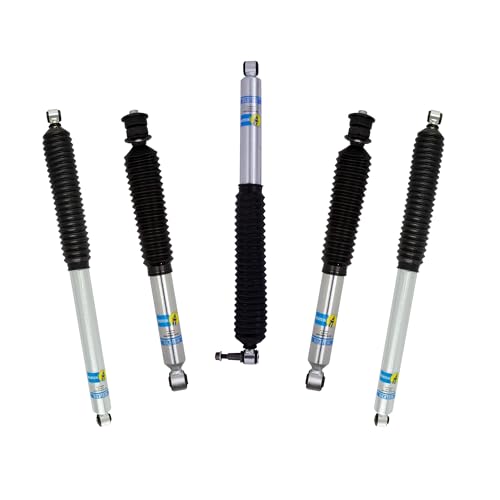 |
Bilstein 5100 Series Shock Absorber Best Overall 46mm monotube gas-pressure, digressive valving, zinc-plated body |
9.5 |
ⓘ We may earn a commission from qualifying purchases made through links on this page, at no extra cost to you.
|
 |
Bilstein 4600 Series Shock Absorber Best for Daily Drivers 46mm monotube gas, fixed factory ride height, OE-style fitment |
9.2 | 🛒 Check Price |
 |
Rancho RS9000XL Adjustable Shock Absorber Most Adjustable 9-position manual valving, twin-tube gas-charged, polyurethane bushings |
9.0 | 🛒 Check Price |
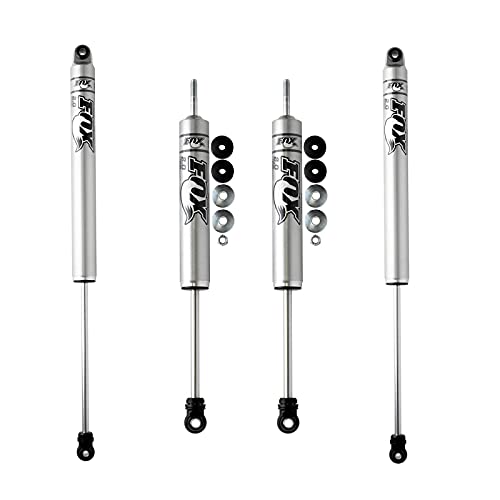 |
Fox 2.0 Performance Series IFP Shock Absorber Best Premium 2.0 inch monotube IFP, race-bred valving, anodized aluminum body |
8.8 | 🛒 Check Price |
 |
Monroe Gas-Magnum Shock Absorber Best for Trucks and Vans Heavy gauge 54mm bore, all-weather fluid, gas-charged twin-tube |
8.6 | 🛒 Check Price |
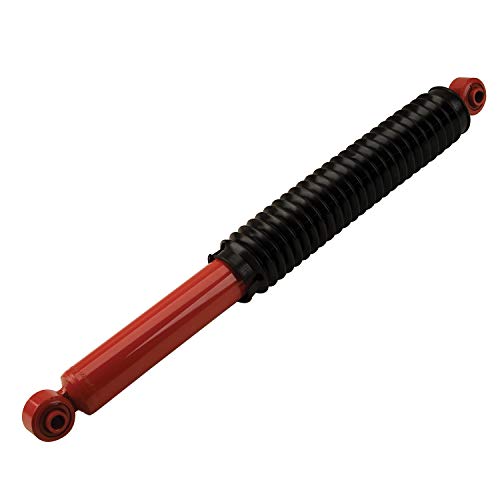 |
KYB MonoMax Gas Shock Absorber Best Monotube Value Large monotube bore, high gas pressure, hardened piston rod |
8.4 | 🛒 Check Price |
 |
Gabriel HiJackers Air Adjustable Shock Absorber Best Air-Assist Air-adjustable load assist, 22 to 90 psi range, integrated air bladder |
8.0 | 🛒 Check Price |
1. Bilstein 5100 Series Shock Absorber: Best Overall
The Bilstein 5100 is the shock most experienced towers reach for first, and for good reason. The 46mm monotube design moves more oil and runs a higher gas charge than the twin-tube shocks that come on most trucks, so it controls a loaded rear end far better and stays consistent when the others would start to fade. On a long grade with a trailer pushing from behind, that consistency is exactly what keeps the truck calm. The digressive valving is the clever part here, staying firm enough to fight sway on big inputs while still soaking up small road texture, so the truck doesn’t feel punishing when you finally drop the trailer.
The honest weakness is ride quality when you’re running empty. Compared to a worn-out factory shock, the 5100 is noticeably firmer over expansion joints and washboard, and a few owners of lighter trucks find it busy on rough pavement. It’s a deliberate trade for load control, not a flaw, but if your truck spends most of its life unloaded you’ll feel it. Make sure you select the version matched to your ride height, because the wrong setting blunts the benefit.
- Large 46mm monotube bore for consistent damping under load
- Digressive piston valving keeps body roll and sway in check
- High gas charge resists fade on long downhill tows
Pros: Outstanding load control without harshness when unloaded; Proven durability and a strong reputation for towing trucks; Direct bolt-on fit for most popular tow rigs
Cons: Firmer than a soft factory shock on rough surfaces; Some applications need the correct ride-height setting to get the best feel
2. Bilstein 4600 Series Shock Absorber: Best for Daily Drivers
If your truck sits at stock height and splits its time between hauling a trailer and running errands, the Bilstein 4600 is the smarter pick over its 5100 sibling. It uses the same large monotube guts but is valved for the factory ride height, so it bolts in without any fuss and delivers most of the towing benefit while keeping the unloaded ride more livable. The self-adjusting valving firms up when the trailer loads the suspension and relaxes when you’re running light, which is a nice trick for a truck that does double duty all week.
Where it gives ground is at the heavy end of the towing spectrum. If you’re regularly near your payload ceiling with a big fifth wheel, the 5100 has the edge in outright body control and resistance to fade. The 4600 is also strictly for stock height trucks, so anyone with a leveling kit or lift should look elsewhere. Within its lane, though, it’s hard to beat for a comfortable yet capable everyday tow setup.
- Same 46mm monotube hardware tuned for stock ride height
- Self-adjusting valving reacts to road and load changes
- Triple chrome-plated piston rod for long service life
Pros: Big damping upgrade with a near factory bolt-in fit; Better balance of comfort and control for mixed driving; Tough construction built for high mileage
Cons: Not designed for lifted or leveled trucks; Less aggressive than the 5100 for heavy continuous towing
3. Rancho RS9000XL Adjustable Shock Absorber: Most Adjustable
The headline feature of the Rancho RS9000XL is right there in the name. Nine selectable damping positions let you soften the shock for an empty commute and firm it up for a loaded trailer, all by twisting a knob at the base of each unit. For a truck that tows occasionally but is comfort-focused the rest of the time, that range is genuinely useful, and it means you’re never stuck with a compromise tune. Set it to the firmer positions and the rear settles down noticeably with weight on the hitch, cutting the sway and porpoising that make long tows tiring.
The compromises are practical ones. Out of the box you have to reach in at each wheel to change the setting, which is a chore on the road unless you spring for the optional in-cab adjustment kit. And because it’s a twin-tube design rather than a monotube, it doesn’t shed heat as well on a long, hard mountain descent, where a Bilstein or Fox will stay more consistent. For flexibility and value, though, it’s the standout.
- Nine selectable damping settings dialed by hand
- Soft setting for empty driving, firm setting for heavy loads
- Optional in-cab adjustment kit available for on-the-fly tuning
Pros: Tune the ride for towing or daily use in seconds; Excellent value for the flexibility it offers; Forgiving when unloaded thanks to the soft settings
Cons: Manual adjustment at each wheel unless you add the remote kit; Twin-tube design fades sooner than a monotube under extreme heat
4. Fox 2.0 Performance Series IFP Shock Absorber: Best Premium
Fox built its name in off-road racing, and the 2.0 Performance Series brings that hardware to towing trucks. The large aluminum monotube body and internal floating piston are designed to keep the oil from aerating as it heats up, which is exactly the failure mode that turns a soft shock into a wallowing mess on a long grade with a heavy load behind you. On sustained descents the Fox stays composed when cheaper shocks have gone spongy, and that confidence is worth a lot when you’re managing a fifth wheel down a mountain pass.
It’s a premium choice and the body knows it, both in the investment required and in the firm, planted character it delivers. Drive the truck empty and you’ll notice the stiffness over broken pavement more than you’d with a 4600 or the soft setting on a Rancho. There’s also a fair bit of off-road capability baked in that a pure tow rig will never use, so you’re partly paying for talent you may not need. For owners who tow hard and want the best heat management available in a bolt-on shock, it earns its keep.
- Large 2.0 inch aluminum body sheds heat under sustained load
- Internal floating piston prevents oil aeration and fade
- Application-specific valving for towing and hauling trucks
Pros: Exceptional fade resistance on long, loaded descents; Premium build quality and strong off-road bonus capability; Controlled, planted feel with a heavy trailer
Cons: Premium investment compared to mainstream options; Firmer character that some find too stiff unloaded
5. Monroe Gas-Magnum Shock Absorber: Best for Trucks and Vans
The Monroe Gas-Magnum is the no-nonsense heavy duty shock for people who just want their truck or van to stop bouncing under a load. The oversized 54mm bore is the largest in this group on paper and is purpose-built for the weight of full-size trucks, work vans, and big SUVs. The gas charge keeps the fluid from foaming when you string together a series of hard hits, so the rear stays controlled towing a trailer over rough roads where a tired factory shock would lose its composure. Application coverage is broad, which makes it an easy fit for older work trucks as well as newer rigs.
What you give up is finesse. There’s no adjustability, so you live with the tune Monroe chose, and that tune prioritizes control over the last word in plushness. Back to back against a Bilstein monotube or the Fox, the Gas-Magnum feels a touch less refined and doesn’t isolate small road texture quite as well. For a hardworking truck that earns its living towing and hauling, though, the toughness and value are tough to argue with.
- Oversized 54mm bore sized for trucks, vans, and SUVs
- Gas charge reduces foaming and fade under repeated hits
- All-weather fluid for consistent damping in heat and cold
Pros: Stout, large-bore design aimed squarely at heavy vehicles; Strong everyday value for the durability on offer; Wide application coverage for older and newer rigs
Cons: Not adjustable, so the tune is fixed; Comfort and refinement trail the premium monotubes
6. KYB MonoMax Gas Shock Absorber: Best Monotube Value
The KYB MonoMax brings genuine monotube construction to the more accessible end of the heavy duty shock market. Where many value shocks use a twin-tube design, the MonoMax runs a single large bore with a high-pressure nitrogen charge, which means better heat dissipation and a firmer, more controlled response when you load the truck up. Owners of saggy, wallowing rigs consistently report that it tightens the rear end right up, killing the float that makes a loaded truck feel nervous at highway speed. For the money, that’s a lot of capability.
The flip side of that firm monotube tune is ride harshness when the truck is empty. The MonoMax doesn’t hide its stiffness, and on broken pavement without a load it can feel busy and a little jarring compared to a softer or adjustable shock. Application coverage is also narrower than the long-established Monroe and Bilstein catalogs, so it pays to confirm the fitment for your exact truck before ordering. If it covers your rig and you tow often, it’s a smart value play.
- Full monotube construction for better heat dissipation
- High-pressure nitrogen charge for firm, fade-resistant control
- Built specifically for trucks and SUVs that tow and haul
Pros: Monotube performance at an accessible price point; Noticeably tightens up a loose, wallowing rear end; Strong build aimed at heavier vehicles
Cons: Firm ride that can feel harsh when unloaded; Limited application coverage compared to some rivals
7. Gabriel HiJackers Air Adjustable Shock Absorber: Best Air-Assist
The Gabriel HiJackers take a different approach to the towing problem. Instead of relying purely on stiffer valving, they add an inflatable air bladder so you can dial in pressure to level the truck and counter rear squat when a heavy trailer loads the hitch. Air them up before a tow and the back end comes up, the headlights stop pointing at the trees, and the truck carries the tongue weight with far less sag. Air them down for an empty run and you get a genuinely soft, comfortable ride, which is a flexibility that fixed shocks can’t match.
The trade-offs are inherent to the air-assist design. The air lines and Schrader fittings are an extra system that can develop slow leaks over the years and need occasional attention, and the damping itself isn’t as sophisticated as a dedicated monotube, so outright body control on rough roads is a step behind a Bilstein or Fox. Think of these as a leveling and load-support solution with shock duty attached rather than the last word in damping. For owners whose main complaint is squat and sag, they solve that problem directly.
- Adjustable air pressure to level the truck under load
- Helps fight rear squat from heavy tongue weight
- Inflate for towing, deflate for an unloaded soft ride
Pros: Levels the rear and reduces sag when hitched up; Dual purpose damping plus load support in one unit; Soft and comfortable when aired down empty
Cons: Air lines and fittings can develop leaks over time; Damping control trails dedicated monotube shocks
Frequently Asked Questions
Do heavy duty shocks actually help with towing sway?
Yes, within their role. Shocks don’t stop sway the way a weight distribution hitch or sway bar does, but they control the up and down and side to side motion of the chassis, and that has a real effect on how settled the truck feels. A worn or soft factory shock lets the rear wallow and porpoise, which amplifies the unsettled feeling when a trailer pushes the back end around. A firmer monotube shock like the Bilstein 5100 or KYB MonoMax damps that motion quickly, so the truck recovers faster after a bump or a gust and feels far more planted. For best results, pair good shocks with a proper weight distribution and sway control hitch.
Will heavy duty shocks fix rear sag when I hook up a trailer?
Not on their own. Standard shocks, even heavy duty ones, control motion but don’t support load, so they won’t hold the rear up the way a stiffer spring or air bag would. If your main complaint is the back end squatting under tongue weight, you want either air-assist shocks like the Gabriel HiJackers, a set of helper springs or air bags, or a weight distribution hitch that transfers load back onto the front axle. A firm monotube shock will make the sagging truck feel more controlled in motion, but to actually raise the rear and level the truck you need load support, not just damping.
Monotube or twin-tube shocks for towing?
Monotube shocks are generally the better choice for serious towing. A monotube uses a single large bore that holds more oil and dissipates heat more effectively, which matters a lot on a long loaded descent where a twin-tube can overheat and fade into a spongy, uncontrolled state. The Bilstein 5100, Fox 2.0, and KYB MonoMax are all monotubes for exactly this reason. Twin-tube shocks like the Rancho RS9000XL and Monroe Gas-Magnum can still tow very well and often ride more softly unloaded, but if you regularly run heavy in the mountains, the heat management of a monotube is worth prioritizing.
Should I replace all four shocks or just the rear ones?
Replace all four. It’s tempting to only do the rear since that’s where the trailer load sits, but the front shocks control dive under braking and keep the steering settled, both of which matter a great deal with a heavy load behind you. Mixing fresh heavy duty rears with tired worn fronts gives an unbalanced ride where one end of the truck reacts differently than the other, which can feel unsettling. Shocks also wear gradually and in pairs, so doing the complete set at once restores balanced, predictable handling and saves you a second job down the road.
Can I install towing shocks myself?
For most trucks, yes. Shock replacement is one of the more approachable suspension jobs and usually requires only hand tools, a jack, and stands, since the shocks bolt to the frame at the top and the axle or control arm at the bottom. Penetrating oil on rusty hardware, a torque wrench for the mounting bolts, and care to support the axle properly will get most people through it in an afternoon. The main cautions are rusted fasteners that may need heat or replacement, and adjustable or air shocks that require routing lines or setting ride height. If your truck has heavy corrosion or you aren’t comfortable under it, a shop visit is reasonable.
Our Verdict
For most people towing with a half-ton or three-quarter-ton truck, the Bilstein 5100 Series is our top pick. Its large monotube design, digressive valving, and high gas charge give the best blend of load control and fade resistance you can bolt on, and its reputation among towers is well earned. If your truck sits at stock height and lives a more balanced daily life, the Bilstein 4600 is the comfortable, do-it-all runner up. Buyers who want to tune the ride on demand should look hard at the adjustable Rancho RS9000XL, while those whose main battle is rear squat will be happiest with the air-assist Gabriel HiJackers.


