Bleeding brakes used to mean roping in a friend to pump the pedal while you crawled under the car shouting “hold it.” A good brake bleeder tool ends that ritual. It lets one person pull old fluid and trapped air out of the lines, leaving you with a firm, confident pedal and a system free of the moisture that quietly corrodes ABS units and calipers.
We ran hand vacuum guns, pressure bleeders, and pneumatic units through real caliper bleeds, clutch slave cylinders, and stubborn ABS systems. Some sealed beautifully and pulled fluid in seconds. Others fought us with leaky fittings and weak suction. Below are the seven brake bleeder tools that earned their spot, ranked best first, with honest notes on where each one falls short.
| Photo | Product | Score | Buy |
|---|---|---|---|
 |
Motive Products Power Bleeder 0100 Best Overall Pressure bleeder, hand-pump reservoir, universal European cap adapter |
9.5 |
ⓘ We may earn a commission from qualifying purchases made through links on this page, at no extra cost to you.
|
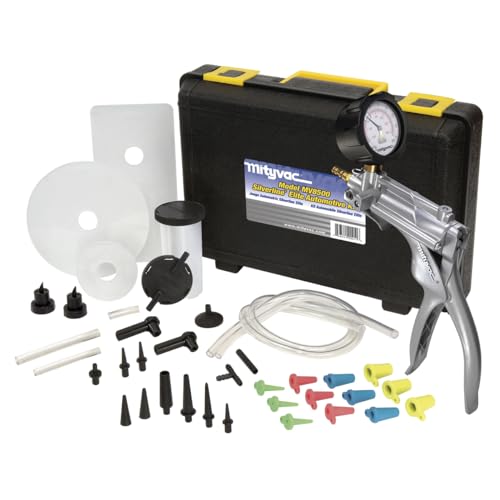 |
Mityvac MV8500 Silverline Elite Vacuum Pump Kit Best Vacuum Kit Hand vacuum pump, metal body, automotive bleed and test kit |
9.3 | 🛒 Check Price |
 |
Phoenix Systems V-12 Reverse Brake Bleeder Best for Stubborn ABS Reverse bleeder, pushes fluid up from caliper to master cylinder |
9.1 | 🛒 Check Price |
|
🚗
|
ABN Brake Bleeder and Vacuum Pump Test Kit Best Value Kit Hand vacuum pump kit with adapters, hoses, and catch reservoir |
8.8 | 🛒 Check Price |
 |
OEMTOOLS 24444 Master Cylinder Bleeder Kit Best for Master Cylinders Bench and on-car master cylinder bleeder tube and fitting set |
8.6 | 🛒 Check Price |
 |
Performance Tool W87030 Pneumatic Brake Bleeder Best Air-Powered Pneumatic vacuum bleeder, runs off shop air compressor |
8.4 | 🛒 Check Price |
 |
Lisle 19402 Brake Bleeder Bottle Best Simple One-Person Kit Bleeder catch bottle with magnetic mount, hose, and check valve |
8.1 | 🛒 Check Price |
1. Motive Products Power Bleeder 0100: Best Overall
The Motive Power Bleeder is the tool that turns a dreaded chore into a fifteen minute job. You fill the tank with fresh fluid, pump it to pressure, and the system pushes clean fluid down through every line while keeping the master cylinder topped up the whole time. There’s no pedal pumping, no second person, and no panic about running the reservoir dry. At each caliper you simply crack the bleeder, watch clear bubble-free fluid arrive, and close it. The included gauge keeps you from over-pressurizing, which matters on plastic reservoirs.
Its one real weakness is the universal cap. The 0100 ships with a rubber adapter meant to fit many reservoirs, and on some shapes it takes a few tries to get a leak-free seal. Owners of a single car often prefer a model-specific cap, which Motive sells separately and which seals instantly. Once that cap is right, this tool is close to flawless, and that’s why it sits at the top of our list.
- Pressurized tank pushes fluid through from the master cylinder for true one-person bleeding
- Built-in gauge shows tank pressure so you stay in the safe range for your system
- Catch bottle and tubing included for clean fluid evacuation at each caliper
Pros: Genuinely a solo job once the cap is sealed; Fast, consistent fluid flow with no pedal pumping; Refilling the master is automatic since the tank feeds it
Cons: The universal cap takes practice to seal without seeping; Tank should be emptied and rinsed after use or fluid hardens inside
2. Mityvac MV8500 Silverline Elite Vacuum Pump Kit: Best Vacuum Kit
The Mityvac MV8500 is the professional version of the hand vacuum gun, and the upgrade is obvious the moment you squeeze it. The metal body builds vacuum faster and holds it better than the plastic guns, so fluid races up the line. You crack the bleeder screw, pump the handle, and watch old dark fluid and bubbles flow into the catch jar until clean fluid runs through. The kit also tackles fluid moisture testing, vacuum-operated component checks, and more, so it earns its place in the box.
The honest caveat applies to all vacuum bleeders, not just this one. Because you’re sucking through the bleeder screw, air can be drawn in around the screw threads and show up as a steady stream of tiny bubbles that never quite stop. A smear of grease or a wrap of thread tape on the screw fixes it, but newcomers sometimes chase phantom air for a while. Learn that trick and the MV8500 is superb.
- All-metal pump generates strong, repeatable vacuum for pulling fluid through bleeder screws
- Comes with a full set of adapters for bleeding, fluid testing, and other vacuum diagnostics
- Clear catch reservoir lets you watch for the last air bubbles to clear
Pros: Flexible beyond brakes, handles many vacuum diagnostic jobs; Durable metal construction that outlasts plastic guns; Pulls air and fluid quickly with smooth trigger action
Cons: Air can sneak past loose bleeder threads and look like trapped air; More kit than a casual user may ever need
3. Phoenix Systems V-12 Reverse Brake Bleeder: Best for Stubborn ABS
The Phoenix V-12 works on a principle the others ignore. Air rises, so the smartest way to remove it’s to push clean fluid up from the caliper toward the master cylinder, sweeping bubbles in the direction they already want to travel. This makes the V-12 the tool to reach for when a car has air trapped in an ABS unit or in a high loop of brake line that a normal bleed simply won’t clear. On systems that stayed spongy after a conventional bleed, this reverse approach often delivers the firm pedal that nothing else could.
The trade-off is that you’re moving fluid in an unusual direction, so if the existing fluid is old and full of sediment, you can drive some of that grime back toward the master cylinder. The fix is to do a normal forward flush first to remove the worst of the old fluid, then finish with the V-12 to chase out the air. Used that way it’s a problem solver that no toolbox focused on tricky brakes should be without.
- Reverse bleeding sends fluid upward so air rises naturally out of the system
- Excels at clearing trapped air from ABS modulators and high points
- One-person operation with a refillable fluid chamber and check valve
Pros: Best method for purging air pockets that vacuum and pressure miss; Truly a solo tool with no pedal work; Compact and quick to set up
Cons: Pushing fluid backward can stir sediment toward the master if fluid is filthy; Reverse technique is unfamiliar and has a small learning curve
4. ABN Brake Bleeder and Vacuum Pump Test Kit: Best Value Kit
The ABN kit is the sensible entry point for a home mechanic who wants to bleed brakes without recruiting help. It bundles a hand vacuum pump with a pressure and vacuum gauge, a catch jar, and a generous set of hoses and adapters, so you can start the same afternoon it arrives. Squeeze the handle to build vacuum, open the bleeder, and watch fluid and air pull up into the clear reservoir. For routine flushes and a firm pedal on most passenger cars, it does exactly what it promises.
The honest limit is durability and raw power. The pump body is plastic, so it won’t survive being dropped on concrete the way an all-metal gun will, and on big trucks with long lines the suction can feel like it’s running out of breath. For occasional driveway work it’s more than enough, but a high-mileage DIYer who bleeds brakes constantly will eventually want to step up to a metal pump.
- Complete starter kit with pump, gauge, hoses, and multiple adapters
- Handles brake and clutch bleeding plus basic vacuum testing
- Clear reservoir and tubing make it easy to spot when air is gone
Pros: Everything a first-timer needs in one box; Light, simple, and easy to store; Covers brakes, clutch, and general vacuum checks
Cons: Plastic body is less durable than premium metal pumps; Suction fades on very long or large-bore lines
5. OEMTOOLS 24444 Master Cylinder Bleeder Kit: Best for Master Cylinders
Replacing a master cylinder and skipping the bench bleed is how people end up with a brand new part and a pedal that sinks to the floor. The OEMTOOLS 24444 exists to prevent exactly that. It supplies the tubes and threaded fittings you screw into the master cylinder ports so fluid can loop back into the reservoir while you stroke the piston, pushing every trapped bubble out before the unit ever goes on the car. Doing this on the bench, or on the vehicle with the lines off, is the difference between one bleed and three.
Its scope is deliberately narrow. This isn’t a tool for flushing the whole system at the calipers, so most people pair it with one of the pressure or vacuum bleeders above. The other small gripe is that the fittings are plastic and come in many sizes, so you must match the thread carefully and start it by hand to avoid cross-threading the soft material. Get the right fitting and it does its one job perfectly.
- Designed to bench bleed a new master cylinder before installation
- Includes assorted tubes and fittings for common master cylinder ports
- Loops fluid back into the reservoir to purge air from the cylinder
Pros: Removes the air that ruins a fresh master cylinder install; Fittings cover many thread sizes; Inexpensive insurance against a spongy pedal after a rebuild
Cons: Single purpose, it bleeds master cylinders, not the whole system; Plastic fittings must be matched carefully to avoid cross-threading
6. Performance Tool W87030 Pneumatic Brake Bleeder: Best Air-Powered
If you already own an air compressor, the Performance Tool W87030 turns brake bleeding into a hands-off operation. Connect it to your shop air, and it generates a continuous vacuum at the catch bottle using the venturi effect, so there’s no squeezing a handle until your forearm aches. Open a bleeder screw and fluid simply flows out in a steady stream until it runs clean. On a full four-corner flush, the constant suction is noticeably faster and less tiring than any hand pump.
The obvious catch is the dependency. Without a compressor this tool is a paperweight, so it only makes sense for garages and serious home shops that already have air on tap. It’s also thirsty, drawing a fair amount of air during a long bleed, which can keep a small compressor cycling. For the right setup it’s a joy, but a renter with no compressor should look at the vacuum or pressure options instead.
- Uses shop air to create continuous vacuum with no hand pumping
- Steady suction makes quick work of full system flushes
- Catch bottle keeps used fluid contained for clean disposal
Pros: Easy continuous vacuum once connected to a compressor; Fast on large jobs and long lines; No hand fatigue during long flushes
Cons: Requires an air compressor to work at all; Air consumption can be high during extended bleeding
7. Lisle 19402 Brake Bleeder Bottle: Best Simple One-Person Kit
Not everyone wants a tank or a pump, and the Lisle 19402 is the answer for purists who just want a clean, reliable solo bleed. The trick is the one-way check valve built into the hose. You open the bleeder screw, the valve lets old fluid and air out into the catch bottle, and when you release the pedal the valve snaps shut so nothing gets sucked back in. The magnetic base lets you stick the bottle to the strut or body so it hangs neatly while you work, and the design is so simple there’s almost nothing to fail.
The compromise is that this is still fundamentally a pedal-bleed method, just a smarter one. You’ll walk back to the cabin to stroke the pedal between checks, which makes it slower than a Motive tank or a vacuum gun that does the moving for you. For a careful DIYer who bleeds brakes once or twice a year and likes feeling the pedal firm up, that small effort is a fair price for such a foolproof, durable little tool.
- One-way check valve hose stops air from being drawn back into the caliper
- Magnetic base sticks to the body so the bottle hangs while you work
- No pump needed, you pedal-bleed solo with the valve doing the sealing
Pros: Dead simple and nearly nothing to break; Magnetic mount frees both hands at the wheel; Lets you pedal-bleed alone without a helper
Cons: Still requires going to the pedal between caliper checks; Slower than a powered pressure or vacuum bleeder
Frequently Asked Questions
Do I really need a brake bleeder tool, or can I just have someone pump the pedal?
The two-person pedal method works, but a dedicated bleeder tool gives you cleaner, more consistent results and lets you work alone. Pressure and vacuum bleeders move fluid steadily without the risk of pushing the master cylinder piston past its normal travel, which on older cars can damage worn seals. They also keep the reservoir topped up automatically on pressure models, so you never accidentally draw air back into the system. If you bleed brakes more than once in a blue moon, a tool pays for itself in saved frustration and a firmer pedal.
What is the difference between a vacuum bleeder and a pressure bleeder?
A vacuum bleeder sucks fluid out from the caliper end, pulling old fluid and air down and out through the bleeder screw into a catch jar. A pressure bleeder does the opposite, pushing fresh fluid from a pressurized tank at the master cylinder down through the lines. Pressure bleeders tend to be cleaner and refill the reservoir as they go, while vacuum kits are more portable and double as diagnostic tools. Vacuum bleeders can draw a little air past the bleeder screw threads, so many people grease the threads to get a perfectly clear stream.
How often should I bleed and flush my brake fluid?
Most manufacturers recommend a full brake fluid flush every two to three years regardless of mileage, because brake fluid absorbs moisture from the air over time. That moisture lowers the boiling point and can cause a soft pedal under hard braking, and it corrodes expensive ABS and caliper components from the inside. If your fluid looks dark instead of light gold, or the pedal feels less firm than it used to, it’s time. Any of the tools in this guide makes that flush a quick job you can do at home.
Can I use a brake bleeder tool to bleed my clutch hydraulics too?
Yes, in most cases. A hydraulic clutch uses the same kind of master and slave cylinder setup as the brakes and usually the same fluid, so vacuum and pressure bleeders work on the clutch slave cylinder bleeder screw the same way they do on a caliper. The vacuum kits in this guide are especially handy for clutches because the slave is often tucked in a tight spot where a helper on the pedal can’t see what is happening. Always confirm your vehicle uses brake fluid and not a special clutch fluid before you start.
In what order should I bleed the brakes?
The traditional rule is to start at the caliper farthest from the master cylinder and work toward the closest, which on most cars means right rear, left rear, right front, then left front. This sequence pushes air through the longest lines first. However, some modern vehicles with electronic stability control specify a different pattern and may require a scan tool to cycle the ABS pump, so always check your specific service information. Whatever the order, keep the reservoir full so you never introduce fresh air, which a pressure bleeder handles for you automatically.
Our Verdict
For the cleanest, fastest, and most reliable home brake bleed, the Motive Products Power Bleeder 0100 is our top pick. It makes solo bleeding genuinely easy, keeps the reservoir filled while it works, and delivers a firm pedal with almost no mess once the cap is sealed. Our runner up is the Mityvac MV8500 Silverline Elite, a tough all-metal vacuum kit that’s just as effective and doubles as a diagnostic tool, making it the smarter buy if you want one device that does more than bleed brakes. If you’re wrestling with a stubborn ABS system, keep the Phoenix V-12 reverse bleeder in mind as the specialist that clears air the others leave behind.

