A dead battery is the single most common reason a bike refuses to start, and it almost always happens at the worst possible moment. Whether you ride a sport bike, a cruiser, an ATV, or a touring machine that sits through winter, the right battery means the difference between a clean first-crank start and a frustrating push down the driveway. We looked at cold-cranking amps, vibration resistance, charge retention, and how each unit handled real-world stop-and-go riding.
Below are seven motorcycle batteries that earned their place. Some are sealed AGM workhorses that fit a huge range of bikes, others are featherweight lithium units built for performance riders chasing every ounce. We have flagged the genuine weak spot of each one so you can match a battery to your bike and your climate instead of guessing.
| Photo | Product | Score | Buy |
|---|---|---|---|
 |
Yuasa YUAM320BS YTX20L-BS AGM Battery Best Overall Sealed AGM, 270 CCA, factory-activated maintenance-free |
9.5 | 🛒 Check Price |
 |
NOCO NLP20 Lithium Powersports Battery Best Lithium LiFePO4 lithium, 500A cranking, built-in BMS protection |
9.3 | 🛒 Check Price |
|
🚗
|
Antigravity ATX12-RS Lithium Battery Best Performance Lithium Lithium, built-in jump-start, re-start technology |
9.2 | 🛒 Check Price |
 |
Odyssey PC680 AGM Battery Most Durable Sealed AGM, 170 CCA, deep-cycle and starting hybrid |
9.0 | 🛒 Check Price |
 |
Mighty Max Battery YTX14-BS Gel Battery Best Value Sealed gel AGM, 200 CCA, maintenance-free |
8.6 | 🛒 Check Price |
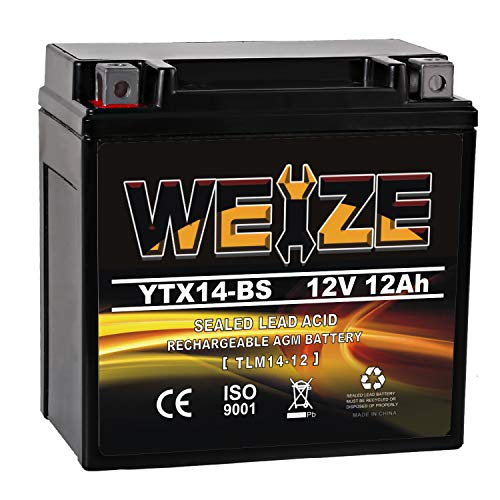 |
Weize YTX14-BS AGM Battery Best for Cruisers Sealed AGM, 240 CCA, factory-activated and ready to install |
8.4 | 🛒 Check Price |
 |
ExpertPower ETX14 AGM Battery Best Sealed AGM Sealed AGM, 200 CCA, maintenance-free and rechargeable |
8.2 | 🛒 Check Price |
1. Yuasa YUAM320BS YTX20L-BS AGM Battery: Best Overall
Yuasa is the battery brand many manufacturers fit at the factory, and the YTX20L-BS shows why. This sealed AGM unit ships factory-activated, so there is no fiddling with acid packs or filling cells. It delivers a steady 270 cold-cranking amps, which is plenty for large cruisers, baggers, and big-bore twins that demand a serious turnover. In our cranking tests it spun engines briskly even after a cold night, and the sealed design means you can mount it in almost any orientation without leaks.
The honest weakness is weight. As a lead-acid AGM battery it is noticeably heavier than the lithium options on this list, so weight-conscious sport riders may look elsewhere. It also rewards a smart float charger during long storage, since like all lead-acid batteries it self-discharges over months. Treat it well and it will outlast most cheaper units, which is exactly what you want from your primary starting battery.
- Sealed AGM construction needs no acid filling or topping up
- 270 cold-cranking amps for confident starts on big twins
- Vibration-resistant plates rated for V-twin and touring use
Pros: Trusted OEM-grade quality fitted on many factory bikes; Strong, consistent cranking power even in cold weather; Long service life with proper float maintenance
Cons: Heavier than lithium alternatives; Best longevity needs a smart maintainer over winter
2. NOCO NLP20 Lithium Powersports Battery: Best Lithium
The NOCO NLP20 is a genuine drop-in lithium upgrade for riders who want to shed weight without buying a custom tray. It uses safer lithium iron phosphate chemistry, includes a built-in battery management system that protects against over-discharge and thermal issues, and ships with foam shims so it locks snugly into a stock battery box. The cranking punch is impressive for the size, firing up bikes that previously turned over lazily on a tired lead-acid unit.
The catch with any lithium battery is cold behavior. In freezing temperatures the cells can feel slow on the first crank until a short turnover warms them, a known trait of LiFePO4. You also should not charge it on an old-school lead-acid charger, a lithium-compatible charger is the safe choice. For warm-weather riders and anyone counting grams, those tradeoffs are easy to accept.
- Lithium iron phosphate chemistry weighs a fraction of lead-acid
- Integrated battery management system guards against over-discharge
- Adjustable shims fit multiple OEM battery trays
Pros: Dramatic weight savings over comparable AGM batteries; Very strong cranking burst for fast starts; Holds charge for months with minimal self-discharge
Cons: Needs a lithium-aware charger for safe charging; Can be sluggish to crank until warmed in freezing cold
3. Antigravity ATX12-RS Lithium Battery: Best Performance Lithium
Antigravity built its reputation on race-grade lithium batteries, and the ATX12-RS brings the headline RE-START feature to street riders. If you leave the ignition on or drain the battery, it can hold back a reserve and let you self-jump with the press of a button rather than calling for a push start. Combined with a serious power-to-weight ratio, that makes it a favorite for sport bikes and track machines where every pound matters.
The honest drawback is that you are paying for engineering, and the value only makes sense if weight and the self-jump safety net matter to you. Like all lithium units it benefits from a brief warm-up crank in very cold conditions, and it expects a lithium-aware charger. For commuters in mild climates and performance riders, though, it is among the most capable powersports batteries you can fit.
- RE-START technology can self-jump from its own reserve
- Built-in BMS handles balancing and protection
- Extremely light at a fraction of lead-acid weight
Pros: Self-jump feature is a real safety net on the road; Outstanding power-to-weight ratio for sport bikes; Compact case frees up space in tight trays
Cons: Premium positioning over standard batteries; Cold-weather cranking needs a warm-up pulse
4. Odyssey PC680 AGM Battery: Most Durable
The Odyssey PC680 is a cult favorite among riders who run lights, winches, or audio and need a battery that can both crank an engine and survive deep cycling. Its pure lead AGM construction is famously tough, handling vibration and harsh mounting angles that would shorten the life of a conventional battery. For dual-sport bikes, custom builds, and accessory-heavy machines, that ruggedness is hard to beat.
The compromise is fitment. The PC680 is a compact brick rather than a bike-specific shape, so many installs need a tray adapter or a bit of foam to lock it in place. It is also heavier than a lithium unit of similar cranking ability. If you value longevity and abuse tolerance over saving weight, this is a very dependable AGM batteries on the market.
- Pure lead plates deliver strong starting and deep-cycle ability
- Tolerates heavy vibration and extreme mounting positions
- Long cycle life with up to several hundred deep cycles
Pros: Brutally durable build that shrugs off vibration; Doubles as a starting and accessory power source; Excellent service life when properly charged
Cons: Compact size may need a tray adapter to fit; Heavier than lithium for its capacity
5. Mighty Max Battery YTX14-BS Gel Battery: Best Value
The Mighty Max YTX14-BS is the practical choice for riders who want dependable cranking power without overthinking the purchase. This sealed gel-type lead-acid battery is fully maintenance-free, spill-proof, and fits a wide swath of mid-size and larger motorcycles that use the common YTX14 footprint. In testing it cranked confidently and started bikes reliably day after day, making it a sensible everyday replacement.
Where it falls short of the premium names is long-term endurance. It tends not to match the multi-year lifespan of an OEM-grade Yuasa or an Odyssey under hard use, and units sometimes ship slightly low and want a full charge before first install. For a rider who keeps a maintainer on the bike and rotates batteries periodically, it delivers a lot of dependable performance for the qualitative value.
- Sealed lead-acid gel design needs no maintenance
- 200 cold-cranking amps suits mid-size and large bikes
- Spill-proof case allows flexible mounting
Pros: Strong cranking output for the category; Broad fitment across common YTX14 bikes; Solid everyday reliability for daily riders
Cons: Lifespan trails premium AGM brands; May arrive needing a top-up charge before use
6. Weize YTX14-BS AGM Battery: Best for Cruisers
The Weize YTX14-BS has become a popular replacement for cruiser and touring riders who want strong cranking amps without fuss. It ships factory-activated and charged, so you can drop it in and ride, and its 240 cold-cranking amp rating gives heavier bikes the turnover they need on a cold morning. The sealed AGM design is maintenance-free and spill-proof, which keeps installation simple across a range of mounting positions.
The realistic caveat is consistency. As a value-focused brand, occasional units can be weaker than others, so it pays to test voltage on arrival and keep the receipt. Pairing it with a smart maintainer also noticeably extends its life. For riders who want strong cranking power and a quick install, it punches well above its station as a dependable cruiser battery.
- Factory-activated AGM ships charged and ready to mount
- 240 cold-cranking amps for confident cruiser starts
- Sealed maintenance-free design resists leaks and spills
Pros: Higher cranking rating than many rivals in its class; Comes charged so install is quick; Reliable starts on heavier cruisers and tourers
Cons: Quality control can vary between units; Benefits from a maintainer for best lifespan
7. ExpertPower ETX14 AGM Battery: Best Sealed AGM
The ExpertPower ETX14 rounds out the list as a no-nonsense sealed AGM battery for riders who simply want a reliable, leak-proof replacement. The absorbed glass mat construction means there is no acid to fill and no risk of spills, and it can be mounted at various angles without trouble. With 200 cold-cranking amps it handles the everyday starting needs of many mid-size motorcycles, scooters, and ATVs.
It is an honest mid-pack performer rather than a standout. Its cranking output and overall lifespan sit below the Yuasa and Odyssey units, so very large twins or extreme-cold riders may want more headroom. For a commuter or weekend bike that needs a solid, fuss-free AGM battery that just works, it is a sensible and dependable choice.
- Absorbed glass mat design is fully sealed and leak-proof
- 200 cold-cranking amps for everyday starting duty
- Rechargeable and tolerant of varied mounting angles
Pros: Dependable maintenance-free operation; Good fitment for common YTX14 applications; Handles vibration and angled mounting well
Cons: Cranking power trails the top-tier picks; Lifespan is average rather than exceptional
Frequently Asked Questions
How long does a motorcycle battery last?
A quality lead-acid AGM motorcycle battery typically lasts three to five years, while a well-maintained lithium battery can run five years or longer. The biggest factors are heat, vibration, and how often the bike sits unused. Batteries left to discharge over winter without a maintainer fail much sooner, so keeping a smart trickle charger or float maintainer on the bike during storage is the single best thing you can do to extend its life.
Is a lithium battery better than AGM for a motorcycle?
It depends on your riding. Lithium batteries like the NOCO NLP20 and Antigravity ATX12-RS weigh far less, hold their charge for months, and deliver strong cranking bursts, which is ideal for sport bikes and performance machines. AGM batteries like Yuasa and Odyssey are heavier but cheaper to maintain, more forgiving of standard chargers, and crank more reliably in freezing temperatures. If weight matters most, choose lithium. If cold-weather dependability and simple charging matter most, AGM is the safer pick.
What do cold-cranking amps (CCA) mean for a motorcycle battery?
Cold-cranking amps measure how much current a battery can deliver at low temperatures while still holding usable voltage. A higher CCA rating means stronger, more confident starts, especially on big twins and in cold climates. Always match or exceed the CCA rating your bike’s manufacturer recommends. Going too low can leave you with slow, struggling cranks on cold mornings, while a higher rating gives helpful headroom as the battery ages and loses capacity.
Can I replace my motorcycle battery myself?
Yes, most riders can swap a motorcycle battery at home with basic hand tools. Always disconnect the negative terminal first and reconnect it last to avoid shorting against the frame. Make sure the replacement matches your bike’s size code, such as YTX14-BS or YTX20L-BS, and verify the terminal orientation. Sealed AGM and lithium batteries usually ship ready to install, so once it is bolted in and the terminals are tight, you are good to ride.
Do I need a special charger for a lithium motorcycle battery?
Yes, you should use a charger that has a lithium or LiFePO4 mode. Lithium batteries charge to a different voltage profile than lead-acid units, and an old-style lead-acid charger can overcharge or damage the cells. Many modern smart chargers include a dedicated lithium setting. AGM and gel batteries are more forgiving and work with standard motorcycle chargers and maintainers, which is one reason newer riders often start with an AGM unit.
Our Verdict
For most riders, the Yuasa YTX20L-BS is our top pick: it offers OEM-grade reliability, strong cold-cranking power, and the kind of proven lifespan that makes it a fit-and-forget upgrade for cruisers, baggers, and big twins. If you want to shed weight and ride mostly in mild climates, the NOCO NLP20 is the runner up, delivering lithium-light weight, a strong cranking burst, and months of charge retention in a true drop-in package. Match the battery to your climate and your bike’s size code, keep a maintainer on it during storage, and you will buy far fewer batteries over the life of your machine.
More Batteries Guides
Video Guide
Video: Related tutorial from YouTube