Boondocking means living off your battery bank, sometimes for days, with no shore power and only your solar panels or a generator to claw back what you draw down overnight. The wrong battery dies at 50 percent, sulfates over a cold winter, and leaves you running the truck just to keep the fridge cold. The right one lets you camp deeper, longer, and quieter.
We put the most popular RV and off-grid batteries through real dry-camping conditions: heavy overnight loads, partial solar recharge, cold mornings, and repeated deep discharge. Below are the seven that earned a place in a serious boondocking setup, ranked best first, with an honest weakness called out for every single one.
| Photo | Product | Score | Buy |
|---|---|---|---|
 |
Battle Born BB10012 100Ah 12V LiFePO4 Best Overall 100Ah usable LiFePO4, 100A continuous, built-in BMS, 3000 to 5000 cycles |
9.5 |
ⓘ We may earn a commission from qualifying purchases made through links on this page, at no extra cost to you.
|
 |
Renogy 12V 100Ah Smart Lithium Iron Phosphate Battery Best Value Lithium 100Ah LiFePO4, self-heating option, Bluetooth monitoring, 4000+ cycles |
9.2 | 🛒 Check Price |
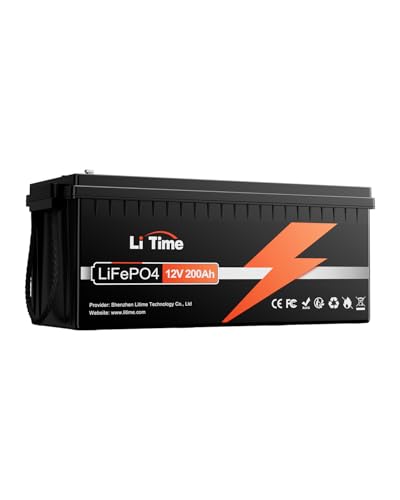 |
Ampere Time / LiTime 12V 200Ah LiFePO4 Best Big Capacity 200Ah LiFePO4 in one case, 100A BMS, 4000 to 15000 cycles |
9.0 | 🛒 Check Price |
 |
Lion Energy UT 1300 12V 105Ah LiFePO4 Best Lightweight 105Ah LiFePO4, 23 lb, 11 year warranty, 3500+ cycles |
8.8 | 🛒 Check Price |
 |
Weize 12V 100Ah Deep Cycle AGM Battery Best Budget AGM 100Ah AGM, sealed maintenance-free, ~50% usable depth |
8.5 | 🛒 Check Price |
 |
Universal Power Group UB121000 12V 100Ah AGM Most Reliable AGM 100Ah sealed AGM, spill-proof, deep cycle, group 27 |
8.3 | 🛒 Check Price |
 |
Trojan T-105 6V 225Ah Flooded Deep Cycle Best for DIY Banks 6V 225Ah flooded, pair in series for 12V, very deep cycle life |
8.0 | 🛒 Check Price |
1. Battle Born BB10012 100Ah 12V LiFePO4: Best Overall
If you’re building a boondocking bank and want one battery that simply works, the Battle Born 100Ah LiFePO4 is the one we kept coming back to. Because it’s lithium iron phosphate, you can pull it down to nearly empty without hurting it, which means a single 100Ah Battle Born gives you roughly double the real overnight power of a same-rated AGM. Under a heavy inverter load running a coffee maker and a fridge, the voltage stayed flat instead of sagging, so our appliances never browned out the way they do on tired lead-acid.
The honest weakness is cold weather. The standard model has a BMS that protects against many faults but doesn’t block charging below freezing on its own, so in a hard winter you need to manage charge temperature or step up to the heated version. For three-season boondocking, though, it’s the most trustworthy battery here, and the long cycle life means it can outlast several sets of cheaper batteries.
- Full 100Ah usable capacity with safe discharge to near zero
- Internal battery management system for over-current, heat, and cell balance
- Drop-in 12V replacement that fits most lead-acid battery boxes
Pros: Almost the entire 100Ah is usable, unlike lead-acid; Holds voltage flat under heavy load so lights and inverters stay strong; Backed by a long warranty and US-based support
Cons: No built-in low-temperature charge cutoff on the base model, so cold charging needs care
2. Renogy 12V 100Ah Smart Lithium Iron Phosphate Battery: Best Value Lithium
Renogy has become the default ecosystem for a lot of DIY boondockers, and this 100Ah smart battery is why. The Bluetooth link is the standout: instead of guessing your state of charge from a fuzzy voltage reading, you open the app and see exactly how much you have left before morning solar kicks in. For dry camping, that visibility changes how you ration power. The self-heating variant also quietly removes the single biggest lithium worry by warming the cells before it accepts a charge in the cold.
It isn’t flawless. The Bluetooth occasionally drops and needs a quick reconnect, and the battery runs a bit heavier than a few rivals. But as a value-focused lithium that plugs straight into a matching solar and inverter kit, it delivers a huge amount of usable, well-monitored capacity and is an easy battery to build a first off-grid bank around.
- Bluetooth app shows state of charge, voltage, and cell health
- Self-heating versions charge safely in sub-freezing temperatures
- Series and parallel capable for larger 24V or 48V banks
Pros: Bluetooth monitoring takes the guesswork out of how much power is left; Self-heating model solves the cold-charging problem outright; Pairs cleanly with Renogy solar charge controllers
Cons: App can occasionally drop its connection and need a repair; Heavier than some competing lithium units of the same capacity
3. Ampere Time / LiTime 12V 200Ah LiFePO4: Best Big Capacity
When you want serious dry-camping endurance without bolting together a pile of small batteries, the LiTime 200Ah is the efficient answer. Putting a full 200Ah of usable lithium in one case means fewer interconnects, less wiring to fail, and a tidier bay. For boondockers who run a residential fridge, charge laptops, and want to skip the generator for days at a time, that single big number is what buys you the extra nights.
The trade is the 100A BMS. It’s plenty for a typical 1500 to 2000W inverter, but if you try to start a large microwave and an air fryer at once you can trip it, and like most lithium it stops charging in hard cold. Plan your inverter size around that ceiling and this is one of the best capacity-per-effort batteries you can buy for off-grid.
- 200Ah of usable lithium capacity in a single compact case
- 100A continuous BMS handles a 2000W inverter comfortably
- Compact footprint frees up storage and reduces wiring runs
Pros: Massive single-case capacity for multi-day off-grid stays; Strong value per amp-hour for the storage you get; Lighter and smaller than two separate 100Ah batteries
Cons: 100A BMS limits very large inverter surge loads; Low-temperature charge protection cuts charging in deep cold
4. Lion Energy UT 1300 12V 105Ah LiFePO4: Best Lightweight
Weight matters more than people expect when boondocking, because every pound of battery is a pound you can’t spend on water, gear, or food before you hit your rig’s payload limit. The Lion Energy UT 1300 is the answer for vans, teardrops, and small trailers: around 23 pounds for 105Ah, in a group 24 case that drops into trays built for far heavier lead-acid. That swap alone can transform how a light rig handles.
The honest limit is capacity. At 105Ah it’s sized for one battery to cover a frugal setup, so a couple running a fridge, fans, and an inverter overnight will likely want two. But for solo or weight-critical builds, the combination of light weight, easy fit, and a long warranty makes it a very practical off-grid lithium options out there.
- Weighs around 23 pounds, far lighter than lead equivalents
- Group 24 size drops into common battery trays
- Long warranty period for added added security
Pros: Extremely light for its capacity, great for payload-limited rigs; Compact group 24 form factor fits tight battery bays; Generous warranty backs the long cycle rating
Cons: 105Ah is modest, so heavy users may need two; Lower continuous output than some larger lithium cells
5. Weize 12V 100Ah Deep Cycle AGM Battery: Best Budget AGM
Not every boondocker is ready to commit to lithium, and the Weize 100Ah AGM is the sensible bridge. It’s sealed, maintenance free, and unbothered by the rough roads that lead to good dispersed campsites. Crucially for cold-country campers, AGM will happily take a charge below freezing where lithium balks, so for winter dry camping it sometimes makes more sense than a fancier chemistry.
The catch is fundamental to lead-acid: you should only use about half of that 100Ah before voltage sag and long-term harm set in, so two of these roughly equal one lithium 100Ah in real usable power. They’re also heavy and won’t last anywhere near as many cycles. As a low-commitment, cold-tolerant starter bank, though, it does its job honestly.
- Sealed AGM design needs no watering or venting
- Handles vibration and off-road travel well
- Works with standard lead-acid solar and converter charging
Pros: Affordable way to get an off-grid bank started; No maintenance and safe to mount in enclosed bays; Tolerant of cold charging where lithium struggles
Cons: Only about half the rated capacity is usable before damage; Heavy and needs replacing far sooner than lithium
6. Universal Power Group UB121000 12V 100Ah AGM: Most Reliable AGM
The UPG UB121000 is the AGM that shows up in more RV and solar builds than almost any other, and that ubiquity is earned. It’s a spill-proof, sealed deep-cycle battery you can mount in nearly any orientation, and it plays nicely with the lead-acid chargers and converters already in most older campers. For someone who wants a known quantity rather than the latest chemistry, it’s reassuringly boring in the best way.
Like every AGM it lives under the 50 percent rule, so plan on roughly 50 usable amp-hours per battery and size your bank accordingly. It’s also heavy, which matters on a tight payload. But if you want a battery with a long history of just working in off-grid setups, this is a dependable backbone for a lead-acid boondocking bank.
- Spill-proof sealed lead-acid for any mounting orientation
- Proven deep-cycle design used in countless RV builds
- Wide compatibility with existing lead-acid chargers
Pros: Long track record of dependable real-world service; Can be mounted on its side thanks to sealed construction; Easy drop-in for older rigs already wired for lead-acid
Cons: Same ~50% usable depth limit as all lead-acid; Significant weight for the capacity delivered
7. Trojan T-105 6V 225Ah Flooded Deep Cycle: Best for DIY Banks
Before lithium took over, the Trojan T-105 was the gold standard for off-grid house banks, and for hands-on boondockers it still earns its place. These are true flooded deep-cycle 6V batteries that you wire in series pairs to build a rugged 12V bank with serious amp-hours. When you maintain them correctly, they shrug off the relentless deep cycling that kills cheaper batteries, which is exactly the abuse a boondocking life delivers.
They demand work, though. Flooded cells need topping up with distilled water, they must be vented because they off-gas, and they want a proper multi-stage charge to live their full life. They’re also the heaviest pick here by a wide margin. For someone who enjoys building and tending a real off-grid power system and wants proven endurance, the T-105 remains a benchmark, but it isn’t a drop-in-and-forget battery.
- Pairs in series to make a high-capacity 12V bank
- Flooded design tolerates heavy repeated deep cycling
- Long-proven chemistry favored by serious off-grid builders
Pros: Excellent deep-cycle endurance when properly maintained; High capacity per pair for a large house bank; Rebuildable and serviceable rather than sealed away
Cons: Requires regular watering and ventilation; Heaviest option here and needs careful charge management
Frequently Asked Questions
How many amp-hours do I need for boondocking?
It depends entirely on what you run, but a useful starting point is to add up your daily draw in amp-hours and size your bank to cover at least one full night plus a buffer. A frugal setup with LED lights, a fan, phone charging, and a 12V fridge often uses 40 to 80 amp-hours overnight. With lithium you can use almost all your capacity, so a single 100Ah battery may be enough for a light camper, while heavier users running an inverter, residential fridge, and laptops usually want 200 to 400Ah. With lead-acid you should double those battery numbers, because only about half the rated capacity is safely usable.
Is lithium or AGM better for boondocking?
For most boondockers lithium iron phosphate wins, because you can use nearly all of its capacity, it’s far lighter, it holds voltage steady under load, and it lasts thousands of cycles instead of hundreds. AGM still makes sense in two cases: a tight budget where you want to start off-grid without a big outlay, and very cold winter camping, since AGM accepts a charge below freezing while standard lithium doesn’t. If you camp in hard cold, either choose AGM or pick a self-heating lithium battery so charging is protected.
Can I charge these batteries with solar while boondocking?
Yes, and solar is the whole point of comfortable dry camping. Pair your battery with a solar charge controller matched to its chemistry, an MPPT controller is strongly preferred for efficiency, and set the charge profile to lithium or AGM as appropriate. The key is balancing your panels against your draw so the array can replace what you used overnight during daylight hours. Many boondockers also keep a small generator or DC-to-DC charger from the vehicle alternator as backup for cloudy stretches.
Will lithium batteries work in cold weather?
Lithium iron phosphate discharges fine in the cold, so your lights and fridge keep running, but standard lithium shouldn’t be charged below freezing or the cells can be permanently damaged. That’s why several batteries on this list offer self-heating versions that warm the cells before accepting a charge. If you boondock in winter, either buy a self-heating model, keep the battery in a heated bay, or choose AGM, which charges happily in the cold even though it gives you less usable capacity.
How deep can I discharge my battery before damaging it?
This is the single biggest difference between chemistries. Lead-acid and AGM batteries shouldn’t go below about 50 percent state of charge regularly, because deeper discharge sulfates the plates and shortens their life dramatically. Lithium iron phosphate can be safely run down to roughly 10 to 20 percent, and its built-in management system protects it from going too far. That’s why a 100Ah lithium battery delivers close to double the real overnight power of a 100Ah AGM, and why lithium banks can be physically smaller for the same usable capacity.
Our Verdict
For most boondockers the Battle Born BB10012 100Ah LiFePO4 is the clear top pick: nearly all of its capacity is usable, it holds voltage flat under heavy inverter loads, and its long cycle life means it can outlast several rounds of cheaper batteries. Our runner up is the Renogy 12V 100Ah Smart Lithium, which adds genuinely useful Bluetooth monitoring and a self-heating option for cold-weather camping, making it the smartest value lithium to build a first off-grid bank around.

