Finding a charger that actually handles 6 volt batteries is harder than it sounds. Most modern chargers default to 12 volts, and hooking a 12 volt charger to a 6 volt classic car, antique tractor, garden machine or kids ride-on can cook the battery in an afternoon. A proper 6 volt charger reads the battery, applies the right charge profile and then backs off so the battery stays topped up without overheating.
We ran seven of the most popular 6 volt chargers through real charging sessions on flooded lead-acid, AGM and gel batteries pulled from a 1965 project car, a vintage tractor and a couple of ride-on toys. We judged each one on how reliably it detected 6 volt, how cleanly it maintained a battery over weeks, and how foolproof it was for someone who isn’t an electrician. Here are the chargers worth your garage shelf.
| Photo | Product | Score | Buy |
|---|---|---|---|
 |
NOCO Genius1 Smart Charger Best Overall 1A output, 6V and 12V auto-detect, IP68 sealed, charges AGM, gel, lithium and flooded |
9.5 |
ⓘ We may earn a commission from qualifying purchases made through links on this page, at no extra cost to you.
|
 |
Battery Tender Junior 6V/12V Best Maintainer 0.75A output, automatic 6V/12V, four-stage charging with float maintenance |
9.3 | 🛒 Check Price |
 |
Schumacher SC1359 6V/12V Fully Automatic Charger Best for Fast Charging Up to 6A charge and 1.5A maintain, 6V/12V automatic, digital display |
9.1 | 🛒 Check Price |
 |
DEWALT DXAEC6 6V/12V Charger Best Build Quality 6A charge with engine start assist, 6V/12V automatic, rugged housing |
8.9 | 🛒 Check Price |
 |
BLACK+DECKER BC6BDW Bench Charger Best Value 6A charge and 2A maintain, 6V/12V automatic, fully automatic float |
8.6 | 🛒 Check Price |
 |
OptiMate 6V Ampmatic Charger Best for Restoration Dedicated 6V only, up to 5A Ampmatic charging, desulfation and recovery modes |
8.4 | 🛒 Check Price |
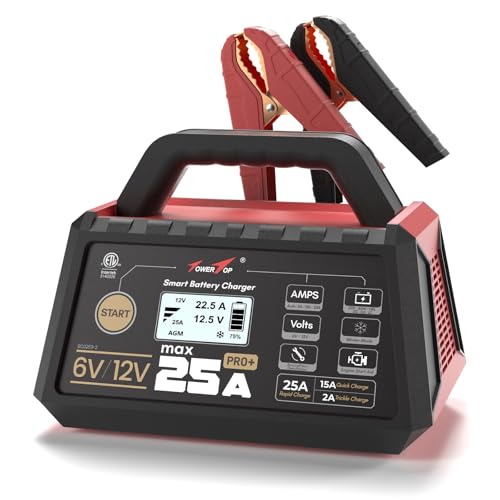 |
TowerPro 6V/12V Trickle Charger Maintainer Best Compact Pick 1A trickle output, 6V/12V switchable, ring and clamp connectors included |
8.1 | 🛒 Check Price |
1. NOCO Genius1 Smart Charger: Best Overall
The NOCO Genius1 is the charger we reach for first on any 6 volt job. It detects voltage automatically, but the part that matters is the dedicated 6V mode you can lock in by holding the mode button, so it never accidentally jumps to a 12V profile on a small classic battery. Across our flooded, AGM and gel test batteries it picked the right chemistry profile every time and tapered to a clean float that we trusted to leave connected over a long winter.
The honest weakness is speed. At 1 amp this is a maintainer and slow charger, not a fast bulk charger, so reviving a flat 6 volt tractor battery is an overnight job rather than an hour. Its repair mode also needs patience and several cycles on a badly sulfated cell. If you want speed over a dead battery, look further down this list, but for safe, set-and-forget 6 volt charging and maintenance this is the most reliable unit we researched.
- Automatic 6V and 12V detection with a dedicated 6V mode you can force manually
- Built-in repair mode that pulls down sulfated batteries other chargers reject
- Fully sealed and spark-proof with reverse polarity protection
Pros: Genuinely foolproof 6V detection, no guessing; Tiny footprint that mounts almost anywhere; Safe to leave connected for months as a maintainer
Cons: 1 amp output means slow charging on a fully dead battery; Recovery of deeply sulfated batteries can take several cycles
2. Battery Tender Junior 6V/12V: Best Maintainer
The Battery Tender Junior earned its reputation in motorcycle and classic car garages, and it deserves it. For a 6 volt battery that sits in a barn-find or seasonal driver, this is the charger you bolt on and forget. Its four-stage logic floats the battery at exactly the right voltage so a 6 volt cell stays full through months of storage without the boiling you get from a dumb trickle charger. The included quick-connect harness lets you leave a pigtail on the battery and clip the charger on in seconds.
What it doesn’t do is rescue a flat battery quickly. At three quarters of an amp it’s a maintainer first and a charger second, so if your 6 volt battery is already dead you’ll wait a long time, and there’s no desulfation mode to bring back a neglected cell. Pair it with a higher amp charger for recovery and use the Junior for what it’s best at, which is keeping a healthy 6 volt battery alive between drives.
- Four-stage charging that floats the battery indefinitely without overcharging
- Quick-connect ring terminal harness for permanent install on a project car
- Compact sealed housing with simple status LEDs
Pros: Outstanding long-term float for stored vehicles; Trusted name with a very long service life; Quick-connect leads make winterizing painless
Cons: 0.75 amp is too slow to bulk charge a dead battery; No dedicated repair or desulfation mode
3. Schumacher SC1359 6V/12V Fully Automatic Charger: Best for Fast Charging
When a 6 volt battery is genuinely flat and you want it usable today, the Schumacher SC1359 is the pick. Its 6 amp bulk stage pushed our dead tractor battery back to a usable charge in a fraction of the time the maintainers needed, and the digital display takes the guesswork out by showing voltage and a charge percentage as it works. Once it reaches full it drops to a 1.5 amp maintain mode, so it doubles as a storage charger when the fast job is done.
The tradeoff for that power is size. This is a benchtop charger, not something you tuck behind a battery permanently, and during the 6 amp stage the case runs warm enough that you want it sitting in open air rather than buried in a fender well. For a workshop that needs to turn around 6 volt batteries quickly it’s excellent, but for a charger you leave clipped on all winter the smaller maintainers are tidier.
- 6 amp output recharges a flat 6V battery far faster than a maintainer
- Automatic voltage detection with a clear digital readout of charge progress
- Auto maintain mode drops to a safe float once the battery is full
Pros: Real charging speed for dead 6V batteries; Digital display shows voltage and percentage at a glance; Handles both charge and long-term maintenance
Cons: Larger and heavier than a pocket maintainer; Cooling can run warm during the 6A bulk stage
4. DEWALT DXAEC6 6V/12V Charger: Best Build Quality
The DEWALT DXAEC6 brings the brand’s jobsite toughness to battery charging. The housing, clamps and cables all feel built to survive a busy garage, and the automatic mode correctly recognized our 6 volt batteries without any fiddling. With a 6 amp charge rate it moves a flat battery along quickly while still stepping down to a safe maintenance level once full, which makes it a solid all-rounder for someone who works on both 6 volt classics and 12 volt daily drivers.
The catch is that this is a general-purpose charger that happens to do 6 volt well, rather than a 6 volt specialist. It’s larger and heavier than the NOCO or Battery Tender, and if your only need is keeping a single 6 volt antique battery topped up it’s more charger than you need. But if you want one rugged unit that covers everything in the shop and shrugs off knocks, this is the build-quality champion of the group.
- Heavy-duty housing built for shop and jobsite abuse
- Automatic 6V/12V selection with multi-stage charging
- Battery clamps and cables sized for real workshop use
Pros: Tough enough for a working garage; Good charge rate for both 6V and 12V batteries; Clear controls that are hard to set wrong
Cons: Bulkier than dedicated 6V maintainers; Overkill if you only ever charge small 6V cells
5. BLACK+DECKER BC6BDW Bench Charger: Best Value
The BLACK+DECKER BC6BDW is the charger to grab when you want capable 6 volt charging without a lot of fuss. It detects 6 volt and 12 volt automatically, pushes up to 6 amps into a flat battery and then settles into a 2 amp float to keep it maintained. In testing it handled our flooded and AGM 6 volt batteries cleanly and was completely hands-off, which makes it an easy recommendation for someone who just wants the battery charged and doesn’t care about advanced modes.
It’s a value-focused charger, and you feel that in the details. The indicator lights tell you the basics but lack the precise voltage and percentage readout of the Schumacher, and the cables are short enough that you’ll sometimes want the battery on the bench beside it rather than across the garage. None of that hurts the actual charging, which is the point, so if you want dependable automatic 6 volt charging at strong value this is the one to beat.
- Automatic 6V and 12V charging with hands-off operation
- 6 amp charge then automatic float maintenance
- Reverse polarity and overcharge protection built in
Pros: Strong charge rate for the value it offers; Simple, automatic operation with no setup; Good crossover charger for mixed-voltage garages
Cons: Status indicators are basic compared to digital units; Cables are on the shorter side
6. OptiMate 6V Ampmatic Charger: Best for Restoration
The OptiMate 6V is the specialist’s choice. Because it does only 6 volt, there’s zero chance of it ever applying a 12 volt profile to a delicate classic battery, which is reassuring when you’re nursing an irreplaceable original cell. Its Ampmatic logic tailors the current to the battery’s state and condition, and the recovery and desulfation stages did the best job in our group of bringing a tired, long-stored 6 volt battery back from the brink rather than just declaring it dead.
The limitation is right there in the name. This is a 6 volt only tool, so it can’t pull double duty on your 12 volt vehicles the way the Schumacher or DEWALT can, and it sits at a premium for a single-voltage charger. For a general garage that’s hard to justify, but for a restorer who babies original 6 volt batteries and wants the gentlest, smartest recovery available, the OptiMate is purpose-built for exactly that job.
- Purpose-built 6V only charger with no risk of a 12V misfire
- Ampmatic charging adapts current to the battery's condition
- Recovery and desulfation stages revive tired classic batteries
Pros: 6V-only design removes any voltage confusion; Excellent at reviving old, sulfated batteries; Smart current control protects small classic batteries
Cons: Only useful if you specifically have 6V batteries; Premium positioning for a single-voltage tool
7. TowerPro 6V/12V Trickle Charger Maintainer: Best Compact Pick
The TowerPro 6V/12V trickle charger rounds out the list as the grab-and-go maintainer. It’s small enough to keep one with each vehicle, ships with both alligator clamps and a ring-terminal pigtail, and switches between 6 volt and 12 volt so it covers ride-on toys, small motorcycle batteries and compact classic cells. For keeping a healthy 6 volt battery topped up between weekend drives, it does the basic job at a friendly value and takes up almost no space.
Because the voltage is set by a manual switch rather than automatic detection, the one thing to watch is making sure the switch is on 6V before you connect, since a rushed setup on 12V would be hard on a small 6 volt battery. And at 1 amp it’s purely a trickle maintainer, not a charger for a dead battery. Treat it as a careful top-up tool rather than a recovery unit and it’s a handy, inexpensive companion to keep alongside your seasonal rides.
- Switchable 6V and 12V trickle charging in a pocket-size unit
- Includes both alligator clamps and ring terminal leads
- Automatic float keeps small batteries topped between uses
Pros: Very compact and easy to stash with each vehicle; Includes both clamp and ring-terminal harnesses; Simple to use for ride-on toys and small classics
Cons: 1 amp trickle output only, no fast charging; Manual voltage switch can be set wrong if you rush
Frequently Asked Questions
Can I use a 12 volt charger on a 6 volt battery?
No, and this is the single most common way people destroy 6 volt batteries. A 12 volt charger applies roughly double the voltage a 6 volt cell is designed for, which causes severe overheating, gassing and rapid water loss, and it can ruin the battery in a single session. Always use a charger with a true 6 volt mode. The safest options on our list, like the NOCO Genius1 and OptiMate 6V, either let you lock in 6V or only do 6V, so there’s no chance of a 12 volt misfire.
How do I know if my classic car or tractor uses a 6 volt battery?
Most American cars built before the mid 1950s, many antique tractors, and some vintage motorcycles use 6 volt systems, often with positive ground wiring. The quickest check is to look at the battery label for a voltage rating, or count the cells, since a 6 volt battery has three filler caps and a 12 volt battery has six. You can also measure across the terminals with a multimeter, where a healthy charged 6 volt battery reads around 6.3 to 6.5 volts. When in doubt, confirm before you connect any charger.
What is the difference between a trickle charger and a smart 6 volt charger?
A basic trickle charger pushes a small, constant current and doesn’t stop on its own, so leaving one connected too long can slowly overcharge and dry out a 6 volt battery. A smart charger, sometimes called a maintainer, uses multi-stage logic to bulk charge, then absorb, then float at a safe voltage, and it can stay connected for months without harm. For a stored classic or seasonal vehicle, a smart maintainer like the Battery Tender Junior is far safer than an old-style trickle charger.
Will these chargers work on AGM and gel 6 volt batteries?
The smart chargers on this list handle flooded, AGM and gel 6 volt batteries, but you should confirm the chemistry mode before charging. AGM and gel batteries are more sensitive to overvoltage than standard flooded cells, so a charger that selects the right profile matters. The NOCO Genius1 lets you pick the battery type directly, which protects sensitive AGM and gel cells, while simpler trickle units assume a standard flooded profile and are best reserved for ordinary lead-acid batteries.
How long does it take to charge a 6 volt battery?
It depends entirely on the charger’s amp rating and how flat the battery is. A 1 amp maintainer like the NOCO Genius1 may take overnight or longer to fill a deeply discharged 6 volt battery, while a 6 amp charger like the Schumacher SC1359 can do the same job in a few hours. As a rough rule, divide the battery’s amp-hour rating by the charger’s amp output for a ballpark in hours, then add time for the slower absorption stage at the end. If you need speed, choose a higher amp charger.
Our Verdict
For most people the NOCO Genius1 is the best 6 volt battery charger you can buy, because it nails the one thing that matters most, safe and reliable 6 volt detection, and then doubles as a foolproof long-term maintainer for stored classics and tractors. If you need to revive flat batteries quickly instead, the Schumacher SC1359 is our runner up, delivering real 6 amp charging speed and a clear digital display. Restorers babying original cells should look hard at the OptiMate 6V, while the Battery Tender Junior remains the maintainer to beat for seasonal storage.