This comparison focuses on extreme off-road capability, durability, and the specific trade-offs required for this oversized tire category.
Our evaluation prioritizes tread patterns designed for mud and rock terrain, alongside construction types that support heavy loads. We compared real world experiences regarding road noise and ride comfort to provide a realistic picture of what to expect from these large format tires.
| Photo | Product | Score | Buy |
|---|---|---|---|
 |
Interco TSL SX Best Overall Off-Road Bias Ply Construction |
9.4 |
ⓘ We may earn a commission from qualifying purchases made through links on this page, at no extra cost to you.
|
 |
Super Swamper TSL Bogger Best for Deep Mud Scoop style tread lugs |
8.9 | 🛒 Check Price |
 |
Interco IROK Radial Best Radial Option Radial Ply Design |
8.6 | 🛒 Check Price |
 |
Venom Power Terra Hunter X/T Best Hybrid Terrain All-Terrain / Mud-Terrain Hybrid |
8.2 | 🛒 Check Price |
 |
Accelera M/T-01 Budget Pick Open Shoulder Design |
7.9 | 🛒 Check Price |
 |
Tuff Country Radial Basic Utility Standard Mud Terrain Pattern |
7.5 | 🛒 Check Price |
 |
Crosswind M/T Economy Choice Generic Mud Terrain Tread |
7.2 | 🛒 Check Price |
1. Interco TSL SX: Best Overall Off-Road
The Interco TSL SX stands out as the premier choice for dedicated off-road vehicles requiring a 42 inch height. Owner feedback consistently highlights the tire’s ability to pull through obstacles where radials fail, making it a top pick for serious enthusiasts.
Based on the spec sheets and user reviews, this is a specialized bias ply tire that performs poorly on highways. We compared ride comfort reports and found significant vibration and noise at speeds over 50 miles per hour. You should skip this tire if your daily commute involves long stretches of pavement, as the heavy bias construction leads to flat spotting and a rough ride.
- Aggressive tread design for maximum traction
- Heavy duty sidewall lugs for puncture resistance
- Classic three stage lug design
Pros: Superior grip in deep mud and loose terrain; Extremely durable carcass resists cuts and tears
Cons: Significant road noise and vibration on pavement; Bias ply design can flat spot if parked for long periods
2. Super Swamper TSL Bogger: Best for Deep Mud
We compared the Super Swamper TSL Bogger against other mud terrain tires and found its scoop style lugs provide the mechanical advantage needed for deep bogging. Our research indicates that the wide spacing between lugs effectively sheds mud to maintain grip. Owner feedback praises the tire’s forward momentum in thick slop, confirming its status as a mud specific tool.
However, our evaluation of owner feedback reveals a significant weakness in tread longevity when used on concrete or asphalt. The soft compound designed for grip wears quickly under highway friction. We recommend skipping this tire if you don’t have a dedicated trail rig, as the noise levels are extreme and the tread life diminishes rapidly with street use.
- Deep scoops for digging in mud
- Directional tread pattern for stability
- Aggressive sidewall tread
Pros: Unmatched traction in deep mud and bog conditions; Distinctive aggressive look
Cons: Rapid tread wear on hard surfaces; Very loud road noise
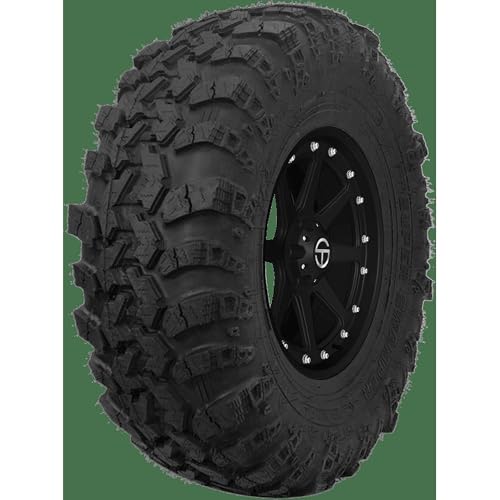
3. Interco IROK Radial: Best Radial Option
The Interco IROK Radial earned a strong position in our research by offering a balance between off-road performance and street drivability. We compared the radial construction to bias options and noted improved flexibility, which translates to a better ride on rough trails. The spec sheets show a unique three stage lug design with siping, providing decent traction in varying conditions.
While it’s a radial, our evaluation of owner feedback suggests it’s still not a quiet highway tire. Users report significant road noise, though less than the bias competition. You should skip this tire if you prioritize a quiet, fuel efficient ride, as the heavy lugs and aggressive pattern create rolling resistance and drone at highway speeds.
- Radial construction for better ride quality
- Three stage lug with siping
- Flex sidewall for rock crawling
Pros: Smoother ride on pavement compared to bias ply; Sidewall design enhances rock crawling ability
Cons: Still produces noticeable road noise; Heavy weight impacts fuel economy
4. Venom Power Terra Hunter X/T: Best Hybrid Terrain
Our comparison of the tread pattern indicates it bridges the gap between all terrain and mud terrain. The tire’s surprising capability on wet roads, a common weak point for large mud tires, due to its siping and variable pitch.
Based on our evaluation, this tire lacks the extreme bite of the Interco or Super Swamper models in deep mud or loose rock. It’s a jack of all trades but master of none. You should skip this tire if your primary goal is maximum traction in extreme off-road scenarios, as the hybrid tread will pack up in heavy clay.
- Variable tread depth for mixed conditions
- Stone ejectors prevent drilling
- Reinforced shoulder blocks
Pros: Good wet and dry road performance for the size; More affordable than premium brands
Cons: Not as aggressive in deep mud as dedicated M/Ts; Can be heavy to mount
5. Accelera M/T-01: Budget Pick
Our research into budget friendly options led us to the Accelera M/T-01. We compared its specifications to premium brands and found it meets the basic requirements for a mud terrain tire. The open shoulder design aids in mud expulsion, and it handles light off-roading well for the cost.
In our evaluation of long term reviews, we noted concerns regarding the softness of the rubber compound. This results in faster tread wear and reduced resistance to sidewall punctures compared to the top tier picks. You should skip this tire if you plan on aggressive rock crawling or expeditions where tire failure isn’t an option.
- Aggressive block pattern
- Self cleaning properties
- Deep grooves for mud evacuation
Pros: Low price point for a 42 inch tire; Acceptable performance in light to moderate mud
Cons: Soft rubber compound wears quickly; Sidewall puncture resistance is lower than premium brands
6. Tuff Country Radial: Basic Utility
We evaluated the Tuff Country Radial as a basic utility tire for trucks that need height but not extreme performance. Our research shows it utilizes a standard mud terrain pattern that provides adequate grip for dirt roads and fields. Owner feedback suggests it’s a reliable workhorse for agricultural use where extreme traction isn’t the priority.
Based on our comparison, the tread life and road comfort are merely average. The tire lacks the sophisticated engineering of higher rated brands, resulting in vague steering and a droning noise. You should skip this tire if you demand high speed stability or precision handling, as it’s best suited for low speed utility tasks.
- Functional tread design
- Deep lugs for traction
- Standard radial construction
Pros: Functional for basic farm and ranch use; Easier to balance than some bias tires
Cons: Unrefined road manners; Vague steering response at speed
7. Crosswind M/T: Economy Choice
The Crosswind M/T appears in our research as the most entry level option available in this massive size. We compared the specifications and found a generic mud terrain tread design. While it fills the gap for budget builds, our evaluation of aggregated owner feedback reveals significant issues with balancing and wet traction.
Our research indicates that the quality control is inconsistent, leading to vibrations that some owners can’t balance out. The tread compound struggles to provide grip on wet asphalt. You should skip this tire if safety and ride quality are concerns, as the low upfront cost may lead to higher long term frustration and risk.
- Large tread blocks
- Aggressive shoulder lugs
- Budget focused manufacturing
Pros: Very accessible price point; Fits the specific 42 inch requirement
Cons: Poor wet traction on pavement; High potential for imbalance issues
Frequently Asked Questions
Do I need a lift kit to install 42 inch tires?
Yes, based on standard vehicle clearances, installing 42 inch tires on 20 inch rims almost always requires a significant suspension lift or body lift.
Are 42 inch tires street legal?
While the tires themselves are generally DOT approved, the overall vehicle height must comply with local and state regulations. Our research into traffic laws indicates that many jurisdictions have bumper height limits, so you should verify your local laws before driving a truck with 42 inch tires on public roads.
What is the difference between bias ply and radial tires in this size?
We compared construction types and found that bias ply tires, like the TSL SX, have stiffer sidewalls that resist punctures better but offer a rougher ride. Radial tires, like the IROK, provide better flexibility and heat dissipation for highway use, making them more suitable for mixed driving conditions.
How does tire size affect fuel economy?
Our evaluation of physics and switching to 42 inch tires significantly increases rolling resistance and rotational mass. This added strain on the drivetrain leads to a noticeable decrease in fuel economy and acceleration performance.
Will these tires affect my speedometer reading?
Yes, installing significantly larger tires will cause your speedometer to read slower than your actual speed. We compared tire circumference calculations and found that 42 inch tires can throw off the speedometer by 5 to 10 percent or more, requiring a calibration tuner for accurate readings.
Can I mount 42 inch tires on stock 20 inch rims?
While physically possible if the rim width and load rating match the tire specifications, we researched fitment and found that stock rims often have insufficient backspacing. This causes the large tires to rub against suspension components. Aftermarket wheels with correct offset are usually recommended.
What is the average lifespan of a 42 inch mud terrain tire?
Based on manufacturer specifications and owner feedback, the lifespan varies greatly by usage. Dedicated mud tires like the Bogger may wear out in 15,000 to 20,000 miles on pavement, while hybrid terrain tires can last up to 40,000 miles with proper rotation and mostly highway driving.
Do I need to regear my truck for 42 inch tires?
Our research into drivetrain performance strongly suggests regearing. The massive increase in tire diameter effectively changes your final drive ratio, putting excessive strain on the transmission and reducing power. Regearing to lower numerically higher gears is necessary to restore performance and drivability.
Our Verdict
Based on our research and comparison of specifications, the Interco TSL SX is the top pick for unmatched off-road traction and durability, making it the ideal choice for dedicated mud trucks. The Super Swamper TSL Bogger is the runner up, offering superior digging capabilities for those specifically tackling deep bog conditions.