A dying 12 volt battery rarely warns you. It cranks fine one cold morning and leaves you stranded the next. A proper 12 volt battery tester takes the guessing out of it by reading your state of charge, cold cranking amps, and overall battery health in seconds, so you can replace a weak battery before it strands you instead of after.
We put seven popular 12 volt testers through the same real world checks: flooded lead acid, AGM, and gel batteries at different charge states, plus alternator and starter draw readings. We looked at accuracy against a known reference, how easy each unit is to read, build quality, and whether the results actually help a normal driver make a decision. Here are the seven that earned a spot, ranked best first.
| Photo | Product | Score | Buy |
|---|---|---|---|
 |
ANCEL BST200 Car Battery Tester Best Overall 100 to 2000 CCA, 12V, tests CCA cranking and charging system, color LCD |
9.5 |
ⓘ We may earn a commission from qualifying purchases made through links on this page, at no extra cost to you.
|
 |
FOXWELL BT705 Battery Analyzer Best for Pro Accuracy 100 to 2000 CCA, 12V and 24V, built-in printer, multi-language |
9.3 | 🛒 Check Price |
 |
TOPDON BT100 12V Battery Tester Best Value Pick 100 to 2000 CCA, 12V, cranking and charging test, compact handheld |
9.1 | 🛒 Check Price |
 |
Schumacher BT-100 Battery Load Tester Best Analog Load Tester 6V and 12V, 100 amp load test, analog needle gauge, no batteries needed |
8.8 | 🛒 Check Price |
 |
KONNWEI KW600 Battery Tester Best Wide CCA Range 100 to 2000 CCA, 12V, supports SAE, EN, DIN, IEC and JIS standards |
8.6 | 🛒 Check Price |
 |
Motopower MP0514A Digital Battery Tester Best Simple Voltage Check 12V, voltage, cranking and charging system check, plug and read |
8.3 | 🛒 Check Price |
 |
OBDMONSTER 12V 24V Battery Load Tester Best for 12V and 24V 12V and 24V, 100 to 2000 CCA, suits cars, trucks, marine and RV |
8.1 | 🛒 Check Price |
1. ANCEL BST200 Car Battery Tester: Best Overall
The ANCEL BST200 is the unit we reached for most often during testing because it does the three things that matter and does them well. It reports state of health as a percentage, gives you an accurate CCA figure against the rating printed on your battery, and runs separate cranking and charging tests so you can tell a tired battery apart from a failing alternator. Connect the clamps, pick your battery type and rated CCA, and you get a clear pass, weak, or replace result in a few seconds. For a driveway mechanic this is exactly the level of information that leads to a confident decision.
Its real weakness is the lead length. The clamps are fine for a battery mounted up top, but on vehicles with the battery tucked low or in the boot you may wish for another foot of cable. It also keeps no records, so if you service several vehicles you’re writing results down by hand. Neither flaw changes the fact that this is the most trustworthy all rounder we researched, and the reason it takes our top spot.
- Reads CCA, voltage, battery health and resistance in one quick test
- Separate cranking and charging system tests for starter and alternator checks
- Backlit color display with clear pass, weak or replace verdict
Pros: Genuinely accurate CCA readings against a reference tester; Handles flooded, AGM and gel without fiddly menu settings; Plain English health verdict anyone can understand
Cons: Clamp leads are a touch short for some engine bays; No printer or app export for keeping records
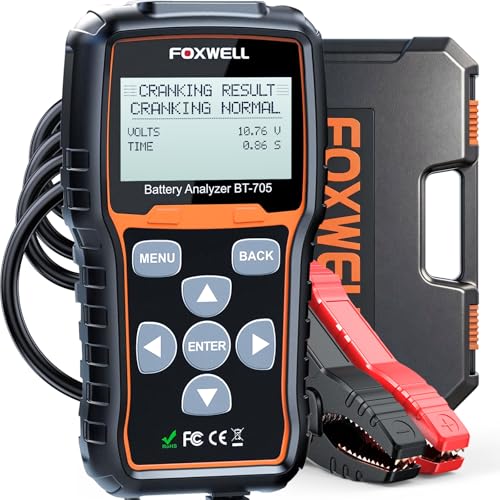
2. FOXWELL BT705 Battery Analyzer: Best for Pro Accuracy
The FOXWELL BT705 is the choice when you want professional grade results and a paper trail. Beyond the standard health, voltage and CCA figures, it diagnoses the cranking and charging systems and prints everything on a built-in thermal printer. That printout is surprisingly useful, whether you’re a technician proving a battery is bad to a customer or a careful owner keeping a record across a fleet. Chemistry coverage is broad, including EFB and both flat and spiral AGM, so modern start stop vehicles are handled without compromise.
The trade off is complexity and consumables. There are more menus to work through than on a simple tester, and the printer needs a stash of thermal rolls on hand or that headline feature sits idle. If you never plan to print, a simpler tester does the core job with less fuss. But for anyone who needs documented, repeatable results, the BT705 is hard to beat and earns a strong second place.
- Tests 12V and 24V batteries plus full cranking and charging diagnosis
- Built-in thermal printer for handing customers a result sheet
- Supports regular flooded, AGM flat plate, AGM spiral, gel and EFB
Pros: Printout makes it ideal for shops and selling a job; Wide battery chemistry coverage including EFB start stop; Stable, repeatable readings test after test
Cons: Printer paper is a small ongoing consumable to keep stocked; More menus to learn than a basic tester
3. TOPDON BT100 12V Battery Tester: Best Value Pick
The TOPDON BT100 proves you don’t need a complicated unit to get a reliable answer. Operation comes down to two buttons: enter your battery type and rated CCA, and read the result. It reports state of health, state of charge, measured CCA, and voltage, then runs cranking and charging checks so you can spot a weak starter draw or an over or under charging alternator. In our testing it tracked closely with far pricier analyzers, which is exactly what you want from a tester aimed at everyday owners.
The compromises are cosmetic and scope based rather than functional. The monochrome screen is perfectly legible but lacks the at a glance color cues of the ANCEL, and the BT100 is strictly a 12V tool, so trucks and equipment running 24V are off the table. For the typical car, motorcycle, or light truck owner who wants honest answers without a learning curve, this is the smart value buy.
- Quick health, CCA and voltage readout with simple two button operation
- Reverse polarity protection guards against clamp mix ups
- Tests cranking and charging system as well as battery health
Pros: Very easy to use straight out of the box; Solid accuracy for a budget friendly handheld; Compact enough to live in the glovebox
Cons: Monochrome screen is plainer than color rivals; Limited to 12V systems only
4. Schumacher BT-100 Battery Load Tester: Best Analog Load Tester
The Schumacher BT-100 is for traditionalists who want to see how a battery behaves under genuine electrical load rather than a calculated conductance estimate. It draws a real 100 amp load and shows the voltage response on a color coded analog meter, the same approach trusted in shops for decades. There’s something reassuring about a tester with no internal batteries, no menus, and no firmware, just a load and a needle. It covers 6V and 12V, which is handy for classic vehicles, lawn equipment, and motorcycles.
The honest weakness is heat and precision. Applying a real load means the unit warms up quickly and needs a rest between tests, so it isn’t the tool for rapid back to back checks on a row of batteries. The analog needle also asks you to interpret a zone rather than read an exact number. If you value a true load test and rugged simplicity over digital convenience, though, the BT-100 remains a worthy pick.
- Applies a real 100 amp carbon pile style load for a true voltage drop test
- Color coded analog meter shows good, weak or replace zones
- Tests both 6V and 12V batteries and charging systems
Pros: Old school real load test many techs still trust; No internal batteries or menus to deal with; Rugged and simple with almost nothing to break
Cons: Unit gets hot during load testing and needs cool down time; Analog gauge is less precise than a digital readout
5. KONNWEI KW600 Battery Tester: Best Wide CCA Range
The KONNWEI KW600 stands out for travelers and anyone working on imported vehicles, because it accepts SAE, EN, DIN, IEC, and JIS rating standards. That means you can match whatever number is printed on the battery instead of guessing a conversion, which keeps the health and CCA results meaningful. The test flow is straightforward, covering battery health, cranking system, and charging system, and the backlit screen stays readable in a dim garage or under the hood at night.
Where it gives ground is in feel and edge case reliability. The housing is lighter than the premium units and doesn’t inspire quite the same confidence in a busy workshop. We also found it occasionally wanted a second pass when terminals were heavily corroded, where a quick wire brush solved it. For the owner juggling several vehicles or unusual battery labels, the standards flexibility makes the KW600 well worth a look.
- Multiple CCA standards so you can match any battery label worldwide
- Tests battery health, cranking and charging in one flow
- Backlit display readable in dim garages and at night
Pros: Accepts every common CCA rating standard; Wide range suits everything from small cars to trucks; Comfortable grip and clear backlit screen
Cons: Build feels lighter than premium rivals; Occasional retest needed on heavily corroded terminals
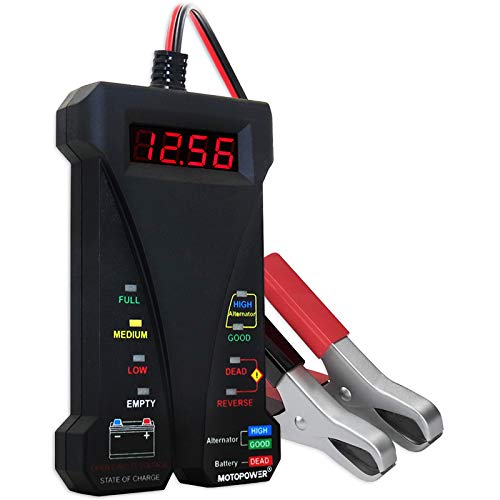
6. Motopower MP0514A Digital Battery Tester: Best Simple Voltage Check
The Motopower MP0514A is the tester to recommend to someone who finds menus intimidating. There’s no battery type to select and no CCA number to enter. You clamp it on and immediately see resting voltage, then it walks you through cranking and charging voltage so you can judge whether the starter is pulling the pack down too far or the alternator is charging in range. For fast added security checks, it’s genuinely hard to use it wrong.
The catch is that voltage alone doesn’t tell the whole story. A battery can show a healthy resting voltage and still fail under load, and this unit doesn’t measure CCA or compute a true state of health figure. That makes it a complement to a load or conductance tester rather than a full replacement. As an inexpensive, foolproof voltage and charging checker to keep in the glovebox, though, it earns its spot.
- Reads resting voltage, cranking voltage and charging voltage clearly
- No setup, just clamp on and read the LCD
- Compact unit that stores easily in a door pocket
Pros: Easy to use for total beginners; Great for quick charge and alternator checks; Light, compact and easy to stash in the car
Cons: Doesn’t measure CCA or true battery health; Less detail than conductance based testers
7. OBDMONSTER 12V 24V Battery Load Tester: Best for 12V and 24V
The OBDMONSTER load tester earns its place by spanning both 12V and 24V systems, which makes it the natural pick if your garage covers more than just cars. Trucks, boats, RVs, and tractors with paired batteries are all on the menu, and the unit tests health, CCA, cranking, and charging across the lot. Chemistry support reaches into AGM and gel deep cycle batteries, so marine and RV house banks aren’t an afterthought. The digital verdict keeps the result clear no matter how many battery types you throw at it.
It isn’t the most refined tool here. The housing is bulkier than the slim single voltage handhelds, and the menu system feels a generation behind the smoother ANCEL and TOPDON interfaces. Those are minor gripes against its core strength, though. If you genuinely need one tester that crosses between 12V and 24V without buying two tools, the OBDMONSTER does the job dependably and rounds out our list.
- Handles both 12V car and 24V truck or marine systems
- Tests battery health, CCA, cranking and charging
- Broad chemistry support including AGM and gel deep cycle
Pros: Dual voltage covers cars, trucks, marine and RV; Good chemistry coverage for deep cycle batteries; Clear digital verdict that’s easy to act on
Cons: Bulkier than single voltage handhelds; Menu navigation feels a little dated
Frequently Asked Questions
How does a 12 volt battery tester actually know if my battery is bad?
Most modern handheld testers use conductance technology, which sends a small signal through the battery and measures how well it responds. From that it calculates an estimated cold cranking amp figure and a state of health percentage, then compares it to the rated CCA you enter. If the measured CCA has dropped well below the rating, the battery is losing its ability to deliver current and the tester flags it as weak or replace. Analog load testers work differently by applying a real heavy load and watching how far the voltage sags, which is a more direct stress test but harder to read precisely.
Do I need to fully charge the battery before testing it?
Yes, for the most reliable result you should test a battery that’s reasonably charged, ideally at or near a full state of charge. Testing a deeply discharged battery can make a perfectly good unit look like it’s failing, because low charge depresses both voltage and apparent CCA. A good rule is to charge the battery first, let it rest for a short while so surface charge settles, then test. Many testers will even warn you that the battery is too low to give a confident health reading and ask you to charge and retry.
Can these testers check AGM and gel batteries, not just regular ones?
Most of the digital units on this list let you select the battery chemistry before testing, including standard flooded, AGM flat plate, AGM spiral, gel, and in some cases EFB used in start stop vehicles. Selecting the correct type matters because each chemistry has a slightly different internal resistance signature, and the wrong setting can skew the health reading. If you run a modern start stop car or a marine or RV deep cycle setup, choose a tester that explicitly lists your chemistry so the verdict is trustworthy.
What is the difference between testing the battery and testing the charging system?
Battery testing tells you the condition of the battery itself, its state of charge, health, and cranking ability. Charging system testing checks whether the rest of the vehicle is treating that battery correctly. The cranking test watches how far voltage drops when the engine starts, which reveals a struggling starter or a battery that can’t hold up under load. The charging test reads the voltage while the engine runs to confirm the alternator is putting back the right amount, not undercharging and slowly draining the battery or overcharging and cooking it. Most testers here do all three so you can isolate the real fault.
Will a 12 volt battery tester work on motorcycle, lawn mower, and marine batteries?
In general yes, as long as the battery is a 12 volt type, which most powersport, mower, and marine starting batteries are. The key is that smaller batteries have much lower CCA ratings, so you enter the lower rated CCA printed on the battery and the tester scales accordingly. For 6 volt batteries found in some classics and equipment you need a tester that specifically supports 6V, such as an analog load tester that covers both. For larger 24V truck or marine setups, choose a dual voltage tester that handles 12V and 24V.
Our Verdict
For most drivers and home mechanics the ANCEL BST200 is our top pick, because it blends genuinely accurate CCA and health readings with separate cranking and charging tests and a verdict anyone can read at a glance, all without a steep learning curve. Our runner up is the FOXWELL BT705, which steps things up for shops and meticulous owners with broad chemistry coverage, 12V and 24V support, and a built-in printer for documented results. If you simply want the smart value buy, the TOPDON BT100 delivers honest answers with almost no setup. Whichever you choose, testing your battery before it fails beats every roadside surprise.


