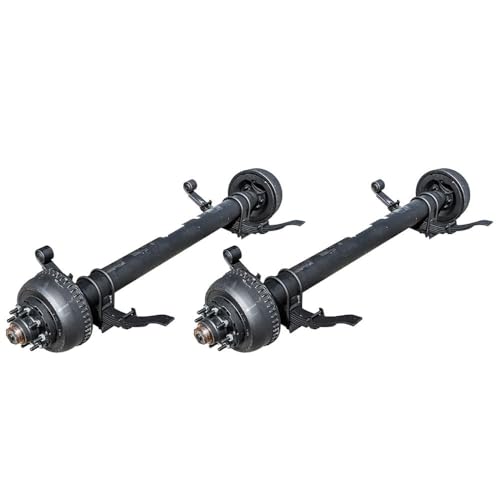
If you tow anything heavier than a small utility trailer, your truck’s brakes shouldn’t have to do all the work alone. A trailer brake controller is the small device that tells your trailer’s own brakes when to grab and how hard, which keeps your rig stable and your stopping distance sane. Here’s what these controllers actually do, the real difference between the two main types, and when the law says you need one.
What a trailer brake controller does
A brake controller is a small box that mounts under your dash and wires into both your truck’s brake system and the trailer’s electric brakes through the plug. When you press the brake pedal, the controller sends power back to the electromagnets on each trailer wheel so the trailer helps slow itself down instead of shoving your tow vehicle forward.
Without one, a loaded trailer relies entirely on the truck to stop everything. That means longer stopping distances, faster brake wear, and a much higher chance of the trailer pushing you around in an emergency stop. A good controller gives you:
- Shorter, steadier stops because both the truck and trailer brake together
- Less sway and push when you brake hard or head downhill
- A manual override lever so you can apply just the trailer brakes to settle a wobble
- Adjustable gain so you can dial braking power up for a heavy load or down for an empty trailer
Proportional controllers explained
A proportional controller, sometimes called an inertia-based controller, uses a small motion sensor to feel how quickly you’re actually slowing down. When you brake gently, it applies the trailer brakes gently. When you stomp the pedal, it sends strong braking to the trailer almost instantly so the whole rig slows as one unit.
Because the trailer brakes mirror what the truck is doing in real time, the towing feel is smooth and natural. Owners generally report less nose-diving, cooler trailer brakes, and far less of that jerky grab you get from cheaper setups. Most sensors self-level once installed, so you usually just set the gain and go.
Time-based controllers explained
A time-based controller, also called a timer or solenoid-based unit, ignores how hard you’re really stopping. The moment you touch the brake pedal, it ramps trailer braking power up at a fixed, preset rate until it hits the maximum you’ve dialed in. You choose how fast it ramps and how much power it reaches.
These units cost less and work with almost any vehicle, but they don’t adapt. If you brake softly for a red light, the trailer can still ramp up and grab as if it were an emergency stop, and in a true panic stop it may build power a beat slower than you’d like. Here’s the short version of how they stack up:
- Proportional: reacts to real deceleration, smoother and more responsive, better for frequent or heavy towing
- Time-based: ramps at a fixed rate, simpler and more affordable, fine for occasional light towing
- Both include a manual slide-out lever and adjustable output
If you tow often or haul serious weight, general guidance from experienced owners leans strongly toward proportional. For a rarely used light trailer, a time-based unit can still get the job done.
When your trailer legally needs one
Brake laws are set at the state level, so the exact rule depends on where you register and drive. That said, the pattern is pretty consistent across the country. Most states require a trailer to have its own working brakes once its loaded weight climbs into the low thousands of pounds, and heavier trailers often need brakes on every axle.
Here’s the key point people miss: the law requires the trailer brakes, and a brake controller is simply the piece that operates electric trailer brakes from the cab. So the practical rule of thumb is:
- If your trailer has electric brakes, you need a controller to use them, and you’re legally required to have working brakes above your state’s weight threshold.
- If your trailer has surge (hydraulic) brakes, those activate on their own and don’t use a dash controller.
- If your trailer is light enough to fall under the threshold and has no brakes at all, a controller isn’t required.
Always check your own state’s Department of Motor Vehicles rules before you tow, and remember that the state where you’re driving matters too, not just where the trailer is plated. When in doubt, having a controller and working trailer brakes is the safer and usually legal choice.
How to choose the right controller
Once you know your trailer uses electric brakes, picking a controller comes down to a few practical questions:
- How many axles? Match the controller to the number of braked axles it’s rated to handle.
- How often do you tow? Frequent or heavy towing rewards a proportional unit.
- Does your truck have a factory plug? Many newer trucks include a wiring harness that makes install nearly plug and play.
- Do you want it hidden? Some models tuck away out of sight, while others mount on the dash with a visible readout.
Whichever you choose, take a few minutes in an empty lot to set the gain. Roll at low speed, apply the brakes, and adjust until the trailer stops firmly without the wheels locking or skidding.
Frequently asked questions
Do I need a brake controller if my trailer has no brakes?
No. A controller only operates electric trailer brakes, so if your trailer has no braking system there’s nothing for it to control. Just confirm your trailer is light enough that your state doesn’t require brakes in the first place, since going over that weight without trailer brakes can be both unsafe and illegal.
Is a proportional controller always better than a time-based one?
For towing feel and stopping performance, proportional units generally win because they match the trailer’s braking to how hard you’re actually stopping. Time-based controllers still work and cost less, which can make them a reasonable pick for an occasional, lightly loaded trailer. If you tow regularly or haul heavy, most owners recommend spending up for proportional.
Will a brake controller work with surge brakes?
No. Surge brakes are hydraulic and activate on their own using the trailer’s momentum against a coupler, so they don’t need a dash-mounted controller. A controller is only for trailers fitted with electric or electric-over-hydraulic brakes.