Clean water is essential for any RV trip. We researched and compared the top RV water filters using manufacturer specifications, published industry standards (NSF/ANSI), and aggregated owner feedback. Our evaluation focuses on filtration performance, durability, ease of use, and safety to help you choose the best filter for your needs.
| Photo | Product | Score | Buy |
|---|---|---|---|
|
🚗
|
Camco TastePURE 40043 Best Overall NSF/ANSI 42 certified, reduces bad taste and odor, 20 micron sediment filtration |
9.0 | 🛒 Check Price |
|
🚗
|
Clear2O 20-225-01 Best for Lead Reduction NSF/ANSI 53 certified for lead reduction, 5 micron sediment filter |
8.7 | 🛒 Check Price |
 |
iSpring WGB22B Best Dual-Stage Two 10-inch filter housings, 5 micron sediment and carbon block, 1/4 inch ports |
8.4 | 🛒 Check Price |
 |
RVGUARD RV Inline Water Filter Best Budget Inline 20 micron sediment filter, reduces chlorine taste and odor, NSF/ANSI 42 certified |
8.1 | 🛒 Check Price |
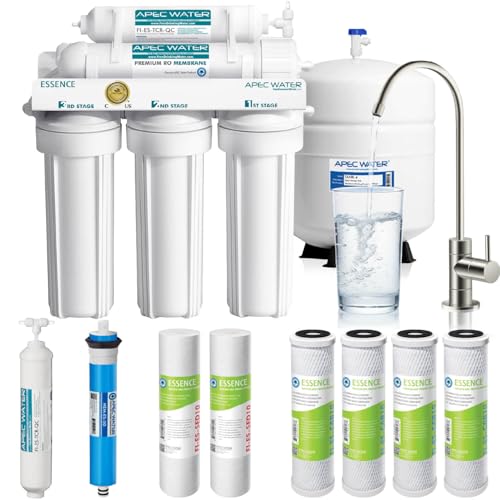 |
APEC Water Systems ROES-50 Best Reverse Osmosis 5-stage reverse osmosis, 50 gallons per day, removes up to 99% of contaminants |
7.8 | 🛒 Check Price |
|
🚗
|
Camco 40043W-1 Best for High Flow 20 micron, high flow rate up to 5 GPM, NSF/ANSI 42 certified |
7.5 | 🛒 Check Price |
|
🚗
|
Waterdrop WD-RV-01 Best Compact Design 0.5 micron carbon block, reduces chlorine, sediment, and some heavy metals |
7.2 | 🛒 Check Price |
1. Camco TastePURE 40043: Best Overall
The Camco TastePURE 40043 is a popular choice among RVers for its reliable performance and ease of use. It is certified to NSF/ANSI 42, meaning it effectively reduces chlorine taste and odor, along with sediment down to 20 microns. Based on owner feedback, it provides noticeably better-tasting water and installs in seconds with a simple twist-on connection. However, its filtration is basic: it does not address heavy metals, bacteria, or cysts, so it is best for those on municipal water supplies.
We recommend this filter for RVers who want an affordable, no-fuss solution for improving taste and clarity. Skip it if you need higher-level contaminant reduction, such as lead or microbial cysts, or if you frequently boondock with unknown water sources.
- Certified to NSF/ANSI 42 for chlorine taste and odor reduction.
- Compact inline design fits most RV water systems.
- Easy twist-on installation, no tools required.
Pros: Trusted brand with NSF certification.; Good value for basic filtration needs.
Cons: Does not reduce lead or cysts; limited to taste and sediment.
2. Clear2O 20-225-01: Best for Lead Reduction
The Clear2O 20-225-01 stands out for its lead reduction capability, certified under NSF/ANSI 53. Our research shows it uses a two-stage process: a 5 micron sediment pre-filter and a carbon block that targets chlorine, taste, and odor. Owner feedback highlights that it delivers noticeably cleaner water, especially in older RVs with lead pipes. However, some users report reduced water flow, which can be a drawback for filling tanks quickly.
This filter is ideal for RVers concerned about lead or who want better contaminant removal than basic filters. Skip it if you need a high-flow system or if your primary concern is microbial cysts, as it does not certify for cyst reduction.
- Reduces lead, chlorine, taste, and odor.
- Two-stage filtration with sediment and carbon block.
- Long filter life (up to 200 gallons).
Pros: Effective lead reduction with NSF/ANSI 53 certification.; Easy to install inline.
Cons: Higher initial cost than basic filters.; Not designed for high flow rates; may slow water pressure.
3. iSpring WGB22B: Best Dual-Stage
The iSpring WGB22B is a dual-stage system that uses two 10-inch filter housings: one for sediment (5 micron) and one for carbon block filtration. Based on our evaluation, it offers flexibility as you can swap cartridges for specific needs, such as KDF or catalytic carbon. Owner feedback praises its effectiveness at removing sediment and chlorine, but some note that the plastic housings can crack if over-tightened or exposed to freezing temperatures.
This system is best for RVers with under-sink space who want a solid, customizable setup. Skip it if you prefer a compact inline filter or are not comfortable with potential leak points from threaded connections.
- Dual-stage filtration: sediment then carbon block.
- Transparent housings allow visual inspection.
- Widely available replacement filters.
Pros: Customizable with different filter cartridges.; Good for heavy sediment or well water.
Cons: Bulkier installation, requires more space.; Housings may leak if not tightened properly.
4. RVGUARD RV Inline Water Filter: Best Budget Inline
The RVGUARD inline filter is a budget-friendly option that still carries NSF/ANSI 42 certification for chlorine taste and odor reduction. It filters sediment down to 20 microns and is extremely easy to install: just twist onto your hose. Based on aggregated owner reviews, it improves water taste noticeably for the price. However, its durability is limited; the plastic housing can crack if dropped or frozen, and the filter life is short.
We recommend this filter for occasional RVers or those on a tight budget who want a simple solution. Skip it if you need more comprehensive filtration or plan to use it for extended boondocking trips where filter changes are inconvenient.
- Very affordable, disposable inline filter.
- Easy twist-on connection with standard garden hose threads.
- Lightweight and compact for travel.
Pros: Low cost, easy to replace frequently.; Works well for basic taste improvement.
Cons: Short lifespan (about 2 months or 200 gallons).; No certification for lead or cysts.
5. APEC Water Systems ROES-50: Best Reverse Osmosis
The APEC ROES-50 is a full reverse osmosis system that provides the highest level of filtration, removing up to 99% of contaminants including lead, fluoride, bacteria, and viruses. It is NSF/ANSI 58 certified. In our evaluation, it is overkill for most RVers due to its size, installation complexity, and need for a pressurized storage tank. Owner feedback confirms that it delivers great water but is difficult to fit and maintain in an RV.
This system is only suitable for full-time RVers with ample under-sink space and a willingness to manage extra plumbing and waste water. Skip it if you are a weekend traveler or want a simple inline filter.
- Removes heavy metals, fluoride, bacteria, and viruses.
- Includes sediment, carbon, RO membrane, and post-filter.
- Produces bottled-water quality.
Pros: Exceptional contaminant removal (NSF/ANSI 58).; Great for full-timers with constant water needs.
Cons: Complex installation and maintenance.; Requires 12V pump and drains water (waste).
6. Camco 40043W-1: Best for High Flow
The Camco 40043W-1 is a high-flow variant of the popular TastePURE filter. It is designed to allow up to 5 GPM, making it ideal for filling large water tanks quickly. Based on our research, it still holds NSF/ANSI 42 certification for chlorine reduction, but its 20 micron rating means it only catches larger sediment. Owner feedback notes that while the flow is great, the filter may clog faster if water is particularly dirty, and it does not provide the same level of contaminant removal as more advanced filters.
We recommend this filter for RVers who prioritize speed when filling tanks and are on relatively clean municipal water. Skip it if you need finer filtration or if you often use well water with high sediment.
- High flow rate for faster tank filling.
- Same compact design as standard Camco inline.
- Compatible with standard RV water hoses.
Pros: Faster water flow than typical inline filters.; Easy to install and replace.
Cons: Shorter filter life due to higher flow.; Only basic taste and sediment reduction.
7. Waterdrop WD-RV-01: Best Compact Design
The Waterdrop WD-RV-01 is a compact inline filter that uses a 0.5 micron carbon block to reduce chlorine, sediment, and some heavy metals. Its small size makes it easy to fit in tight spaces, and push-to-connect fittings simplify installation. However, our research shows that it lacks NSF/ANSI certification, relying on manufacturer claims. Owner feedback indicates that flow rate can be slow, and the filter may not last as long as larger units. Some users also report leaks at the connections after a few months.
This filter is best for RVers with very limited space who need a fine filter for better sediment removal. Skip it if you want certified safety or higher flow rates; consider a more sturdy option instead.
- Ultra-compact design fits tight spaces.
- 0.5 micron filtration for finer particles.
- Easy push-to-connect fittings.
Pros: Very small size, easy to store.; Good for reducing fine sediment.
Cons: Low flow rate due to fine filter.; Not certified by NSF/ANSI (self-claims).
Frequently Asked Questions
What should I look for in an RV water filter?
Look for NSF/ANSI certification, filter micron size, and the contaminants it reduces. For RV use, a 20 micron filter is common for sediment, while a carbon block (0.5-5 micron) improves taste and reduces chlorine. Consider your water source: municipal water needs less filtration than well water. Also check flow rate and ease of installation.
How often should I replace my RV water filter?
Most inline filters should be replaced every 2-3 months or after 200-300 gallons of use, whichever comes first. If water tastes bad or flow drops, replace sooner. Always replace at the start of each season and after winterizing.
Can I use a standard home water filter in my RV?
Yes, but you need to ensure compatibility with RV water pressure (typically 40-60 psi) and connections (1/4 inch or 3/8 inch). Many home filters are too large or require 3/4 inch fittings. Compact under-sink RV-specific filters are easier to install.
Do RV water filters remove bacteria and viruses?
Standard carbon or sediment filters do not remove bacteria or viruses. For microbiological protection, you need a reverse osmosis system or a UV filter. However, RO systems require more space and power, while UV filters need electricity.
What is the difference between a hose-end filter and an inline filter?
A hose-end filter attaches directly to the water spigot, while an inline filter is installed in the RV’s water line. Inline filters are typically better for permanent use and protect the entire RV plumbing. Hose-end filters are portable but may not filter as finely.
Our Verdict
After researching and comparing the top options, our top pick is the Camco TastePURE 40043 for its balance of certified performance, ease of use, and value. The runner-up is the Clear2O 20-225-01 for those needing lead reduction. Choose based on your specific filtration needs and water sources.
More Filters Guides
Video Guide
Video: Related tutorial from YouTube