A good car polisher is the single tool that separates a hazy, swirl-marred finish from glass-smooth, mirror-deep paint. We spent real time correcting oxidized clearcoat, removing wash swirls, and applying sealants with each machine on this list, paying close attention to how easily a first-timer could control it without burning through the paint.
Below are seven polishers that genuinely earn their place, ranging from beginner-friendly dual action units to a serious long-throw machine for heavy correction. Every pick is judged on real-world correction power, vibration and comfort over a full panel, build quality, and how forgiving it’s when you’re still learning. No fluff, no spec-sheet padding, just what worked.
| Photo | Product | Score | Buy |
|---|---|---|---|
 |
Griot's Garage G9 Random Orbital Polisher Best Overall 9mm orbit, dual action, variable speed 1-6, lifetime warranty |
9.5 |
ⓘ We may earn a commission from qualifying purchases made through links on this page, at no extra cost to you.
|
 |
Rupes BigFoot LHR 15 Mark III Random Orbital Polisher Best for Paint Correction 15mm long-throw orbit, brushless motor, progressive speed trigger |
9.3 | 🛒 Check Price |
 |
Adam's Polishes Swirl Killer 15mm Mini Polisher Best for Tight Spaces 15mm orbit in a short-body design, 3-inch pad compatible, variable speed |
9.1 | 🛒 Check Price |
 |
TORQ TORQX Random Orbital Polisher Kit Best for Beginners 8mm orbit, 5-inch backing plate, 6-speed dial, forgiving entry-level DA |
8.9 | 🛒 Check Price |
 |
DEWALT DWP849X Variable Speed Rotary Polisher Best Rotary Rotary, 0-600 / 0-3500 RPM variable speed, 12 amp motor, 7-inch capable |
8.7 | 🛒 Check Price |
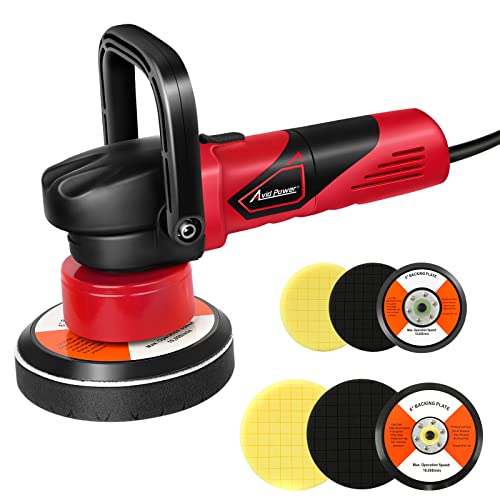 |
Avid Power 6-Inch Cordless Dual Action Polisher Best Cordless Cordless 20V battery, dual action, 6-inch pad, variable speed, lightweight |
8.4 | 🛒 Check Price |
 |
BLACK+DECKER WP900 6-Inch Random Orbit Waxer Polisher Best for Wax and Sealant 6-inch random orbit, 4400 OPM, foam pad and bonnets, light single-speed |
8.0 | 🛒 Check Price |
1. Griot's Garage G9 Random Orbital Polisher: Best Overall
The Griot’s Garage G9 is the polisher we hand to anyone serious about doing the job right, regardless of experience. Its 9mm random orbital action is the sweet spot for car care: aggressive enough to cut down moderate swirls and water spots in a couple of passes, but smooth and stable enough that it almost never stalls when you lean into a stubborn defect. The motor pulls strongly through the full speed range, and the vibration damping is genuinely impressive, so your hands and forearms aren’t numb after a full vehicle.
Where it shines is consistency and confidence. The speed dial is precise, the grip is comfortable from any angle, and the lifetime warranty means you’re buying a tool for the long haul rather than a season. The honest weakness is heft. After an hour of overhead and vertical panels you feel the weight, and on truly severe single-stage oxidation a long-throw machine will finish faster. For the vast majority of cars and detailers, though, this is the one to beat.
- Smooth 9mm random orbital throw that resists pad stalling under pressure
- Variable speed dial from 1 to 6 with a steady, vibration-damped motor
- Backed by Griot's lifetime warranty and a rubber overmold grip
Pros: Exceptional balance and low vibration over long sessions; Strong enough for real correction yet very forgiving for beginners; Outstanding warranty and build quality
Cons: Heavier in the hand than some compact units; The 9mm throw is a step behind long-throw machines on severe defects
2. Rupes BigFoot LHR 15 Mark III Random Orbital Polisher: Best for Paint Correction
If your priority is correcting paint fast and finishing flawlessly, the Rupes BigFoot LHR 15 Mark III is the machine the pros reach for. The 15mm long-throw orbit covers more surface per pass and works defects deeper into the panel, so a job that takes several passes with a short-throw unit can be done in fewer here. The brushless motor is quiet and torquey, the progressive trigger gives you fine control on startup, and the whole tool feels engineered rather than assembled.
The trade-off is that all that throw and reach is less nimble in tight quarters. On mirror caps, around badges, and on sharply curved bumpers, the larger orbit and pad size make it easy to walk the machine onto an edge if you aren’t careful. It rewards a confident hand and a clean technique, which makes it a better second machine than a first one. For dedicated correction work on full-size panels, though, the throughput is hard to match.
- Long 15mm orbit clears large defects and panels in fewer passes
- Brushless motor with smooth progressive trigger and digital speed control
- Renowned ergonomics with a low, balanced center of gravity
Pros: Massive correction throughput on big panels; Refined, premium feel with very low operating noise; Pairs perfectly with the Rupes pad and polish system
Cons: Long throw is harder to control in tight, curved areas; Premium positioning makes it a bigger commitment for casual users
3. Adam's Polishes Swirl Killer 15mm Mini Polisher: Best for Tight Spaces
The Adam’s Swirl Killer 15mm Mini solves the problem every detailer hits eventually: the big machine simply won’t fit. With a short body and small pad compatibility, it tucks into mirror caps, A-pillars, narrow rocker panels, and the tight curves of modern bumpers where a 5-inch backing plate just can’t reach. Despite the size, it carries a genuine 15mm throw, so it actually corrects rather than just spreads polish around.
It’s light, easy to control on vertical and overhead surfaces, and the variable speed lets you dial it down for sealants and waxes too. The honest caveat is scope. This is a complement, not a replacement. Trying to correct an entire hood with the small pad is slow and tiring, and you’ll reach for a larger machine for the open panels. As the second polisher that handles the 20 percent of areas the big one can’t, it’s excellent.
- Compact short body reaches mirrors, pillars, and door jambs with ease
- Surprising 15mm throw packed into a small, lightweight housing
- Variable speed control and a comfortable single-hand grip
Pros: Goes where full-size polishers can’t fit; Light and easy to control overhead or on verticals; Strong correction for its size class
Cons: Not meant to correct an entire car on its own; Smaller pads cover less area per pass
4. TORQ TORQX Random Orbital Polisher Kit: Best for Beginners
For someone touching a polisher for the very first time, the TORQ TORQX takes most of the fear out of the process. The shorter 8mm random orbital throw is inherently forgiving, meaning you’d have to work very hard to burn through paint with it, which is exactly what a nervous beginner needs. The six-speed dial is clearly marked, the handle is comfortable, and it commonly ships as a kit with pads and polishes so you aren’t guessing about what to pair it with.
That safety comes with a ceiling. The 8mm throw and modest motor mean it corrects slower than the long-throw machines and can bog down if you press too firmly, which ironically teaches good light-pressure habits. It isn’t the tool for a detailing business doing heavy correction all day. As a learning machine that builds confidence and still delivers a clean, swirl-reduced finish, it’s one of the easiest starting points available.
- Forgiving 8mm orbit that’s very hard to damage paint with
- Six-speed dial and a comfortable handle for new users
- Often sold as a kit with pads and polishes to start fast
Pros: Extremely beginner-friendly and safe on clearcoat; Comfortable, intuitive controls; Frequently bundled as a complete starter kit
Cons: 8mm throw is slower on heavier defects; Less powerful motor can stall under firm pressure
5. DEWALT DWP849X Variable Speed Rotary Polisher: Best Rotary
When the paint is genuinely thrashed, with heavy oxidation, deep scratches, or single-stage chalking, a rotary still corrects faster than anything else, and the DEWALT DWP849X is the workhorse pros trust. The 12 amp motor has the torque to drive wool and aggressive foam pads without bogging, and the variable speed from a near crawl up to 3500 RPM lets you cut hard then refine. It’s built like a tool that expects to be used every day, because it’s.
This is also the one machine on the list you must respect. Rotary action drives the pad directly, which means heat builds fast and an inattentive moment near an edge can strike through the clear. It also tends to leave holograms that you then refine out, often with a DA afterward. In skilled hands it’s unmatched for raw cutting speed, but a beginner should earn their way to it. For correction specialists, it’s a staple.
- Powerful 12 amp rotary motor for serious defect removal
- Variable speed trigger plus dial from 0 to 3500 RPM
- Wool and foam pad compatible up to large backing plates
Pros: Cuts heavy oxidation and deep defects faster than any DA; Proven, rugged motor built for daily professional use; Excellent speed control across a wide range
Cons: Direct rotary action can burn paint in untrained hands; Steeper learning curve and more holograms to refine out
6. Avid Power 6-Inch Cordless Dual Action Polisher: Best Cordless
The Avid Power Cordless DA is the pick when you simply don’t want to fight a power cord, or there’s no convenient outlet near where you park. Running on a 20V battery, it gives you real freedom to move around the whole car, into the garage, or out on the driveway, with no cable dragging across freshly polished panels. The dual action movement keeps it safe on clearcoat, and the light body makes applying waxes, sealants, and light polish easy.
Cordless convenience has a clear cost: runtime and raw power. A battery won’t carry you through a full multi-stage correction without a swap or recharge, and it doesn’t cut as hard as a corded long-throw machine on heavy defects. Think of it as a strong tool for maintenance polishing, glaze, sealant application, and light swirl cleanup rather than a once-a-year heavy correction. Within that lane, the convenience is genuinely liberating.
- Cordless 20V freedom with no cable to drag across the paint
- Dual action movement that’s safe on clearcoat
- Light body that’s easy to maneuver and store
Pros: Total cordless freedom, ideal for driveways without an outlet; Light and easy to handle for waxes and sealants; Approachable and forgiving for casual use
Cons: Battery limits runtime for full correction sessions; Less cutting power than corded machines
7. BLACK+DECKER WP900 6-Inch Random Orbit Waxer Polisher: Best for Wax and Sealant
The BLACK+DECKER WP900 is honest about what it’s: a waxer and finisher, not a correction machine. Its gentle 6-inch random orbit spreads wax, sealant, and glaze evenly across a panel and then buffs the residue off with the included bonnets, saving your arms from hours of hand application. It’s feather light, it couldn’t be simpler to operate, and there’s essentially nothing to learn before you get a uniform, glossy result.
The boundary is firm. This machine has nowhere near the throw, power, or pad versatility to cut swirls or correct defects, so don’t expect it to fix damaged paint. If you try to use it for serious polishing you’ll be disappointed. But for the very common job of laying down a protective coat of wax on already-clean paint and removing it evenly, it does that one thing well and makes regular maintenance genuinely pleasant.
- Simple random orbit action designed for applying and removing wax
- Includes foam applicator and bonnet pads out of the box
- Very light, very simple, and easy for anyone to pick up
Pros: Easy wax application and removal with no learning curve; Lightweight and comfortable for long wax sessions; Comes ready to use with included bonnets
Cons: Not a correction tool, it won’t remove swirls; Single speed limits versatility
Frequently Asked Questions
What is the difference between a dual action and a rotary polisher?
A dual action, or random orbital, polisher both spins and oscillates the pad on an offset, which spreads heat and friction so it’s very forgiving and unlikely to burn the paint. That makes it the right choice for almost everyone, especially beginners. A rotary polisher drives the pad directly in one rotation, generating far more cutting power and heat, which removes heavy defects faster but can strike through the clearcoat in untrained hands. Most enthusiasts should start with a dual action and only graduate to a rotary once they have real experience.
Can a beginner safely use a car polisher without damaging the paint?
Yes, as long as you start with a dual action machine rather than a rotary. The random orbital movement is designed to be self-regulating, so even with firm pressure it’s very difficult to burn paint. Keep the machine moving in slow, overlapping passes, avoid lingering on hard edges and body lines, keep the cord clear of the surface, and use the lowest speed that gets the job done. Test on a small, less visible panel first. Follow those basics and a first-timer can get excellent, swirl-free results with confidence.
What pad and polish should I use with my new polisher?
Match the pad and polish aggressiveness to the defect. For light swirls and to refine gloss, use a soft finishing foam pad with a fine polish. For moderate swirls and scratches, step up to a medium cutting pad with a one-step correction compound. For heavy oxidation, use a firm cutting pad with an aggressive compound, then refine with a softer pad afterward. Many polishers are sold as kits with matched pads and polishes, which removes the guesswork. Always start with the least aggressive combination that works and only step up if needed.
What size backing plate and pad is best for car polishing?
A 5-inch backing plate with 5.5-inch pads is the most adaptable choice for full-size panels, balancing coverage with control. Larger 6-inch setups cover ground faster but are harder to manage on curves. For tight areas like mirrors, pillars, and bumpers, a compact polisher with a 3-inch pad reaches places a full-size plate can’t. Many detailers own one full-size machine for open panels and one mini polisher for the tight spots, which together cover an entire vehicle comfortably.
How often should I polish my car?
Polishing actually removes a thin layer of clearcoat to level defects, so it isn’t something to do constantly. A full correction once or twice a year, or whenever swirls and scratches become noticeable, is plenty for most cars. Between corrections, focus on proper washing technique, a good wax or sealant, and a quality drying towel to prevent new swirls. If you wash carefully, you may go years between full corrections. Applying wax or sealant with a polisher, by contrast, can be done as often as every few months with no harm.
Our Verdict
For the best all-around car polisher, the Griot’s Garage G9 wins on balance, low vibration, forgiving power, and a lifetime warranty that makes it a buy-once tool for beginners and pros alike. If your focus is fast, flawless paint correction on larger panels, the Rupes BigFoot LHR 15 Mark III is the standout runner up thanks to its long 15mm throw and refined ergonomics. Pair either with a compact machine like the Adam’s Swirl Killer for tight areas, and you can correct an entire car to a swirl-free shine.