A paint thickness gauge is the one tool that stops you from burning through a clear coat with a polisher. Before you commit to a wet sanding pass or an aggressive cutting compound, knowing how many microns of clear coat sit on a panel is the difference between a flawless correction and an expensive respray. For detailers, it also reveals hidden bodywork, repaints, and filler that a seller never disclosed.
We ran seven of the most popular gauges across painted steel doors, an aluminum hood, and a few galvanized panels to see which ones read consistently, which handled both ferrous and non-ferrous metals, and which were genuinely fast to use on a real car. Below are our picks, ranked best first, with honest notes on where each one falls short.
| Photo | Product | Score | Buy |
|---|---|---|---|
 |
PosiTest DFT Combo Coating Thickness Gauge Best Overall Reads ferrous and non-ferrous, 0 to 40 mils / 0 to 1000 microns, auto substrate detection |
9.5 |
ⓘ We may earn a commission from qualifying purchases made through links on this page, at no extra cost to you.
|
 |
Defelsko PosiTector 200 B1 Coating Thickness Gauge Best for Clear Coat Layers Ultrasonic, measures individual coating layers up to 1000 microns total |
9.3 | 🛒 Check Price |
 |
Elcometer 456 Coating Thickness Gauge Best Pro-Grade Build Ferrous and non-ferrous, statistics and memory, scratch-resistant display |
9.1 | 🛒 Check Price |
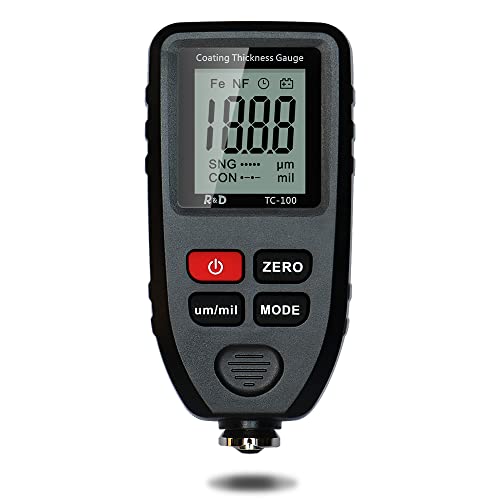 |
Tooltronix Paint Coating Thickness Gauge Best Value for Detailers Auto F/NF detection, 0 to 1300 microns, backlit LCD with hold function |
8.9 | 🛒 Check Price |
|
🚗
|
Wagner Meters PaintCheck Coating Thickness Gauge Best Easy-to-Use Pick Ferrous and non-ferrous, microns and mils toggle, single-button operation |
8.7 | 🛒 Check Price |
|
🚗
|
VVV-Group ETARI ET-555 Paint Thickness Gauge Best for Used Car Inspection Auto F/NF, fast continuous reading mode, 0 to 2000 microns range |
8.4 | 🛒 Check Price |
 |
Allinwell Car Paint Coating Thickness Tester Best Compact Everyday Gauge Auto ferrous/non-ferrous, backlit LCD, pocket-size body |
8.0 | 🛒 Check Price |
1. PosiTest DFT Combo Coating Thickness Gauge: Best Overall
The PosiTest DFT Combo was the gauge our testers reached for without thinking. It senses whether a panel is steel or aluminum on its own, so you never fumble with a mode button while leaning over a fender. Across repeated readings on the same spot it barely deviated, which is exactly what you want when you’re deciding whether a clear coat has enough material left to safely correct. The included calibration foils let you verify the meter against a known thickness before a job, and that traceability matters when you’re inspecting a car before purchase.
The honest weakness is that this Combo version has no data logging, no Bluetooth, and no onboard memory, so if you need to document dozens of readings for a paint correction report you’ll be writing them down by hand. It also sits at the upper end of the market, which is hard to justify for someone polishing one personal car a year. For a working detailer who lives by accuracy, though, the value is clear over the life of the tool.
- Automatic ferrous and non-ferrous substrate recognition on every reading
- Tough rubberized housing built for daily shop use
- Certified calibration foils included for verification
Pros: Outstanding accuracy and repeatability panel to panel; Truly grab-and-go with no mode switching; Trusted DeFelsko build quality and support
Cons: Premium positioning puts it above casual hobby budgets; No onboard memory or app logging on the Combo model
2. Defelsko PosiTector 200 B1 Coating Thickness Gauge: Best for Clear Coat Layers
The PosiTector 200 B1 is the specialist pick for detailers who care about the clear coat specifically, not just the total film. Because it uses ultrasonic measurement, it can break a reading into individual layers, so you can see how much clear sits above the base. That’s invaluable before wet sanding, and it also reads plastic bumpers and fiberglass panels that magnetic and eddy current gauges simply ignore. On a modern car with mixed panel materials, that flexibility paid off repeatedly in our testing.
The trade off is workflow. Ultrasonic gauges need a drop of couplant gel on the panel for each reading, which slows you down and means wiping the surface afterward. The interface also takes longer to learn than a point-and-read magnetic meter. If your work centers on quick pass-or-fail thickness checks, this is more gauge than you need, but for serious paint analysis it stands alone.
- Ultrasonic sensor reads total film and individual layers
- Works on plastic and fiberglass body panels, not just metal
- Bright reversible display readable in shop lighting
Pros: Sees individual clear coat and base thickness, not just total; Measures non-metal substrates other gauges can’t; Excellent for documenting paint condition
Cons: Needs couplant gel for ultrasonic readings; Steeper learning curve than magnetic gauges
3. Elcometer 456 Coating Thickness Gauge: Best Pro-Grade Build
The Elcometer 456 comes from the industrial coatings world, and it shows. In our testing it delivered reference-level consistency across both ferrous steel and non-ferrous aluminum panels, and its onboard statistics made it easy to capture an average across a door rather than trusting a single spot. For a detailing business that produces written paint condition reports or vehicle inspection documents, that memory and averaging capability turns a tedious task into a quick one.
The catch is that all this capability is more than a typical detailer needs, and the gauge is built and priced as a tool for coatings inspectors. If you only check thickness occasionally before a polish, you’ll use a fraction of its features. But if accuracy and documentation are central to how you sell your service, the 456 is hard to fault and likely to outlast cheaper meters several times over.
- Industrial-grade accuracy with dual F and NF probe support
- Onboard statistics and reading memory for reports
- Rugged housing rated for demanding workshop environments
Pros: Reference-level accuracy and consistency; Stores readings and calculates averages automatically; Built to survive years of professional abuse
Cons: Overkill for most single-car detailers; Higher commitment than hobby-focused meters
4. Tooltronix Paint Coating Thickness Gauge: Best Value for Detailers
The Tooltronix gauge hits the sweet spot for working detailers who want reliable readings without industrial pricing. It automatically detects whether it’s sitting on steel or aluminum and switches modes for you, and the backlit screen with a hold function is genuinely helpful when you’re reading a low rocker panel or an underside edge where you can’t see the display straight on. In our side-by-side checks it tracked closely with the far more expensive meters on flat panels.
Where it gives ground is durability and edge performance. The housing is plastic and feels less reassuring than the rubber-armored pro units if you drop it on concrete, and on very curved or sharp body lines the readings wandered more than the premium gauges did. For everyday clear coat checks before a correction, though, it does the core job well and represents excellent value.
- Automatic switching between ferrous and non-ferrous surfaces
- Backlit screen with data hold for awkward angles
- Compact body that fits a detailing apron pocket
Pros: Strong accuracy for its place in the market; Genuinely easy to operate with no setup; Compact and light for all-day use
Cons: Plastic housing feels less rugged than pro meters; Calibration check relies on the supplied foils only
5. Wagner Meters PaintCheck Coating Thickness Gauge: Best Easy-to-Use Pick
Wagner Meters built the PaintCheck for people who want a thickness reading without a manual, and that simplicity is its strength. One button, big digits, and an instant toggle between microns and mils mean a first-time user can be checking panels within a minute of opening the box. Throughout testing it gave dependable numbers on both ferrous and non-ferrous panels, which makes it a sensible choice for a detailer onboarding staff who have never used a gauge before.
The simplicity costs you on the back end. There’s no memory, no averaging, and no logging, so documenting a full vehicle means recording every number yourself. We also noticed the automatic substrate detection settled a touch slower than the PosiTest, so on a fast walkaround you wait a beat longer per reading. For straightforward go or no-go decisions, none of that gets in the way.
- Simple one-button workflow with clear large digits
- Switches readout between microns and mils instantly
- Stable readings on both steel and aluminum panels
Pros: Very beginner friendly with minimal menus; Clear, large display easy to read at a glance; Reliable dual-metal coverage
Cons: No memory or statistics features; Slower auto-detect than the top picks
6. VVV-Group ETARI ET-555 Paint Thickness Gauge: Best for Used Car Inspection
The ETARI ET-555 is purpose-built for the inspection side of detailing, where you walk a used car and need to find filler and prior repairs fast. Its continuous reading mode lets you slide the probe across a panel and watch the numbers update in real time, so an entire door is scanned in seconds rather than spot by spot. The wide range easily flags the thick readings that betray body filler or a heavy repaint, and the alerts make abnormalities obvious even to a less experienced eye.
The compromise is precision at the thin end. When you’re trying to resolve a few microns of difference in a healthy factory clear coat before correction, this gauge isn’t as tight as the PosiTest or Elcometer. The housing is also more utilitarian than premium. As a fast pre-purchase and pre-detail scanner, however, it earns its place and surfaces problems quickly.
- Rapid continuous mode for scanning a whole car quickly
- Wide measurement range catches thick filler and repaints
- Audible and visual alerts flag abnormal readings
Pros: Very fast for walkaround inspections; Wide range spots body filler easily; Helpful alerts highlight repainted areas
Cons: Less precise at the thin clear coat extreme; Build quality is functional rather than premium
7. Allinwell Car Paint Coating Thickness Tester: Best Compact Everyday Gauge
The Allinwell tester is the gauge to keep in a glovebox or apron for quick, casual checks. It’s small, light, and automatic about detecting steel versus aluminum, with a backlit screen that reads fine in a dim garage. For a hobbyist about to polish a personal car, or a detailer who just wants a fast sanity check that there’s enough clear coat to work with, it covers the essentials and comes with foils and a case to keep it organized.
Push it harder and the limits appear. In repeated readings on the same spot it drifted a little more than the higher-tier gauges, so for critical wet sanding decisions we would verify against a more precise meter. The lightweight body also wants careful handling rather than rough shop life. As an affordable, portable everyday gauge for non-critical checks, though, it does what most users need.
- Pocket-friendly size for quick checks anywhere
- Automatic metal detection with backlit readout
- Includes calibration foils and a storage case
Pros: Highly portable and simple to carry; Accessible entry point for new detailers; Fine accuracy for basic clear coat checks
Cons: Repeatability drifts more than premium meters; Lightweight build needs careful handling
Frequently Asked Questions
Why does a detailer actually need a paint thickness gauge?
A paint thickness gauge tells you how much clear coat and paint sit on a panel, measured in microns, before you start polishing or wet sanding. Aggressive correction removes material, and clear coat is finite, so cutting too far burns through to the base and forces an expensive respray. The gauge also reveals hidden repaints, body filler, and prior accident repairs that a previous owner or seller never disclosed, which makes it essential for pre-purchase inspections as well as safe paint correction.
What is the difference between ferrous and non-ferrous readings?
Ferrous refers to steel and other magnetic substrates, while non-ferrous covers aluminum and similar metals that aren’t magnetic. Magnetic induction gauges read coatings over steel, and eddy current sensors read coatings over aluminum. Most modern cars mix both, with steel doors and an aluminum hood, for example, so the best gauges for detailing automatically detect the substrate and switch methods for you. Buying a meter that only reads ferrous surfaces will leave you blind on a growing number of body panels.
What is a healthy clear coat thickness in microns?
Factory clear coat is often somewhere around 40 to 60 microns, sitting on top of base and primer, so total paint readings on an unmolested panel frequently land in the roughly 80 to 150 micron range depending on the manufacturer. There’s no single universal number, which is why detailers compare readings across panels on the same car rather than chasing an absolute figure. A panel reading dramatically higher than its neighbors usually signals filler or a repaint, while an unusually thin reading is a warning to correct gently or not at all.
Do I need an ultrasonic gauge or is a magnetic one enough?
For most detailing work, a magnetic and eddy current gauge that reads total film thickness on steel and aluminum is enough to make safe correction decisions. Ultrasonic gauges like the PosiTector 200 cost more and need couplant gel, but they can separate the reading into individual layers and measure plastic and fiberglass panels that magnetic meters can’t. If you frequently work on bumpers, fiberglass, or need to know clear coat thickness specifically rather than total film, ultrasonic is worth it. Otherwise a quality magnetic gauge handles the job.
How do I calibrate and verify a paint thickness gauge?
Most gauges ship with certified calibration foils of known thickness and a bare metal substrate. Before an important job, place a foil on bare metal and confirm the gauge reads the foil’s stated value within tolerance, adjusting the calibration if your meter allows it. Doing this on the same type of metal you’ll be measuring improves accuracy, and verifying before a paint correction or a vehicle inspection protects you if a reading is ever questioned. Re-check periodically, since handling and temperature can cause small drift over time.
Our Verdict
For working detailers, the PosiTest DFT Combo is our top pick because it pairs reference-grade accuracy with automatic substrate detection and a build that survives daily shop use, so you spend your attention on the paint and not the meter. If your focus leans toward the clear coat itself or you regularly read plastic and fiberglass panels, the PosiTector 200 B1 is the runner up and the smarter buy, trading a little speed for the ability to see individual layers. Whichever you choose, owning a reliable gauge is the cheapest insurance against burning through a clear coat that money can buy.