Bleeding brakes used to mean roping in a friend to pump the pedal while you crawled under the car shouting “hold it.” A good one man brake bleeder ends that ritual for good. Whether it works by vacuum, pressure, or a simple one-way check valve, the right tool lets you flush old fluid and chase out air bubbles entirely on your own, with cleaner results and far less swearing.
We ran each of these kits across real jobs, from a daily driver fluid flush to a stubborn ABS module and motorcycle calipers, paying attention to seal quality, how easily they prime, and whether they actually pull a vacuum without sucking air past the bleeder threads. Below are the seven we trust most, ranked best first, with honest notes on where each one falls short.
| Photo | Product | Score | Buy |
|---|---|---|---|
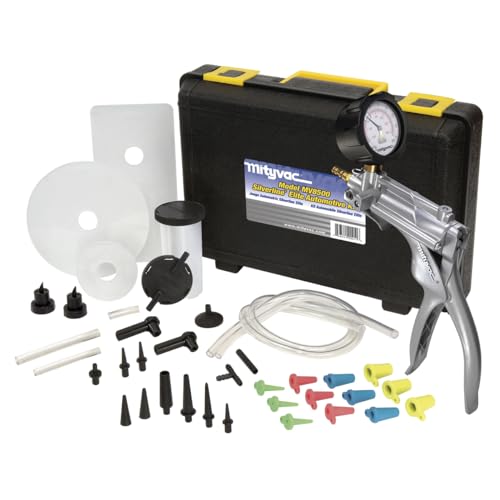 |
Mityvac MV8500 Silverline Elite Vacuum Brake Bleeding Kit Best Overall Hand-operated vacuum pump, metal body, full automotive adapter set |
9.5 |
ⓘ We may earn a commission from qualifying purchases made through links on this page, at no extra cost to you.
|
 |
Motive Products 0100 Power Bleeder Best Pressure Bleeder Pressurized tank bleeder, hand pump, universal master cylinder cap adapter |
9.3 | 🛒 Check Price |
 |
Phoenix Systems V12 Reverse Brake Bleeder Kit Best for Stubborn Air Reverse (bottom-up) bleeder, brass body, manual fluid injection |
9.1 | 🛒 Check Price |
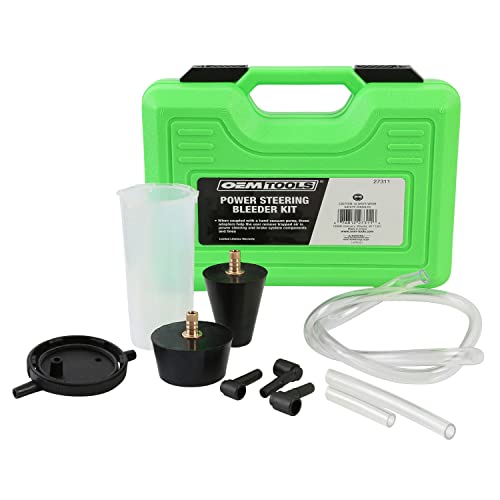 |
OEMTOOLS 24441 Vacuum Brake Bleeder and Fluid Evacuator Best Value Hand vacuum pump kit with gauge and full adapter set |
8.9 | 🛒 Check Price |
 |
ABN Vacuum Brake Bleeder and Clutch Bleeding Kit Best Starter Kit Hand vacuum pump with brake and clutch adapters, compact case |
8.6 | 🛒 Check Price |
 |
Performance Tool W54170 Vacuum Brake Bleeder Kit Most Compact Compact hand vacuum pump, gauge, brake bleed adapters |
8.3 | 🛒 Check Price |
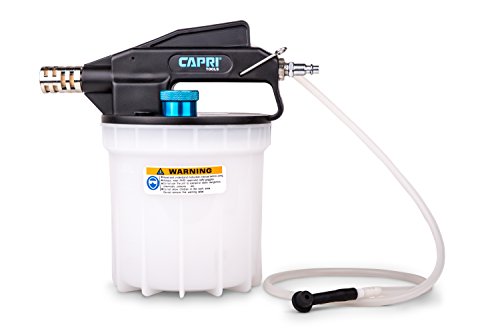 |
Capri Tools CP21075 Manual Brake Bleeder Bottle Kit Simplest Solo Method One-way check valve bleeder bottle with magnetic mount and hose |
8.0 | 🛒 Check Price |
1. Mityvac MV8500 Silverline Elite Vacuum Brake Bleeding Kit: Best Overall
The Mityvac MV8500 is the kit we reached for first and kept reaching for. The all-metal pump has a confident, mechanical action that builds vacuum fast and holds it, so you can actually see on the gauge whether your system is sealing or whether air is leaking in. Pair it with the included adapters and you can bleed brakes, pull a clutch slave, transfer fluid, or even diagnose vacuum-operated components, which makes it more of a permanent shop tool than a one-job gadget.
Its main quirk is one shared by every vacuum bleeder: drawing fluid through the bleeder screw means you also draw a little air past the threads, which can make it look like bubbles never stop. The fix is simple, smear a bit of grease around the bleeder threads or snug them slightly, and the readings settle down. Once you learn that trick, the MV8500 is as close to foolproof as solo brake bleeding gets.
- All-metal pump body with a smooth, broken-in feel that pulls a strong vacuum every stroke
- Comes with a wide adapter and fitting set for bleeders, fluid transfer, and reservoir refill
- Built-in gauge and bleed reservoir let you monitor vacuum and catch fluid cleanly
Pros: Pulls and holds a strong, repeatable vacuum better than any plastic pump we tried; Adaptable enough for brakes, clutch hydraulics, fluid transfer, and vacuum testing; Durable metal construction that feels like a lifetime tool
Cons: Air can sneak past the bleeder screw threads, so a dab of grease on the threads helps readings; Heavier and bulkier than the budget vacuum options
2. Motive Products 0100 Power Bleeder: Best Pressure Bleeder
The Motive 0100 takes the opposite approach to the vacuum kits, it pressurizes the master cylinder from the top so fresh fluid is pushed down through the lines and out the bleeders, carrying air with it. In practice this is the most relaxed way to bleed brakes alone. You set a safe pressure with the hand pump, then simply open each bleeder in turn and watch clean fluid flow into a bottle. No running back to the pedal, no guessing.
The catch with the universal model is the cap adapter. It clamps onto a range of reservoirs, but getting a perfect seal on an odd-shaped cap can take a couple of tries, and a poor seal means dribbles. A vehicle-specific cap solves it if you stick with one car. Keep an eye on the fluid level so the reservoir never empties and pulls fresh air in, and the 0100 rewards you with a flush that genuinely feels professional.
- Pressurizes the master cylinder so fluid pushes air down and out at each caliper
- Large catch tank holds enough fresh fluid for a full flush without stopping
- Hand pump and gauge let you dial in safe pressure and walk to each wheel solo
Pros: Genuinely one-person operation, no pedal pumping at all; Delivers a clean, bubble-free flush that rivals professional shop results; Big reservoir means fewer refills mid-job
Cons: The universal cap adapter can be fiddly to seal on some reservoirs; You must watch the master cylinder so it never runs dry
3. Phoenix Systems V12 Reverse Brake Bleeder Kit: Best for Stubborn Air
When a brake job just won’t firm up, the Phoenix V12 is the secret weapon. It bleeds in reverse, injecting fresh fluid up from the caliper bleeder so that air bubbles travel the way they naturally want to go, upward and out into the master cylinder reservoir. Because air rises rather than fighting against downward flow, this method clears pockets that stump traditional vacuum and pressure bleeders, especially in ABS units and calipers mounted above the lines.
It isn’t the fastest tool here. You’re working the injector by hand and watching fluid climb, so a full four-wheel flush takes patience, and you have to draw fluid out of the reservoir as the level rises to avoid an overflow. But for that one car that refuses to give a hard pedal, the V12 succeeds where everything else stalls, and the brass build means it’ll keep doing it for years.
- Pushes fluid upward from the caliper so air rises naturally with the flow
- Brass and metal construction built for repeated professional use
- Excellent for difficult ABS systems and high-mount calipers that trap air
Pros: Reverse bleeding clears trapped air that vacuum and pressure kits miss; Solidly built and reusable for years; Ideal for ABS modules and tricky brake-line geometry
Cons: Slower and more hands-on than a pressure tank; You must keep the reservoir from overflowing as fluid rises
4. OEMTOOLS 24441 Vacuum Brake Bleeder and Fluid Evacuator: Best Value
The OEMTOOLS 24441 gives a beginner almost everything they need to bleed brakes solo without a steep learning curve. It’s a hand-operated vacuum pump with a clear catch reservoir, a gauge, and a generous spread of adapters, so out of the box you can draw old fluid out of a caliper and watch it collect cleanly. It works as a fluid evacuator too, which makes it a useful all-rounder for a home garage rather than a single-purpose tool.
The compromise is build quality. The pump body is plastic, and while it pulls a perfectly good vacuum when new, the seals don’t have the long-haul toughness of an all-metal Mityvac, so very frequent users may notice it softening over time. For the occasional DIY flush every year or two, though, it covers the job comfortably and is the easiest recommendation for someone bleeding brakes alone for the first time.
- Complete hand vacuum kit with reservoir, hoses, and multiple adapters
- Built-in gauge for monitoring vacuum and diagnosing components
- Doubles as a fluid evacuator for oil and small fluid transfers
Pros: Strong feature set and accessory bundle for the value; Easy to set up and use for a first-time solo bleeder; Handy for brake bleeding and general vacuum testing
Cons: Plastic pump body doesn’t feel as durable as metal rivals; Seals can weaken over heavy long-term use
5. ABN Vacuum Brake Bleeder and Clutch Bleeding Kit: Best Starter Kit
The ABN vacuum kit is aimed squarely at the weekend mechanic taking on their first solo brake bleed. It’s a light hand pump bundled with the hoses, adapters, and a catch jar you need to pull fluid through a bleeder screw, and it includes clutch fittings so the same kit covers a clutch slave cylinder. The low weight makes it comfortable to work the pump repeatedly without your forearm tiring out halfway through a wheel.
As a lighter-duty tool, its seals and check valve aren’t built for daily shop abuse, and on a long flush you may find the vacuum fades a little and needs a few extra strokes to recover. That’s a fair trade for the accessibility, though. If you want a low-commitment way to stop relying on a helper and learn the process, the ABN kit gets you there without much fuss.
- Covers both brake and clutch hydraulic bleeding from one kit
- Lightweight pump that’s easy to operate single-handed
- Includes hoses, adapters, and a catch jar in a tidy package
Pros: Affordable, approachable entry into solo bleeding; Light and comfortable for extended pumping; Handles brakes and clutch hydraulics alike
Cons: Lighter-duty seals than premium pumps; Vacuum can fade faster on long sessions
6. Performance Tool W54170 Vacuum Brake Bleeder Kit: Most Compact
The Performance Tool W54170 is the kit to grab when you want something small that lives in a toolbox drawer and comes out for the occasional job. It’s a compact hand vacuum pump with a gauge and the basic adapter set, so for a quick single-caliper bleed or topping off after a pad change it’s ready in seconds with almost no setup. The size makes it genuinely convenient in a way the bigger tanks and metal pumps aren’t.
That compactness costs you a bit of capacity. The catch reservoir is small, so on a full four-wheel fluid flush you’ll be stopping to empty it more often than with a larger kit, and the plastic construction is best treated as light duty. For fast, occasional solo bleeds, though, it’s a tidy and dependable little tool that does exactly what it promises.
- Small, grab-and-go pump that stores easily in a toolbox drawer
- Gauge included for vacuum monitoring and basic diagnostics
- Comes with the adapters needed for common bleeder screws
Pros: Compact and convenient for tight storage and quick jobs; Simple to operate with no setup learning curve; Gauge adds light diagnostic ability
Cons: Smaller reservoir means more frequent emptying; Mostly plastic build limits heavy repeated use
7. Capri Tools CP21075 Manual Brake Bleeder Bottle Kit: Simplest Solo Method
Not everyone wants a pump or a pressure tank, and the Capri Tools CP21075 proves you don’t need one. It’s a catch bottle fitted with a one-way check valve and a length of hose, with a magnet to stick it to the body or suspension near the wheel. You open the bleeder, push the pedal, and the check valve holds the expelled fluid and air in the bottle so nothing gets sucked back in when you release. That single valve is what turns a two-person job into a one-person one.
The honest limitation is that this is still a pedal-based method, so although you don’t need a helper, you do walk back to the cabin to work the pedal between strokes, which makes a full flush slower than a power bleeder. But there’s almost nothing to go wrong, no priming, no seals to fail, no power needed, and for a clean, reliable solo bleed on a budget it’s hard to beat the simplicity.
- One-way check valve stops drawn fluid and air from returning to the caliper
- Magnetic mount holds the catch bottle hands-free near the wheel
- No pump or power needed, just open the bleeder and pump the pedal
Pros: Dead simple, nothing to prime or pressurize; Magnetic bottle frees both hands while you work; Inexpensive and nearly foolproof
Cons: Still requires walking to the pedal between wheels; Slower than a pressure or vacuum kit on a full flush
Frequently Asked Questions
How does a one man brake bleeder actually work?
There are three common designs and each removes the need for a helper in a different way. A vacuum bleeder uses a hand pump to suck old fluid and air out through the bleeder screw into a catch reservoir. A pressure bleeder seals onto the master cylinder and pushes fresh fluid down through the lines so air exits at the calipers. A check-valve bottle uses a one-way valve so that when you pump the pedal, expelled fluid and air can’t get drawn back into the caliper. All three let you bleed brakes accurately on your own once you understand the method.
Why do I still see bubbles with a vacuum brake bleeder?
This is the most common confusion with vacuum bleeders, and it usually doesn’t mean your brakes still have air in them. The vacuum draws fluid out through the bleeder screw, and as it does, it also pulls a little air in past the loose threads of the screw, so you see a steady stream of small bubbles that never seems to stop. The fix is to smear a film of grease around the bleeder screw threads or snug the screw slightly, which seals the threads against incoming air and lets you see the true condition of the fluid.
Is vacuum or pressure better for bleeding brakes alone?
Both work well solo, and the best choice depends on the job. Vacuum kits are compact, affordable, and great for quick single-caliper bleeds and fluid evacuation, though they can pull air past bleeder threads. Pressure bleeders give the cleanest, most professional full flush with the least effort because you simply open each wheel and watch clean fluid flow, but they cost a bit more and need a good seal on the master cylinder. For stubborn ABS systems where air refuses to clear, a reverse bleeder that pushes fluid upward often succeeds where both vacuum and pressure stall.
What brake bleeding sequence should I follow?
Always check your specific service manual, because some modern vehicles with ABS or electronic stability control require a particular order or a scan tool to cycle the ABS module. As a general rule for traditional systems, you bleed starting from the wheel farthest from the master cylinder and work to the nearest, which is usually right rear, left rear, right front, then left front. Keep the master cylinder reservoir topped up the entire time so it never runs dry and pulls fresh air into the system, which would force you to start over.
How often should I bleed or flush my brake fluid?
Most manufacturers recommend a full brake fluid flush every two to three years, because brake fluid is hygroscopic, meaning it absorbs moisture from the air over time. That absorbed water lowers the fluid’s boiling point and can cause a soft pedal or fade under hard braking, and it promotes internal corrosion. You should also bleed the brakes any time you open the hydraulic system, such as after replacing a caliper, line, or master cylinder, since that introduces air. A one man bleeder makes this routine maintenance easy enough to actually keep up with.
Our Verdict
For most people the Mityvac MV8500 Silverline Elite is the one to own, a tough metal vacuum pump that handles brakes, clutches, and fluid transfer with a strong, repeatable pull and years of durability. If you want the most relaxed, professional-feeling full flush, the Motive Products 0100 Power Bleeder is the runner up, pressurizing the master cylinder so you simply open each wheel and watch clean, air-free fluid flow without ever touching the pedal. Either one ends the days of needing a helper.

