A loaded travel trailer pushing down on the back of your truck does more than make the headlights point at the sky. It lightens the front axle, ruins your steering and braking, and invites the white-knuckle sway that turns a highway crosswind into a scary moment. A load distribution hitch, often called a weight distribution hitch, uses spring bars to push that tongue weight forward across both axles of the tow vehicle and back onto the trailer, so the whole rig sits level and tracks straight.
We looked at how each system distributes weight, how it fights sway, how brutal it’s to hook up at a campsite, and whether the rated tongue weight actually matches what real trailers carry. Below are the seven load distribution hitches we trust most, ranked best first, with honest notes on where each one falls short.
| Photo | Product | Score | Buy |
|---|---|---|---|
 |
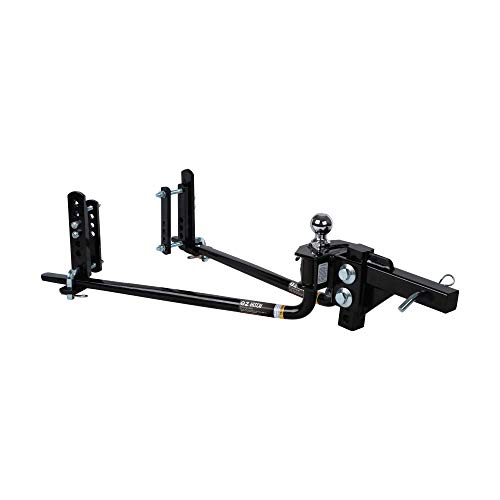
Equal-i-zer 4-Point Sway Control Hitch Best Overall Integrated 4-point friction sway control, trunnion bars, ratings from 6,000 to 16,000 lb GTW |
9.5 |
ⓘ We may earn a commission from qualifying purchases made through links on this page, at no extra cost to you.
|
 |
Fastway e2 2-Point Sway Control Trunnion Hitch Best Value Built-in 2-point sway control, trunnion bars, common ratings 8,000, 10,000 and 12,000 lb GTW |
9.3 | 🛒 Check Price |
 |
Husky 32218 Center Line TS Weight Distribution Hitch Best Sway Control Spring-bar tension sway control, trunnion bars, ratings up to 15,000 lb GTW / 1,500 lb tongue |
9.2 | 🛒 Check Price |
 |
CURT 17063 TruTrack 4P Weight Distribution Hitch Best for Heavy Trailers 4-point integrated sway control, adjustable, 8,000 to 15,000 lb GTW with 800 to 1,500 lb tongue |
9.0 | 🛒 Check Price |
 |
Andersen 3344 No-Sway Weight Distribution Hitch Lightest and Quietest Chain-free design, no metal spring bars, up to 14,000 lb GTW / 1,400 lb tongue |
8.8 | 🛒 Check Price |
 |
Reese 49902 Strait-Line Weight Distribution Hitch Best Brand Heritage Dual-cam sway control, trunnion bars, ratings to 15,000 lb GTW / 1,500 lb tongue |
8.5 | 🛒 Check Price |
 |
EAZ LIFT 48058 Elite Weight Distribution Hitch Best for Occasional Towing Includes add-on friction sway bar, trunnion bars, 1,000 lb tongue / 10,000 lb GTW typical |
8.2 | 🛒 Check Price |
1. Equal-i-zer 4-Point Sway Control Hitch: Best Overall
The Equal-i-zer earns the top spot because it does two jobs with one elegant mechanism. The same brackets that hold the spring bars also create four friction points that clamp down on trailer sway, so you aren’t bolting a separate friction bar onto the A-frame and hoping it stays adjusted. Hook up, drop the bars into the brackets, and the sway control is already live. For anyone towing a tall travel trailer that gets shoved around by passing semis, that integration is the difference between fighting the wheel and relaxing.
The honest weakness is noise. Those friction points squawk and groan during slow, tight maneuvers like pulling into a campsite or a gas station, and it can sound alarming the first few times. It’s normal and not a sign of damage, but it bothers some owners enough to mention it constantly. The head is also heavy and the initial socket setup of the head angle takes patience. Get past those two quirks and this is the hitch we would put on our own trailer.
- Four-point sway control built into the head and bracket contact points, no add-on bar to bolt up
- Trunnion spring bars in several weight ratings to match tongue weight closely
- Sealed, low-maintenance design with no chains, hooks, or external sway slider to grease
Pros: Sway control is integrated and works the moment you tighten the brackets; Wide rating range fits everything from a small camper to a heavy fifth-wheel-class travel trailer; Proven reputation and excellent resale demand
Cons: The friction points can creak and groan on tight turns until you get used to it; Heavier head assembly than chain-style kits, so initial setup is a workout
2. Fastway e2 2-Point Sway Control Trunnion Hitch: Best Value
The Fastway e2 is the smart-money pick. It uses the same idea as the Equal-i-zer, friction sway control baked directly into the spring bar brackets, but with two contact points instead of four. For most half-ton trucks pulling a typical travel trailer, two points is plenty to settle the rig and kill the slow wag that builds behind a semi. Because the head comes largely pre-assembled and the trunnion bars clear the ground better than round bars, this is one of the friendlier kits to live with day to day.
The trade-off versus our top pick is simply margin. In the nastiest mountain-pass crosswinds with a very tall trailer, a four-point system has more authority to clamp down, and you can feel the difference. The e2 also has stiff brackets out of the box that take real effort to flip when you connect and disconnect, though they loosen up over the first few trips. For the towing security it provides, it’s hard to do better for the money.
- Two integrated sway-control friction brackets, no separate sway bar to store or mount
- Trunnion-style bars sit higher for better ground clearance than round-bar kits
- Pre-assembled head ships mostly built to shorten driveway setup time
Pros: Sway control is integrated, so there’s one less part to forget at home; Strong, simple design that holds adjustment well over thousands of miles; Genuinely good value for the towing confidence it delivers
Cons: Two-point control is slightly less aggressive than four-point systems in heavy crosswinds; Brackets can be stiff to flip up and down until they wear in
3. Husky 32218 Center Line TS Weight Distribution Hitch: Best Sway Control
The Husky Center Line TS takes a different road to sway control. Instead of friction pads that drag on the trailer frame, it uses the geometry and tension of the spring bars themselves to keep the trailer tracking dead center. The big payoff is silence. There’s none of the creaking and groaning that friction systems make in parking lots, and there’s nothing to fade or wear out over time. It also has a reputation for taming bounce, so the ride behind the truck feels planted rather than choppy.
The catch is the hookup effort. Because the bars work under tension, seating them takes more force and a confident technique, and the whole package is on the heavy side to wrestle into place. Owners who tow alone sometimes find the first few connections fiddly. Once it’s dialed in, though, this is one of the quietest and most composed weight distribution systems you can buy, which is why it’s our pick for pure sway control.
- Sway control comes from spring-bar tension, so there’s no friction noise or fade
- Trunnion bars with a no-bounce design that smooths the ride over bumps
- Two-point connection with a U-bolt-free, quieter bracket system
Pros: Quiet operation with no friction groan on turns; Very effective at resisting sway through the spring-bar geometry; Smooth, controlled feel that reduces trailer bounce
Cons: Hookup requires a bit more muscle to seat the bars under tension; Heavier overall package to handle during installation
4. CURT 17063 TruTrack 4P Weight Distribution Hitch: Best for Heavy Trailers
The CURT TruTrack 4P is built for people who tow on the heavier end of the half-ton and three-quarter-ton range and want maximum control. It combines four-point friction with spring-bar tension, so it fights sway on multiple fronts, and it’s adjustable enough that you can tune the distribution and sway resistance to the exact tongue weight of your trailer. For a big, slab-sided travel trailer that acts like a sail in wind, that layered control inspires real confidence.
That capability comes with complexity. There are more adjustment points to understand, and getting the head angle and bar tension right the first time takes reading the manual carefully and a bit of trial and error. A casual user who just wants to bolt it on and go may feel it’s fussier than a simpler two-point kit. But if you carry serious weight and want the rig to feel nailed down, the extra setup time pays off every mile.
- Four-point sway control with both friction and spring-bar tension working together
- Adjustable system that fine-tunes to different trailer tongue weights
- Corrosion-resistant finish built to survive road salt and weather
Pros: Aggressive four-point control for tall, heavy travel trailers; Adjustability lets you match the setup precisely to your rig; Durable finish that resists rust over years of use
Cons: More adjustment knobs mean a steeper initial learning curve; Premium system that asks for careful setup to get right
5. Andersen 3344 No-Sway Weight Distribution Hitch: Lightest and Quietest
The Andersen No-Sway throws out the heavy steel spring bars entirely. Instead, it uses chains tensioned against polyurethane cushion bushings, which does two remarkable things. First, the kit weighs a fraction of a traditional setup, so lifting it onto the ball and connecting it’s genuinely easy, even towing solo. Second, with no metal sliding on metal, it tows nearly silent, with none of the parking-lot groan that friction hitches are known for. The single bolt per side also makes adjustment refreshingly simple.
The honest weakness is the bushings. Those polyurethane cushions are a consumable that flatten and wear over time and need periodic replacement to keep the system performing, which is a maintenance step the all-steel kits avoid. And while it controls sway well for most rigs, drivers with very tall trailers in fierce wind sometimes wish for the brute clamping force of a four-point friction system. For weight, noise, and ease of use, though, nothing else is close.
- Replaces heavy steel spring bars with composite-cushioned chains for a much lighter kit
- No metal-on-metal contact means near-silent towing with no friction groan
- Greatly reduced overall weight makes hookup and storage far easier
Pros: By far the lightest system to lift and connect; Almost completely silent, with no creaking on turns; Sway control and weight distribution adjust quickly with a single bolt per side
Cons: Polyurethane bushings are a wear item that needs replacing over time; Some owners find sway control less aggressive than four-point friction systems
6. Reese 49902 Strait-Line Weight Distribution Hitch: Best Brand Heritage
The Reese Strait-Line carries a name that has been on the back of trucks for generations, and its dual-cam sway control is a distinctive approach. Rather than relying purely on friction to dampen sway after it begins, the cams actively work to keep the trailer pointed straight, returning it to center as you drive. When it’s set up correctly, the rig feels locked onto the truck and tracks beautifully through wind and truck wash.
The phrase to underline is when it’s set up correctly. The cam system is the fussiest to adjust on this list, and getting the cams seated and tensioned right takes patience and a careful read of the instructions. Slow, tight turns also produce a clunk as the cams move, which is normal but takes getting used to. For an experienced tower who doesn’t mind dialing it in, the proactive sway control is excellent, but newcomers may find a simpler integrated-friction hitch less frustrating.
- Dual-cam sway control actively centers the trailer and resists sway before it starts
- Trunnion spring bars with a clearance advantage over round-bar designs
- Backed by one of the oldest and most established names in towing
Pros: Dual-cam system proactively prevents sway rather than just dampening it; Long, trusted brand history with wide parts availability; Solid distribution performance that keeps the rig level
Cons: Cam setup is more involved and finicky to adjust correctly; Cams can clunk audibly when maneuvering at low speed
7. EAZ LIFT 48058 Elite Weight Distribution Hitch: Best for Occasional Towing
The EAZ LIFT Elite is the sensible choice for someone who tows a few weekends a year and wants a complete, no-guesswork kit. Everything arrives in the box, the spring bars, the hitch ball, and a friction sway bar, so you aren’t hunting down extra parts to make it work. The design is traditional and easy to understand, which makes it a forgiving first weight distribution hitch for an owner who is still learning how the whole system behaves on the road.
The compromise is in the sway control. It bolts on as a separate friction bar rather than being integrated into the brackets, which means it’s one more thing to install each trip and one more thing that can be left in the garage. The dampening is also less sophisticated than the four-point integrated systems higher on this list. For frequent heavy towing it’s a step behind, but for occasional, moderate trailer trips it’s a dependable and approachable setup.
- Comes as a complete kit with spring bars, hitch ball, and an interchangeable sway bar
- Trunnion bars with a pre-installed sway control bracket for straightforward setup
- Forged, machined components that hold up to regular seasonal use
Pros: A complete, ready-to-tow package right out of the box; Simple, well-understood design that’s easy to learn; Good value for someone who tows a few times a season
Cons: Friction sway bar is a separate add-on part that can be left behind; Sway control is less refined than integrated four-point systems
Frequently Asked Questions
What is the difference between a load distribution hitch and a weight distribution hitch?
There’s no difference. Load distribution hitch and weight distribution hitch are two names for the exact same thing, sometimes also called a WDH or an equalizing hitch. All of them use spring bars to transfer tongue weight off the rear axle of the tow vehicle and spread it forward to the front axle and back to the trailer axles, so the rig sits level and steers and brakes safely. If a product page uses either phrase, it’s describing this same category of hitch.
Do I really need sway control with a load distribution hitch?
For most travel trailers, yes. Weight distribution alone fixes the level and ride height problem, but it doesn’t stop side-to-side sway from crosswinds, passing semis, or sharp steering corrections. Sway control adds friction or geometry that resists that wag before it builds into something dangerous. The best modern hitches, like the Equal-i-zer and Fastway e2, build sway control directly into the spring bar brackets so you get both functions in one unit. Tall, lightweight trailers benefit the most from strong sway control.
How do I choose the right spring bar rating for my trailer?
Match the spring bar rating to your actual loaded tongue weight, not to the maximum your trailer could ever weigh. Tongue weight is usually about 10 to 15 percent of the loaded trailer weight. Weigh the trailer fully packed with water, gear, and propane, then pick a bar rating where that tongue weight falls comfortably inside the bar’s range, ideally near the middle. Bars rated far too high will ride harsh, and bars rated too low will sag and underperform. When in doubt, choose the rating that brackets your real-world tongue weight.
Can I install a weight distribution hitch myself?
Yes, most owners install these themselves with basic hand tools, a torque wrench, and a way to measure fender heights. The core steps are setting the head angle, mounting the brackets on the trailer A-frame, and adjusting the bracket height or chain links until the truck and trailer fender heights return close to their unloaded measurements. It takes patience the first time, and you should always torque fasteners to the manufacturer spec. If you’re uncomfortable measuring and adjusting, many trailer and RV shops will set it up and show you the routine.
Why does my hitch creak and groan when I turn?
That noise is completely normal on friction-based sway control hitches like the Equal-i-zer, Fastway e2, and EAZ LIFT. The groan comes from the friction surfaces gripping as the trailer angle changes during slow, tight turns, and it’s actually the sound of the sway control doing its job. It doesn’t mean anything is broken. If you want a near-silent system, a tension-based hitch like the Husky Center Line TS or a composite-chain design like the Andersen No-Sway avoids that sound almost entirely.
Our Verdict
For the best blend of weight distribution, built-in four-point sway control, and a broad selection of ratings to fit nearly any travel trailer, the Equal-i-zer 4-Point Sway Control Hitch is our top pick and the one we would bolt to our own rig despite its turn-noise quirk. If you want most of that confidence for friendlier money, the Fastway e2 is the runner up, delivering integrated sway control and easy living for the majority of half-ton tow setups. Whichever you choose, match the spring bars to your real loaded tongue weight and you’ll feel the difference the moment you pull onto the highway.
