The Holley Sniper EFI bolts onto a standard 4150 (square bore) carburetor flange, which means the manifold underneath it does most of the heavy lifting for how your engine actually runs. Pair the Sniper with the wrong manifold and you get a peaky, laggy combination that never feels right. Pair it with the correct dual-plane or single-plane casting and the self-tuning throttle body finally has the airflow and plenum volume it needs to behave on the street and pull hard up top.
We focused on aluminum 4150 manifolds that physically clear the Sniper unit, feed the engine evenly, and suit the power band most Sniper users are chasing. Below are seven proven manifolds across Chevy, Ford, and Mopar applications, ranked by how well they actually work behind a Sniper, not just by spec sheet hype.
| Photo | Product | Score | Buy |
|---|---|---|---|
 |
Edelbrock Performer EPS 2701 (Small Block Chevy) Best Overall Dual-plane aluminum, 4150 flange, idle to 5500 RPM, SBC 262-400 |
9.5 |
ⓘ We may earn a commission from qualifying purchases made through links on this page, at no extra cost to you.
|
 |
Edelbrock Performer RPM Air-Gap 7501 (Small Block Chevy) Best for Power Dual-plane air-gap aluminum, 4150 flange, 1500 to 6500 RPM, SBC |
9.3 | 🛒 Check Price |
 |
Edelbrock Performer 2101 (Small Block Ford 289/302) Best for Small Block Ford Dual-plane aluminum, 4150 flange, idle to 5500 RPM, SBF 289/302 |
9.1 | 🛒 Check Price |
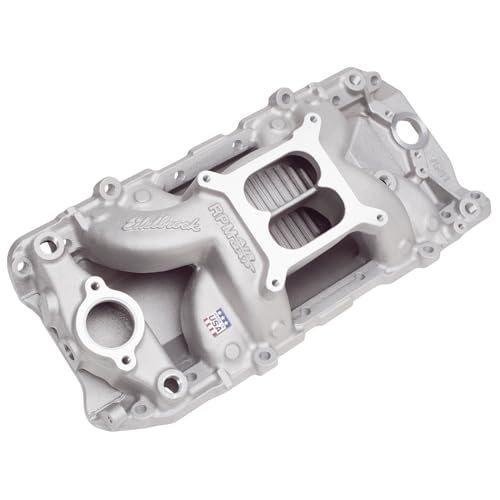 |
Edelbrock Performer RPM Air-Gap 7561 (Big Block Chevy) Best for Big Block Dual-plane air-gap aluminum, 4150 flange, 1500 to 6500 RPM, BBC 396-502 |
9.0 | 🛒 Check Price |
|
Edelbrock Performer 318/360 LA (Small Block Mopar) Best for Mopar Dual-plane aluminum, 4150 flange, idle to 5500 RPM, Chrysler LA 318/360 |
8.8 | 🛒 Check Price |
 |
Edelbrock Victor Jr. 2902 (Small Block Chevy) Best Single-Plane Single-plane aluminum, 4150 flange, 3500 to 8000 RPM, SBC race |
8.5 | 🛒 Check Price |
 |
Weiand Stealth 8501 (Small Block Chevy) Best Value Dual-plane aluminum, 4150 flange, idle to 6000 RPM, SBC 262-400 |
8.2 | 🛒 Check Price |
1. Edelbrock Performer EPS 2701 (Small Block Chevy): Best Overall
The Edelbrock Performer EPS is the manifold we recommend first for the typical Holley Sniper small block Chevy. Its dual-plane layout splits the plenum so each cylinder pulls a strong, consistent signal at low RPM, and that pairs beautifully with the Sniper’s self-tuning logic. The result is crisp tip-in, a smooth idle, and torque right off the bottom, which is exactly what a street car wants. The 4150 square-bore flange clears the Sniper unit without spacers or grinding on most combinations.
The honest weakness is the power band. The EPS is tuned for idle to roughly 5500 RPM, so if you’re building a high-compression, big-cam engine that lives past 6000 RPM, this manifold will sign off before you want it to. For the vast majority of Sniper street builds, though, that ceiling is a non-issue, and the drivability it delivers is hard to beat.
- Dual-plane design for strong low and mid-range torque
- Square-bore 4150 flange that clears the Sniper throttle body
- Accepts standard or EGR-style applications on early small blocks
Pros: Excellent street manners and instant throttle response with the Sniper; Lightweight aluminum saves weight over stock iron; Wide RPM range suits daily drivers and weekend cruisers alike
Cons: Tops out around 5500 RPM, so it isn’t the pick for a high-revving race build
2. Edelbrock Performer RPM Air-Gap 7501 (Small Block Chevy): Best for Power
When a Sniper owner wants more than a basic Performer can give, the RPM Air-Gap is the natural step up. The air gap under the runners keeps engine oil heat away from the incoming charge, so the air the Sniper meters stays cooler and denser. That translates to a measurable bump in mid-range and top-end power while still keeping enough plenum separation to drive nicely around town. Behind a Sniper with a healthy cam, this is a genuinely strong combination.
The trade-off is height. Stacking a Sniper throttle body on top of an already tall air-gap manifold eats hood clearance fast, so measure carefully before buying, especially with a drop-base air cleaner. In cold climates the air gap can also keep the manifold cool enough to slightly delay full warm-up driveability. Neither issue is a deal breaker, but both deserve a check before you commit.
- Air-gap design isolates runners from hot oil to cool the charge
- Dual-plane runners extend usable power to 6500 RPM
- Square-bore 4150 mounting pad sized for the Sniper unit
Pros: Cooler intake charge for a denser, more efficient mixture; Strong mid-range and top-end without killing low-speed torque; Great match for a moderate cam and 1.6 rockers
Cons: Taller casting can create hood clearance issues with the Sniper stacked on top; Air gap can run cold in winter until the engine is fully warm
3. Edelbrock Performer 2101 (Small Block Ford 289/302): Best for Small Block Ford
Ford guys running a Sniper on a 289 or 302 are well served by the Edelbrock Performer 2101. It uses the correct Windsor port layout and a dual-plane runner design that gives the broad, low-end torque a street Mustang or hot rod thrives on. The 4150 flange means the Sniper drops on cleanly, and the smooth idle this manifold produces helps the EFI’s learning routine settle in fast. Compared to a heavy factory Ford iron intake, the gain in both weight and breathing is obvious.
Its limitation mirrors the Chevy Performer: the power band is street-biased and runs out of steam near 5500 RPM. If you have built a high-winding 302 with big heads, look at the RPM Air-Gap version instead. Also confirm you’re buying the small block, not the 351W casting, because the two aren’t interchangeable and the wrong one won’t seal.
- Designed for the 289 and 302 Windsor with stock-style port locations
- Dual-plane runners for broad street torque
- 4150 square-bore flange ready for the Sniper throttle body
Pros: Direct bolt-on for the most common small block Ford swaps; Reliable idle quality that helps the Sniper learn quickly; Noticeable gain over a factory cast-iron Ford intake
Cons: Limited to the 5500 RPM range for hotter 302 combinations; Not intended for 351W heads without the correct dedicated version
4. Edelbrock Performer RPM Air-Gap 7561 (Big Block Chevy): Best for Big Block
For a big block Chevy wearing a Sniper, the Performer RPM Air-Gap 7561 is the manifold that keeps a 454 or 502 happy on the street while still letting it breathe up top. Big cubes move a lot of air, and the air-gap construction keeps that air cool, which matters even more on a large-displacement engine that generates serious underhood heat. The dual-plane runners preserve the stump-pulling torque that makes a big block fun to drive, and the Sniper meters it all without drama.
The two things to get right are port shape and height. Big block Chevy heads come in oval and rectangular port, and the manifold must match, so confirm your heads before ordering. As with all air-gap castings, stacking the Sniper on top builds a tall package, and many big block cars will need a cowl or aftermarket hood for clearance. Plan the hood situation before the manifold arrives.
- Air-gap runners for a cooler charge on big-cube engines
- Dual-plane layout that keeps big block torque strong down low
- Oval-port and rectangular-port options for various BBC heads
Pros: Feeds a thirsty big block without choking low-RPM drivability; Cooler intake charge benefits the larger displacement; Strong casting suited to high-torque applications
Cons: Verify oval versus rectangular port to match your heads; Tall stack height with the Sniper may demand a cowl hood
5. Edelbrock Performer 318/360 LA (Small Block Mopar): Best for Mopar
Mopar fans often struggle to find a clean EFI-ready intake, which is why the Edelbrock Performer for the LA 318 and 360 earns its spot here. It’s a true dual-plane casting designed for the Chrysler small block, delivering the broad low and mid-range torque these engines are known for. Bolting a Sniper to it modernizes a classic Mopar without forcing you to hunt for an obscure adapter, and the manifold’s smooth idle gives the self-tuning system a stable baseline to work from.
The weakness is the familiar one for a Performer-series intake: it’s built for the street and runs out around 5500 RPM, so a built race 360 will want something more aggressive. Mopar engines also have their own quirks around distributor clearance and firewall room, so dry-fit the Sniper before final assembly to be sure the throttle body and linkage clear everything cleanly.
- Built for the Chrysler LA small block 318 and 360
- Dual-plane runners for strong street torque
- Square-bore 4150 pad sized for the Sniper unit
Pros: Correct fit for the often-overlooked Mopar LA platform; Big weight savings over the factory Chrysler iron intake; Smooth idle that suits the Sniper's auto-tune
Cons: Street-oriented power band, not for a race-spec 360; Mopar-specific, so distributor and clearance checks are wise
6. Edelbrock Victor Jr. 2902 (Small Block Chevy): Best Single-Plane
The Victor Jr. Is the manifold for the Sniper owner who is chasing top-end power and is willing to give up some street manners to get it. Its single-plane open plenum lets all eight cylinders share one large chamber, which maximizes high-RPM airflow into a big-cam, high-compression small block. If your engine lives in the upper RPM range and runs ported heads, this casting will let the Sniper feed it the air it needs where a dual-plane would start to fall behind.
That performance comes at a clear cost down low. A single-plane like the Victor Jr. Trades low-speed torque and idle quality for top-end breathing, so a mild street engine will actually feel worse with it than with a Performer. The Sniper can compensate to a point, but it can’t manufacture a strong low-RPM signal that the manifold itself doesn’t produce. Choose this one only if your combination genuinely lives at high RPM.
- Single-plane open-plenum design for maximum top-end airflow
- 4150 flange that accepts the Sniper throttle body
- Built for high-RPM, high-compression race small blocks
Pros: Outstanding upper-RPM power for a serious performance build; Open plenum feeds large cubic-inch, high-flow heads; Strong, race-proven casting
Cons: Soft low-speed torque and a rougher idle on the street; Overkill for a mild daily-driven Sniper combination
7. Weiand Stealth 8501 (Small Block Chevy): Best Value
The Weiand Stealth is the smart-value pick for a small block Chevy Sniper setup. It’s a dual-plane manifold that delivers the same kind of broad street torque as the entry Performer but pushes the usable range a little higher, toward 6000 RPM. The 4150 flange takes the Sniper directly, the aluminum casting trims weight, and Weiand’s long track record means you aren’t gambling on quality. For a street car that wants a dependable, well-rounded intake without paying for race features it’ll never use, the Stealth makes a lot of sense.
Because it’s a conventional dual-plane without an air gap, it gives up a bit of top-end punch and runs a slightly warmer charge than the RPM Air-Gap. In practice most street drivers will never feel that difference, but a builder pushing for every last bit of power up high will. As an honest, no-nonsense manifold for a Sniper daily driver, though, the Stealth is hard to fault.
- Dual-plane design with a slightly higher RPM ceiling than a basic Performer
- Square-bore 4150 flange compatible with the Sniper
- Lightweight aluminum from a long-standing performance brand
Pros: Strong all-around street performance and solid value; Good low and mid-range torque for everyday driving; Proven Weiand casting quality
Cons: Not quite the top-end of an air-gap design; No air gap, so charge temperatures run a touch warmer
Frequently Asked Questions
What kind of intake manifold do I need for a Holley Sniper EFI?
The Holley Sniper EFI throttle body is built to bolt onto a standard 4150 square-bore carburetor flange, so you need an intake manifold with that same 4150 mounting pad. Almost any aftermarket aluminum carbureted manifold for your engine with a square-bore flange will work, which is why classic dual-plane intakes like the Edelbrock Performer series are such common Sniper partners. You don’t need a special EFI-specific manifold; you need the correct carb-flange manifold for your specific engine family.
Should I run a dual-plane or single-plane manifold with my Sniper?
For the vast majority of Sniper builds, a dual-plane manifold is the right answer. Dual-plane designs split the plenum to give each cylinder a strong intake signal at low RPM, which produces the smooth idle, crisp throttle response, and street torque most people want, and it gives the Sniper’s auto-tune a stable baseline. A single-plane like the Victor Jr. Only makes sense on a high-RPM, big-cam race engine where top-end airflow matters more than low-speed drivability.
Will the Sniper throttle body clear an air-gap intake manifold?
It’ll physically bolt on, but the bigger concern is total height. An air-gap manifold is already a tall casting, and stacking the Sniper throttle body plus an air cleaner on top builds a very tall package. Many cars will need a cowl hood or a drop-base air cleaner to clear. Before buying, measure from your manifold flange to the underside of your closed hood and compare it against the combined height of the manifold and Sniper unit to avoid a surprise.
Do I need to match the manifold to my cylinder head ports?
Yes, especially on big blocks. Big block Chevy heads come in oval-port and rectangular-port versions, and the manifold must match the head port shape or the runners won’t line up correctly. Small blocks are more forgiving but still need the correct casting for the engine family, such as small block Ford versus 351 Windsor, or Chrysler LA versus Magnum. Always confirm your exact engine and head combination before ordering so the manifold seals and flows as intended.
Can I keep my existing carburetor manifold when I install a Sniper?
Often yes. If your engine already runs a good aluminum dual-plane manifold with a 4150 square-bore flange, the Sniper will usually bolt right onto it, and many people install a Sniper without changing the intake at all. Upgrading the manifold only makes sense if your current one is a restrictive factory iron casting or is mismatched to your power goals. If your existing manifold is a quality unit that suits your power band, you can save the swap and run the Sniper as is.
Our Verdict
For most Holley Sniper builds the Edelbrock Performer EPS is our top pick, because its dual-plane design gives the self-tuning throttle body the smooth idle and strong street torque it was made for, on a clean 4150 flange that drops the Sniper right on. If you’re chasing more mid-range and top-end power and have the hood clearance to spare, the Edelbrock Performer RPM Air-Gap is the runner up, adding a cooler charge and a higher RPM ceiling without giving up everyday drivability. Match either to your specific engine and heads and your Sniper will reward you with crisp, dependable performance.
More Performance Guides
- Turbocharger vs Supercharger: Choose Your Boost
- Cat-Back or Axle-Back: Which Exhaust Fits Your Goals
- Signs It’s Time to Clean Your Engine Throttle Body
- Cold Air Intake: What It Does and Real Horsepower Gains
- Catalytic Converter Failure: Signs and What It Does
- Best Aluminum Intakes for Small Block Chevy Engines


