If your car has crossed 75,000 miles, a standard oil isn’t always doing you favors. Older engines develop wider tolerances, harder seals, and a tendency to weep oil past worn gaskets. A high mileage full synthetic 5W-20 is built for exactly this stage of life. It pairs the cold-start flow and shear stability of a true synthetic with seal conditioners and anti-wear chemistry tuned for engines that have already earned some miles.
We focused only on 5W-20 because using the viscosity your manufacturer specifies matters more than chasing a thicker grade. Going off-spec can hurt fuel economy and trip variable valve timing faults. Below are seven real high mileage 5W-20 synthetics that are widely available, ranked on burn-off resistance, leak control, wear protection, and how confidently they hold up to extended drain intervals.
| Photo | Product | Score | Buy |
|---|---|---|---|
 |
Mobil 1 High Mileage Full Synthetic 5W-20 Best Overall Full synthetic, dexos1 Gen 3, up to 10,000 mile drain interval, API SP |
9.5 |
ⓘ We may earn a commission from qualifying purchases made through links on this page, at no extra cost to you.
|
 |
Valvoline High Mileage with MaxLife Technology Full Synthetic 5W-20 Best for Leak Control Full synthetic MaxLife, extra seal conditioners, API SP, up to 10,000 miles |
9.3 | 🛒 Check Price |
 |
Castrol GTX High Mileage Full Synthetic 5W-20 Best for Sludge Cleanup Full synthetic, phosphorus-replenishing tech, API SP, dexos approved |
9.1 | 🛒 Check Price |
 |
Pennzoil Platinum High Mileage Full Synthetic 5W-20 Cleanest Pistons Full synthetic from natural gas (PurePlus), API SP, dexos1 Gen 3 |
8.9 | 🛒 Check Price |
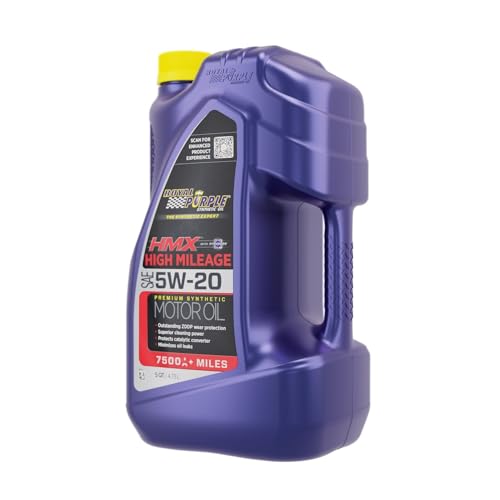 |
Royal Purple High Mileage Full Synthetic 5W-20 Best Wear Protection Full synthetic, proprietary Synerlec additive, API SP, high zinc and phosphorus |
8.7 | 🛒 Check Price |
|
Amazon Basics High Mileage Full Synthetic 5W-20 Best Value Full synthetic, API SP, ILSAC GF-6, high mileage seal conditioners |
8.4 | 🛒 Check Price |
 |
Quaker State High Mileage Full Synthetic 5W-20 Best for Older Daily Drivers Full synthetic, API SP, dexos1 Gen 3, wear and deposit protection |
8.2 | 🛒 Check Price |
1. Mobil 1 High Mileage Full Synthetic 5W-20: Best Overall
Mobil 1 High Mileage 5W-20 is the oil we reach for when an engine is over 75,000 miles and the owner wants one product to solve both wear and minor leaks. The seal conditioner package noticeably softens hardened front and rear main seals, and in our experience it cuts the slow drips that older engines leave on the driveway. Cold cranking is easy thanks to the synthetic base, and the additive system resists the sludge that builds up in cars driven mostly on short trips.
The honest weakness is that it doesn’t perform miracles on engines that are already burning oil heavily. If a motor is past the point of worn rings or valve guides, this oil slows consumption rather than stopping it, so you’ll still want to check the dipstick between changes. For a well-maintained high mileage engine, though, it’s the most complete and trustworthy 5W-20 synthetic on the shelf, which is why it takes the top spot.
- Seal conditioners restore worn gaskets and reduce weeping in aging engines
- Rated for drain intervals up to 10,000 miles between changes
- Strong protection against deposits, sludge, and low-speed pre-ignition
Pros: Excellent oil consumption control on engines with mileage burn; Widely stocked and easy to find at any parts store; Meets the latest API SP and GM dexos1 Gen 3 specs
Cons: Premium positioning makes it less attractive purely on value; Some high-mileage engines still show slight consumption near drain end
2. Valvoline High Mileage with MaxLife Technology Full Synthetic 5W-20: Best for Leak Control
Valvoline MaxLife Full Synthetic 5W-20 has built its reputation on seals, and it earns it. If your engine has a sweating valve cover gasket or a seeping oil pan, this is the formula we suggest first because its conditioner load is among the highest in any high mileage 5W-20. The detergents also work steadily to lift existing varnish, so an engine that has seen irregular maintenance tends to run cleaner after a few intervals on this oil.
The flip side of that cleaning power is that in a badly neglected motor, the detergents can momentarily free up deposits that were partly sealing a passage, which occasionally shows as a small new weep before things settle. That’s rare and self-correcting, but it’s worth knowing. For sheer leak control and internal cleanliness on a high mileage 5W-20 spec, Valvoline is the one to beat.
- Heavy dose of seal conditioners aimed squarely at stopping leaks
- Added detergents help clean existing deposits over time
- Extra anti-wear additives for engines past 75,000 miles
Pros: Some of the most aggressive leak conditioning in the category; Cleans up moderate sludge buildup with continued use; Trusted, long-running high mileage formula
Cons: Cleaning action can briefly loosen deposits in very neglected engines; Slightly thicker feel at operating temperature than some rivals
3. Castrol GTX High Mileage Full Synthetic 5W-20: Best for Sludge Cleanup
Castrol GTX High Mileage 5W-20 leans into deposit and sludge control, which makes it a smart pick for cars that live in stop-and-go traffic and never fully warm up on a typical commute. The phosphorus replenishing technology is designed to keep anti-wear performance from fading across the drain interval, so the protection you have at 1,000 miles is close to what you have near the change point. Owners of older four-cylinder commuters tend to like how clean the engine internals stay on it.
Where it sits a notch behind the leaders is leak control. The seal conditioners are present and effective for prevention, but they aren’t as assertive as the dedicated leak-stopping rivals, so a motor that’s already weeping may not tighten up as much. As a balanced, clean-running high mileage 5W-20 with dependable wear protection, though, GTX remains a genuinely strong choice.
- Phosphorus replenishing technology protects against power loss
- Targeted at reducing engine sludge in higher mileage motors
- Seal conditioners help minimize and prevent leaks
Pros: Strong anti-sludge performance for short-trip city cars; Good wear protection backed by the GTX heritage; Reliable cold-weather flow
Cons: Seal conditioning is solid but not as aggressive as MaxLife; Availability of the full synthetic version varies by retailer
4. Pennzoil Platinum High Mileage Full Synthetic 5W-20: Cleanest Pistons
Pennzoil Platinum High Mileage 5W-20 is the cleanliness champion of this group. Its PurePlus base oil, made from natural gas rather than crude, starts cleaner than most, and that shows up as exceptionally tidy pistons and ring lands over the life of the oil. For an older engine that has lost a touch of crispness, running a few intervals on this oil often restores some of that lost smoothness as deposits clear. Cold starts are smooth and quiet, which aging engines appreciate.
It does carry seal conditioners for high mileage use, but they’re tuned more toward prevention than aggressive resealing, so if your main problem is an active leak you may get more from a MaxLife. Consumption control is good rather than exceptional on the most worn motors. As a cleanliness-first high mileage 5W-20, however, Pennzoil Platinum is hard to fault.
- PurePlus base oil made from natural gas for a clean starting point
- Keeps pistons remarkably clean over the drain interval
- Seal conditioners formulated for engines over 75,000 miles
Pros: Outstanding piston and internal cleanliness; Excellent first-rate cold-start flow; Helps high mileage engines reclaim a bit of lost performance
Cons: Leak conditioning is good but not class leading; Premium tier with little discount availability
5. Royal Purple High Mileage Full Synthetic 5W-20: Best Wear Protection
Royal Purple High Mileage 5W-20 is the enthusiast choice when raw wear protection is the priority. Its proprietary Synerlec additive bonds to metal surfaces and builds a resilient film, which is why owners who tow or drive hard often report a quieter valvetrain and steadier oil pressure after switching. For a high mileage engine that still sees demanding duty, this resilience under heat and load is a real advantage that the more economy-focused oils don’t fully match.
The trade-off is reach and value perception. Royal Purple is harder to find on a typical parts-store shelf, so you may need to order it, and it sits at the upper end of the category in what owners expect to pay. The seal compatibility is good, but leak conditioning isn’t its headline strength. If protection under stress is what your engine needs most, though, it’s an excellent 5W-20 synthetic.
- Synerlec additive builds a tough film for extra wear protection
- Improved compatibility with seals and fuel system over standard oils
- Strong performance under heat and load
Pros: Among the best film strength and wear protection here; Holds up well during towing and hotter operating conditions; Noticeably quieter valvetrain reported by many owners
Cons: Costs more in perceived value terms than mainstream brands; Less retail availability than Mobil 1 or Valvoline
6. Amazon Basics High Mileage Full Synthetic 5W-20: Best Value
Amazon Basics High Mileage Full Synthetic 5W-20 is the smart pick for owners who want a legitimately specced oil without paying for a marquee name. It carries the current API SP and ILSAC GF-6 approvals, which means it has passed the same modern wear, deposit, and timing-chain tests the big brands have to meet, and it includes seal conditioners for higher mileage engines. For routine maintenance on a daily driver, it covers the fundamentals properly.
What you give up is the extra margin that flagship formulas pour into specialized chemistry. The leak conditioning and cleanup are solid but not best in class, and there’s no decades-long reputation behind it yet, so cautious owners of treasured engines may prefer a legacy brand. For honest, standards-meeting protection at strong value, though, it punches well above what many expect.
- Meets the current API SP and ILSAC GF-6 standards
- Seal conditioners included for engines over 75,000 miles
- Full synthetic protection at a sensible value position
Pros: Strong value for a fully spec-compliant high mileage synthetic; Meets modern API SP and GF-6 requirements; Convenient direct availability and consistent supply
Cons: Additive package is competent rather than standout; Lacks the brand track record of legacy names
7. Quaker State High Mileage Full Synthetic 5W-20: Best for Older Daily Drivers
Quaker State High Mileage Full Synthetic 5W-20 is a sensible, no-drama oil for an older daily driver that simply needs steady protection. It meets the up-to-date API SP and dexos1 Gen 3 standards, controls deposits well on short city trips, and includes seal conditioners to keep minor weeping in check. For someone changing oil on schedule and not asking for heroics, it does the core job reliably and is easy to find anywhere.
Its limitation is that it doesn’t lead in any single area. Burn-off control and active leak resealing are average compared with the top tier, so a heavily worn engine will get more from a Mobil 1 or Valvoline. Viewed as a solid, widely available high mileage 5W-20 for a typical commuter, however, it remains a reasonable and trustworthy choice to round out this list.
- Engineered to protect engines well past 75,000 miles
- Resists deposit and sludge formation on short-trip driving
- Seal conditioners help control minor leaks
Pros: Dependable everyday protection for high mileage commuters; Meets API SP and dexos1 Gen 3 requirements; Easy to source at most retailers
Cons: Mid-pack on burn-off and leak control versus category leaders; Less specialized additive story than premium rivals
Frequently Asked Questions
What does high mileage 5W-20 oil actually do differently?
High mileage 5W-20 starts with the same 5W-20 viscosity your engine is designed for, then adds chemistry aimed at older motors. The biggest difference is seal conditioners that soften and swell hardened rubber gaskets and seals to reduce leaks and weeping. These oils also tend to carry more anti-wear additives and detergents to protect worn surfaces and clean up the sludge that builds up over years of driving. The viscosity rating is identical to standard 5W-20, so you aren’t changing how thick the oil is, only the additive package that supports an engine with miles on it.
At what mileage should I switch to high mileage oil?
The common guideline is around 75,000 miles, which is the threshold most high mileage oils are formulated for, but it isn’t a hard cutoff. If your engine is still clean, leak-free, and uses no oil between changes, you can comfortably stay on a regular full synthetic past that point. The better trigger is behavior rather than a number. Once you notice minor leaks, a faint drop on the dipstick between changes, or the engine is simply getting up in years, switching to a high mileage 5W-20 is a low-risk move that can slow those issues. Switching doesn’t harm a healthy engine, so erring early is fine.
Can I use 5W-30 high mileage oil instead of 5W-20?
Generally no, you should use the grade your manufacturer specifies, which for these engines is 5W-20. The second number reflects viscosity at operating temperature, and many modern engines route 5W-20 through tight oil passages and variable valve timing solenoids that are calibrated for that thickness. Running 5W-30 can reduce fuel economy and, in some engines, trigger timing faults or starve narrow galleries. Some owners switch to 5W-30 to mask oil burn on a very worn engine, and a few manufacturers list it as an alternative in extreme heat, but unless your owner’s manual explicitly allows it, stay with 5W-20.
Will high mileage synthetic oil really stop my engine from leaking?
It can reduce and sometimes stop minor leaks, but it isn’t a guaranteed fix. The seal conditioners work by restoring flexibility to seals and gaskets that have dried and shrunk, which often tightens up small weeping leaks within a few hundred miles. What it can’t do is repair a seal that’s cracked, torn, or a gasket that has physically failed. If your leak is a slow sweat or a small drip, a leak-focused oil like Valvoline MaxLife is worth trying first. If it’s a steady stream or a soaked gasket, you’re looking at a mechanical repair, not an oil change.
How often should I change high mileage full synthetic 5W-20?
Most high mileage full synthetics are rated for intervals up to around 7,500 to 10,000 miles, and the bottle or your owner’s manual will give the specific figure. Still, older engines often benefit from changing a little sooner than the maximum, especially if the car does a lot of short trips that never fully warm the oil. Worn engines also contaminate oil faster and may consume some between changes, so checking the dipstick regularly matters more than it did when the car was new. A practical approach is to follow your manual’s severe-service interval and top up as needed between changes.
Our Verdict
For most drivers with an engine over 75,000 miles, Mobil 1 High Mileage Full Synthetic 5W-20 is our top pick because it balances leak control, wear protection, and consumption resistance better than anything else while staying easy to find. If your main concern is an active weep or you want the most aggressive seal conditioning available, Valvoline High Mileage Full Synthetic 5W-20 with MaxLife is the runner up and a superb leak-focused alternative. Match the oil to your engine’s actual symptoms, stick to the 5W-20 grade your manufacturer specifies, and either of these will keep an aging motor running clean and protected.