Driving an RV is nothing like driving a car, and your navigation needs to know the difference. A standard phone app will happily send a 12-foot motorhome under a 10-foot bridge or down a road with a weight limit your rig blows past. A dedicated RV GPS solves that by routing around low clearances, narrow lanes, sharp switchbacks, and propane restrictions once you enter your length, height, and weight.
We looked at the RV navigators travelers actually buy and use on long hauls, judging them on the quality of their truck and RV routing, the size and brightness of the display, how well they find campgrounds and dump stations, and whether the live traffic and warnings are genuinely useful or just noise. Below are our seven top picks, ranked best first, with honest notes on where each one falls short.
| Photo | Product | Score | Buy |
|---|---|---|---|
 |
Garmin RV 1090 Best Overall 10-inch HD touchscreen, RV-specific routing, Wi-Fi map updates, BC 40 backup cam ready |
9.5 | 🛒 Check Price |
 |
Garmin RV 890 Best Value Pick 8-inch edge-to-edge display, RV routing, Wi-Fi updates, BC 40 wireless backup cam compatible |
9.3 | 🛒 Check Price |
 |
Garmin RV 795 Best 7-Inch Pick 7-inch display, RV routing, built-in Wi-Fi, voice command, smartphone live services |
9.1 | 🛒 Check Price |
 |
Rand McNally OverDryve 8 RV Best Connected Tablet 8-inch tablet, RV routing, dash cam built in, Bluetooth calling, live weather and traffic |
8.9 | 🛒 Check Price |
|
Garmin RV 1095 Best Big Screen 10-inch HD display, RV routing, included BC 50 wireless backup camera, Wi-Fi updates |
8.7 | 🛒 Check Price |
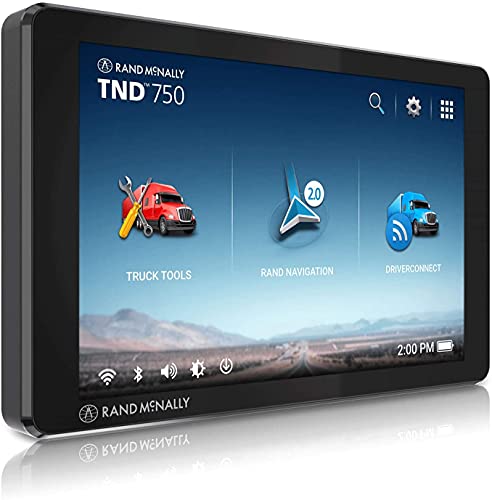 |
Rand McNally TND 750 Best Truck-Grade Routing 7-inch display, truck and RV routing, Wi-Fi updates, lifetime maps, junction view |
8.5 | 🛒 Check Price |
 |
Garmin Overlander Best for Off-Grid 7-inch rugged display, on-road RV and off-road routing, topographic maps, multi-band GNSS |
8.3 | 🛒 Check Price |
1. Garmin RV 1090: Best Overall
The Garmin RV 1090 is the unit we kept reaching for first, and it earns the top spot mostly on its 10-inch screen. On a long travel day, a bigger, brighter display genuinely lowers stress, because you can read the next turn and the lane guidance without squinting or leaning forward. You enter your rig profile once, and from then on it routes you around low bridges, weight-limited roads, and tight residential turns that a phone would never flag. The campground and points-of-interest database is deep, and the trip planner lets you string together stops, set a daily drive limit, and preview the route before you ever pull out of the site.
The honest weakness is size. That same 10-inch screen that we love can dominate a smaller windshield, and on a compact Class B van it sometimes felt like too much glass in the line of sight. The included suction mount is sturdy but tall, so plan your placement. Voice commands also work better with a strong cellular tether for live traffic, and in remote stretches the smart features quiet down to basic offline navigation. None of that undercuts the core routing, which is why this is still our overall winner.
- Huge 10-inch edge-to-edge display that stays readable in bright cab sunlight
- Custom RV routing using your length, height, weight, and width to avoid hazards
- Pre-loaded campgrounds, services, and a Tread-style trip planner with photos
Pros: Best-in-class big screen makes complex interchanges easy to read at a glance; Reliable RV routing with clear low-clearance and sharp-curve warnings; Wireless map and software updates over Wi-Fi, no cable or computer needed
Cons: Large footprint can crowd a smaller windshield or dash; Voice command response can lag in areas with weak data
2. Garmin RV 890: Best Value Pick
The Garmin RV 890 is the sweet spot for most RV travelers and the unit we recommend to anyone who does not specifically need the largest screen on the market. It runs the same RV routing as the flagship, so you still get hazard warnings, custom vehicle profiles, and an enormous campground and services database, but the 8-inch body fits cleanly on far more windshields. The magnetic powered mount is a small thing that pays off daily, since you can lift the unit off in one motion when you park and pop it back on without fiddling with cables.
Its limitation is mostly relative. If you have spent time with the 1090, the 8-inch screen can feel a touch cramped on busy multi-lane approaches, and that is the main reason it sits just behind our top pick rather than tied with it. Like the rest of the line, the smartest features, live traffic, weather, and connected search, lean on a paired phone, so in dead zones you fall back to solid but plain offline routing. For the blend of capability and practicality, this is the one most people should buy.
- 8-inch bright display that fits more windshields than the 10-inch models
- Full RV-specific routing with custom vehicle profiles and warnings
- Magnetic powered mount makes it quick to grab and stow at every stop
Pros: Excellent balance of screen size and dash footprint for most rigs; Same trusted Garmin RV routing engine as the larger 1090; Easy magnetic mount and clean menu layout for travelers new to GPS units
Cons: 8-inch screen feels small after you have used the 10-inch version; Live services depend on a paired phone with a steady connection
3. Garmin RV 795: Best 7-Inch Pick
The Garmin RV 795 is built for travelers who want full RV routing without a giant slab of glass on the dash. The 7-inch screen is the right call for camper vans, truck campers, and smaller Class C rigs where windshield real estate is tight. It keeps the features that matter, custom vehicle profiles, low-clearance and sharp-curve alerts, and a complete campground directory, and adds genuinely handy voice control so you can reroute or search for fuel without taking your hands off the wheel. Paired with the Garmin Drive app, you also get live traffic and weather.
The trade-off is detail. At 7 inches there is simply less map on screen, so on dense interchanges you sometimes get less advance picture of which fork is coming. The built-in speaker is also on the weaker side, and at highway speed with the windows down we occasionally missed a spoken instruction and leaned on the on-screen guidance instead. If you can route audio through your stereo, that complaint mostly disappears, and what remains is a very capable compact RV navigator.
- Compact 7-inch unit that suits vans and smaller motorhomes
- Voice-activated navigation so you can keep both hands on the wheel
- Live traffic, weather, and connected services through the Garmin Drive app
Pros: Compact size fits tight cabs without blocking your view; Voice control is genuinely useful on long solo drives; Strong RV routing in a lighter, more portable body
Cons: Smaller screen shows less map detail at a glance; Speaker can be hard to hear over road noise at highway speed
4. Rand McNally OverDryve 8 RV: Best Connected Tablet
The Rand McNally OverDryve 8 RV stands out because it tries to be more than a navigator. It is an 8-inch connected tablet that handles RV routing, but also bundles in a built-in dash cam, Bluetooth hands-free calling, live weather, and music, so it can serve as the central screen of your cab. For travelers who like the idea of one device covering several jobs, that consolidation is appealing, and the RV routing itself respects your vehicle profile while surfacing RV parks and campgrounds along the way. The tablet feel makes it approachable if you are coming from a phone rather than a traditional GPS.
The cost of doing everything is focus. With dash cam, media, calling, and navigation all stacked on one device, the menus are busier and there is a real learning curve before it feels natural. Performance is the other watch-out, since the tablet can stutter when you ask it to do too much at once, something a single-purpose GPS rarely does. If you want one screen to rule the dash and are willing to climb the learning curve, it delivers, but pure-navigation purists may prefer a simpler unit.
- Android-based tablet doubles as an entertainment and information hub
- Built-in dash cam records the road as you navigate
- RV-specific routing plus campground and RV park listings
Pros: All-in-one design combines GPS, dash cam, and Bluetooth hands-free; Bright tablet interface feels familiar to phone and tablet users; Good RV park and campground content for trip planning
Cons: More features mean a steeper learning curve at first; Tablet can feel sluggish compared with a dedicated GPS
5. Garmin RV 1095: Best Big Screen
The Garmin RV 1095 is essentially the big-screen experience with a backup camera thrown in, and that bundle is the whole reason to consider it. You get the same readable 10-inch HD display and the same well-proven RV routing, then add the included BC 50 wireless camera so you can see directly behind your rig while reversing into a site. For travelers who have been meaning to add a rear camera anyway, buying it together with the navigator removes a separate purchase and a separate install headache, and the integration on screen is clean.
It lands a little lower in our ranking only because the camera bundle is not a fit for everyone. If your RV already has a rear view system, you are paying for hardware you do not need, and the 10-inch body carries the same windshield-hogging caveat as the 1090. The initial setup also takes patience, since mounting the camera and pairing it is more involved than just sticking a GPS to the glass. For those who want one box that solves both navigation and backing visibility, though, it is a smart, capable choice.
- Massive 10-inch screen with included wireless backup camera
- RV routing with detailed hazard and elevation awareness
- Bundled BC 50 camera adds rear visibility for safer backing
Pros: Comes with a wireless backup camera in the box for added value; Same large, easy-to-read display as our top pick; Strong routing plus extras like elevation and curve warnings
Cons: Large unit takes up significant windshield space; Backup camera mounting and pairing take some setup time
6. Rand McNally TND 750: Best Truck-Grade Routing
The Rand McNally TND 750 comes from the trucking world, and that heritage shows in how seriously it treats vehicle dimensions. You enter your RV profile and it routes with a commercial mindset, steering you clear of restricted roads, low clearances, and weight-limited bridges with the kind of confidence that comes from a company that has navigated 18-wheelers for years. The junction view and lane guidance are particular strengths, painting a clear picture of complex exits so you are not guessing which lane to hold at 60 miles per hour. Wi-Fi updates keep the maps fresh without dragging out a laptop.
Where it shows its roots is the experience around the routing. The interface is functional rather than polished, and next to a slick consumer unit it can feel a bit plain and dated. The touchscreen also is not the most responsive we researched, so quick taps sometimes need a second press. If you value routing accuracy for a large rig above visual flash, those are easy compromises, but travelers who want a modern, app-like feel may find it a little workmanlike.
- Detailed truck and RV routing tuned for large, heavy vehicles
- Clear junction and lane guidance for complex highway exits
- Wi-Fi map updates and a rugged, road-focused interface
Pros: Routing logic built around big-vehicle restrictions and weigh points; Junction view makes tricky interchanges much less stressful; Wi-Fi updates keep maps current without a computer
Cons: Interface looks more utilitarian than consumer GPS units; Touch response is not as crisp as a modern tablet
7. Garmin Overlander: Best for Off-Grid
The Garmin Overlander is the pick for RV travelers whose idea of a campsite ends well past the pavement. It is a rugged, water-resistant unit that switches between on-road navigation with vehicle profiles and genuine off-road, off-grid routing using topographic maps and public land boundaries. For van-lifers and adventure-rig owners who chase boondocking spots and forest roads, that dual nature is hard to beat, because the same screen that gets you across the interstate can also keep you oriented on an unmarked dirt track with no cell signal. The multi-band reception holds a fix in tree cover and canyons where lesser units wander.
The catch is that this specialization is wasted on a lot of buyers. If you stick to established RV parks and paved routes, you are paying for rugged off-grid capability you will rarely touch, and the on-road RV routing, while good, is not quite as polished as Garmin’s dedicated RV models. The interface also assumes you want the off-road tools front and center. For overlanders and remote campers it is the obvious choice, but for a traditional motorhome that lives on highways, one of the road-focused units above will serve you better.
- Rugged, IPX7 water-resistant build for overlanding and dirt roads
- Switches between RV road routing and off-grid topographic navigation
- Detailed topo maps and public land data for boondocking
Pros: Handles both highway RV routing and serious off-road exploration; Durable, weather-resistant body survives rough conditions; Excellent topographic and public land mapping for remote camping
Cons: Overkill for travelers who never leave paved campgrounds; On-road routing is good but not as refined as the dedicated RV line
Frequently Asked Questions
Do I really need an RV GPS, or can I just use my phone?
A phone app is fine for a car, but it does not know your RV is 12 feet tall, 30 feet long, and several tons heavy. A dedicated RV GPS lets you enter those dimensions and then actively routes you around low bridges, narrow roads, weight-limited routes, sharp switchbacks, and sometimes propane restrictions. It also warns you about upcoming hazards and steep grades. For a small camper van you might get away with a phone, but for any larger motorhome or trailer, a true RV GPS is the difference between a calm drive and a white-knuckle moment under a clearance bar.
How does RV routing actually avoid low bridges and weight limits?
When you set up the device, you create a vehicle profile with your length, height, width, and weight. The GPS then cross-references that profile against road attribute data in its maps, including posted clearances, bridge weight limits, and restricted roads. When it plots a route, it filters out segments your rig cannot legally or safely use and chooses an alternative. It is not perfect, since map data can lag behind real-world signage, so you should still watch posted signs, but it dramatically reduces the chance of being sent somewhere your RV does not fit.
What screen size is best for an RV GPS?
It depends on your rig and your eyes. Larger 8-inch and 10-inch screens show more of the map and make lane guidance and complex interchanges much easier to read at a glance, which lowers fatigue on long days. The trade-off is that a big unit eats windshield space and can intrude on your sightline, especially in a compact van. A 7-inch unit is more discreet and fits tighter cabs. Many full-size motorhome owners prefer 8 inches as the sweet spot, while van and truck-camper travelers often lean toward 7.
Will an RV GPS help me find campgrounds and dump stations?
Yes, and this is one of the best reasons to own one. RV-specific units come pre-loaded with directories of campgrounds, RV parks, dump stations, fuel stops with high clearances, and other traveler services. You can search along your route, see details, and add stops to a trip plan. Some units include photos, amenities, and user-style ratings to help you choose. Combined with the routing, this turns the GPS into a planning tool, not just a turn-by-turn voice, letting you map a multi-day journey with overnight stops before you leave the driveway.
How do I keep the maps up to date?
Most modern RV navigators update over built-in Wi-Fi, so when you are parked at a campground or at home you connect to the network and download the latest map and software directly to the device. That is far easier than the old method of plugging into a computer. Many units include map updates at no extra charge for the life of the device, so it is worth confirming that when you buy. Keeping maps current matters more for RVs than cars, because new clearance, construction, and restriction data is exactly what keeps your big rig out of trouble.
Our Verdict
For most RV travelers, the Garmin RV 1090 is our top pick thanks to its huge, easy-to-read 10-inch screen, dependable big-rig routing, and deep campground database that together make long travel days noticeably calmer. If its size is more glass than your dash wants, the Garmin RV 890 is our runner up and the smarter buy for many people, delivering the same trusted RV routing in an 8-inch body that fits more windshields, plus a grab-and-go magnetic mount. Choose the 1090 for maximum screen, the 890 for the best all-around balance, and step toward the Overlander only if your campsites tend to be off the pavement.
More GPS Navigation Guides
Video Guide
Video: Related tutorial from YouTube