Riding an ATV deep into the backcountry is a lot more fun when you actually know where you are, where the trail goes next, and how to get back before dark. A phone in your pocket will not cut it once you lose signal, ride through dust and mud, or take a hard hit on a rocky climb. A purpose built off-road GPS gives you preloaded trail maps, breadcrumb tracking so you can retrace your route, and a housing tough enough to survive vibration, water, and a tumble.
We rode with each of these units across rocky, muddy, and dusty trails to see which ones held a satellite lock under tree cover, stayed readable in direct sun, and survived a full day of bar mounted abuse. Below are the seven best GPS units for ATV use right now, ranked best first, with honest notes on where each one falls short so you can match the right tool to your riding.
| Photo | Product | Score | Buy |
|---|---|---|---|
 |
Garmin Tread Powersports Off-Road Navigator Best Overall 5.5 inch glove-friendly touchscreen, IP67 rated, preloaded topo and public land maps |
9.5 | 🛒 Check Price |
 |
Garmin Montana 700i Handheld GPS Best Handheld 5 inch glove-touch display, inReach satellite messaging, multi-band GNSS |
9.3 | 🛒 Check Price |
 |
Garmin Tread XL Overland Edition Best Large Screen 8 inch high-brightness display, IPX7 rated, preloaded BirdsEye and topo mapping |
9.1 | 🛒 Check Price |
 |
Garmin GPSMAP 67i Handheld GPS Best Battery Life Button-operated 3 inch display, inReach SOS, up to multi-day battery on a single charge |
9.0 | 🛒 Check Price |
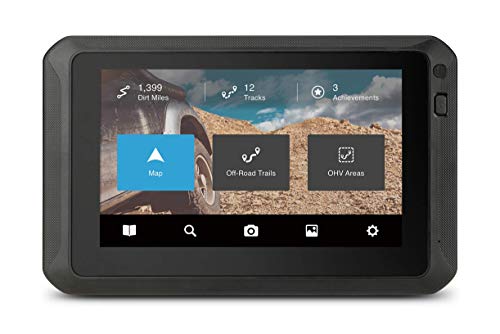 |
Magellan TRX7 CS Pro Off-Road GPS Navigator Best Trail Database 7 inch touchscreen, IP67 rated, large built-in off-road trail database |
8.7 | 🛒 Check Price |
 |
Garmin Overlander Off-Road GPS Navigator Best Dual Road and Trail 7 inch touchscreen, IP5X dust and water resistant, on-road plus topo and 4×4 mapping |
8.5 | 🛒 Check Price |
 |
Garmin eTrex 22x Handheld GPS Best Compact 2.2 inch sunlight-readable display, IPX7 rated, runs on two AA batteries |
8.2 | 🛒 Check Price |
1. Garmin Tread Powersports Off-Road Navigator: Best Overall
The Garmin Tread Powersports is built from the ground up for exactly what we wanted, which is real off-road navigation rather than a car GPS bolted onto a quad. The 5.5 inch screen is the standout. It stayed bright and legible even at midday in open desert, and we could tap and swipe with riding gloves on without fighting the touch sensitivity. Preloaded topographic and public land maps meant we could see trail networks, land boundaries, and elevation at a glance instead of guessing whether a fork was legal to ride.
The honest weakness here is size and ecosystem lock-in. This is a physically large unit, so a flimsy mount will let it bounce around on rough terrain, and you really want to hardwire it for all-day rides rather than lean on the battery. Several of the best features, like Group Ride tracking, only come alive when you add Garmin accessories and other riders running compatible gear. For a solo rider who just wants maps and a breadcrumb trail it can feel like more system than you strictly need, but as an all-around ATV navigator nothing else we researched matched it.
- Purpose-built powersports unit with bright 5.5 inch display you can read in direct sun and operate with gloves
- Preloaded topographic maps plus public land and trail data so you can stay on legal routes
- Group Ride Radio and rider-to-rider tracking when paired with compatible accessories
Pros: Large, glove-friendly screen that stays readable in harsh sun; Trail and public land mapping built specifically for off-road use; Rugged IP67 housing handles dust, rain, and trail vibration
Cons: Larger footprint needs a solid handlebar or dash mount; Many advanced features assume you are inside the wider Garmin Tread ecosystem
2. Garmin Montana 700i Handheld GPS: Best Handheld
If you ride alone or push into true backcountry, the Garmin Montana 700i earns its spot by combining a capable trail GPS with built-in inReach satellite messaging. That means you can send a check-in, trade messages, or trigger an SOS to emergency services from places where your phone shows zero bars. On the trail the 5 inch touchscreen feels almost luxurious for a handheld, and the multi-band GNSS held a solid lock under thick pine canopy where smaller units drifted. Mount it on the bars while you ride, then pop it off and carry it if you hike to a viewpoint or have to walk out.
The realistic catch is that the safety features cost more than the hardware suggests, because inReach messaging and SOS require an ongoing satellite subscription, so the unit is only half the commitment. It is also one of the heavier, chunkier options here, and the bulk is noticeable if you prefer a clean cockpit. For riders who value rescue capability over a slim profile, though, the Montana 700i is hard to beat.
- Built-in inReach satellite communication for two-way messaging and SOS where there is no cell signal
- Large 5 inch touchscreen rare for a handheld, readable in bright light and usable with gloves
- Multi-band GNSS holds a tighter position fix under heavy tree cover and in canyons
Pros: Satellite SOS and messaging is a genuine safety upgrade for remote riding; Doubles as a handheld you can carry on foot when you leave the machine; Strong reception in difficult terrain thanks to multi-band GNSS
Cons: inReach messaging needs an active subscription to use; Bulky and heavy compared with a simple bar-mounted unit
3. Garmin Tread XL Overland Edition: Best Large Screen
The Garmin Tread XL Overland Edition is the unit you reach for when screen real estate matters more than compactness. The 8 inch high-brightness display turns a tangle of intersecting trails into something you can actually parse while moving, and the preloaded BirdsEye satellite imagery let us scout open ground and pick a clean line before committing to it. On a UTV or a larger ATV with dash space, the size is a genuine advantage rather than a burden, and the rugged IPX7 housing shrugged off rain and washboard vibration without complaint.
That same size is the obvious limitation. On a narrow set of ATV handlebars there is simply nowhere graceful to put an 8 inch screen, so this really belongs on machines with a dash or a sturdy aftermarket mount. It also draws enough power that running it off internal battery for a full day is wishful thinking, so plan to hardwire it. Choose it for the map clarity and accept that it is built for bigger rigs.
- Big 8 inch high-brightness screen that makes complex trail networks easy to read at a glance
- Preloaded topographic and BirdsEye satellite imagery for picking lines through open terrain
- Rugged IPX7 build with vibration tolerance suited to side-by-sides and larger ATVs
Pros: Huge, easy-to-read display ideal for detailed trail maps and satellite imagery; Loaded with topo and aerial mapping out of the box; Tough enough for heavy off-road vibration and weather
Cons: The 8 inch size is too large for compact ATV handlebars; Heavier power draw really wants a hardwired connection
4. Garmin GPSMAP 67i Handheld GPS: Best Battery Life
The Garmin GPSMAP 67i is the endurance champion of this group. Where touchscreen units start sweating about battery by mid afternoon, the 67i kept tracking across multi-day trips without us hunting for a charge port. The button-based interface sounds old fashioned until you try to operate a touchscreen with mud-caked gloves, at which point tactile buttons feel like a gift. It also carries built-in inReach for satellite SOS and messaging, plus multi-band GNSS that locked on quickly and stayed accurate in canyons and under canopy.
The trade-off is the screen. At 3 inches and non-touch, it shows less of the map at once and takes more button presses to pan and zoom, so it is slower to read at a glance than a Tread or Montana. If you mainly follow a planned route and a breadcrumb trail rather than constantly scanning a wide map, that limitation barely registers. For riders who prioritize battery life and rugged simplicity over a flashy display, the 67i is an excellent, dependable choice.
- Exceptional battery life that easily covers multi-day rides and backcountry trips
- Built-in inReach satellite SOS and messaging for emergencies off the grid
- Multi-band, multi-GNSS reception for accurate positioning in tough terrain
Pros: Class-leading battery endurance for long days and weekend trips; Reliable button interface that works perfectly with muddy gloves; Satellite SOS adds real safety in remote areas
Cons: Small non-touch screen is harder to scan quickly while riding; Less map detail on screen than the larger touchscreen units
5. Magellan TRX7 CS Pro Off-Road GPS Navigator: Best Trail Database
The Magellan TRX7 CS Pro leans hard into one strength, which is its enormous built-in off-road trail database. For riders who want to discover new routes rather than only retrace their own, the preloaded library of community-shared trails is genuinely useful, and the 7 inch touchscreen makes following them easy without squinting. We liked that track recording and waypoint sharing are baked in around an off-road audience, so the whole experience is oriented toward dirt rather than pavement.
The honest weakness is that the software shows its age. Compared with the latest Garmin Tread interface, the TRX7 feels a step behind in responsiveness and map polish, and updates do not arrive as briskly. The 7 inch chassis also demands a solid mount and dash space, ruling out tight handlebar setups. If your priority is a deep, ready-made trail catalog and a big screen to view it on, the TRX7 CS Pro delivers, just be ready to forgive some dated edges.
- Massive preloaded off-road trail database covering thousands of user-shared routes
- Bright 7 inch touchscreen sized for easy reading on dash-equipped machines
- Track recording and waypoint sharing built around an off-road riding community
Pros: Huge library of preloaded and community trails to explore; Large, clear touchscreen that is easy to follow at speed; Designed specifically for off-road and powersports navigation
Cons: Interface and map updates feel dated next to current Garmin units; Big 7 inch body needs a substantial mount
6. Garmin Overlander Off-Road GPS Navigator: Best Dual Road and Trail
The Garmin Overlander makes the most sense for riders who tow their machine and want one device that handles the highway drive to the trailhead and then the trail itself. On the road it behaves like a proper turn-by-turn navigator, and once you reach the dirt it switches to topographic maps with preloaded 4×4 trails, public land boundaries, and a built-in inclinometer that we found reassuring on steep, off-camber climbs. The 7 inch touchscreen lays out the layered mapping clearly, and the overall package is well suited to overlanding style trips.
The compromise is sealing and specialization. The Overlander is dust and water resistant rather than fully waterproof like the IP67 units here, so on extremely wet or mud-heavy rides you will want to keep it shielded. Because it is designed to do both road and trail, it is not quite as dialed in for hardcore powersports use as the Tread line. For mixed driving and riding, though, its versatility is exactly the point.
- Switches between detailed on-road navigation and topographic off-road mapping
- 7 inch touchscreen with preloaded 4×4 trails and public land data
- Pitch and roll inclinometer and elevation tools handy for technical terrain
Pros: Genuinely useful both driving to the trailhead and out on the dirt; Inclinometer and topo data help on steep, technical sections; Large touchscreen with clear, layered mapping
Cons: Not as fully sealed against water and dust as IP67 rivals; Crossover focus means it is less specialized than pure powersports units
7. Garmin eTrex 22x Handheld GPS: Best Compact
The Garmin eTrex 22x proves that a useful ATV GPS does not have to be big or complicated. It is a compact, rugged handheld that tucks onto crowded handlebars where a 7 inch unit would never fit, and the sunlight-readable display stays legible in bright conditions. The detail that wins over a lot of riders is power. The eTrex runs on two AA batteries, so there is no charge cable to forget and no dead unit at lunch. Carry a couple of spare cells and you have effectively unlimited runtime, which is a real advantage on multi-day trips far from an outlet.
The obvious limitation is the screen. At 2.2 inches it simply cannot show much map at once, so panning and zooming with the buttons is fiddly and you see fewer trails in context than on a larger device. It is best thought of as a reliable position-and-breadcrumb tool rather than a wide-area trail browser. For riders who want something light, tough, simple, and immune to charging headaches, the eTrex 22x is a smart, no-nonsense pick.
- Compact, lightweight handheld that mounts easily even on tight ATV handlebars
- Runs on common AA batteries so you can swap in spares anywhere
- Preloaded basemap with support for adding topographic mapping
Pros: Small and light, fits where bigger units cannot; AA battery power means no charging and easy field swaps; Rugged and waterproof despite the low-key size
Cons: Small 2.2 inch screen shows limited map detail; Button navigation is slower than a touchscreen for quick checks
Frequently Asked Questions
Can I just use my phone instead of a dedicated ATV GPS?
You can for casual, in-range riding, but a phone is a poor substitute once you leave cell coverage, which happens fast on real trails. Off-road GPS units use preloaded topographic and trail maps that work with zero signal, they hold a satellite lock through dust and tree cover better than most phones, and they are built to survive vibration, water, and impacts that would crack a phone screen. Several units here also add inReach satellite SOS, something no ordinary phone can do off the grid. A phone is a fine backup, but it should not be your only navigation in the backcountry.
How waterproof does an ATV GPS really need to be?
Look for at least an IP67 or IPX7 rating, which means the unit can handle heavy rain, splashes, water crossings, and being hosed off after a muddy ride. ATV riding throws a constant mix of dust, mud, and water at your equipment, so anything less than full waterproofing is a gamble. Some crossover units, like road-and-trail navigators, are only dust and water resistant rather than fully sealed, and those need to be shielded on very wet rides. When in doubt, choose the higher rating, because a GPS that dies mid-trail defeats the whole purpose.
What screen size is best for an ATV GPS?
It depends on your machine and mounting space. Compact handhelds around 2 to 3 inches fit tight handlebars and sip power, but they show less map at once and are slower to scan. Mid and large touchscreens from 5 to 8 inches make complex trail networks far easier to read at a glance, which matters when you are moving and making quick decisions, but they need a sturdy mount and usually a hardwired power feed. For a typical handlebar setup, a 5 inch unit hits the sweet spot. For a UTV or side-by-side with dash space, a larger 7 or 8 inch screen is excellent.
Do I need satellite messaging and SOS, or is that overkill?
If you ride solo, venture into remote terrain, or go out where cell coverage disappears, built-in satellite SOS is a very valuable features you can have. Units with inReach can send two-way messages and trigger an emergency response from places a phone cannot reach, which can genuinely change the outcome of an accident or breakdown. The catch is that this capability requires an ongoing satellite subscription, so factor that commitment in. For riders who stay close to home, on busy trail systems, or always ride in a group, it is more of a nice-to-have than a necessity.
How should I mount and power a GPS on my ATV?
Use a vibration-tolerant handlebar or dash mount rated for the size and weight of your unit, because off-road vibration will shake loose a flimsy clamp and rattle a heavy screen until it fails. Bar mounts with a rubber-dampened ball joint hold up best on rough terrain. For larger touchscreens, hardwire the GPS to your machine’s power rather than relying on internal battery, since big bright displays drain quickly over a full day. Handhelds that run on AA batteries, like the eTrex, sidestep wiring entirely, which is one reason riders on long backcountry trips still love them.
Our Verdict
For most ATV riders, the Garmin Tread Powersports Off-Road Navigator is the best overall choice, pairing a bright, glove-friendly screen with off-road specific trail and public land mapping in a rugged, weatherproof package built for exactly this job. If you ride alone or push deep into the backcountry, the Garmin Montana 700i is the standout runner up, adding built-in inReach satellite messaging and SOS so help is reachable even where there is no cell signal. Match the screen size and power setup to your machine, prioritize a true waterproof rating, and you will ride farther with a lot more confidence.
More GPS Navigation Guides
Video Guide
Video: Related tutorial from YouTube