Picking the right gauge speaker wire is one of those quiet decisions that quietly makes or breaks your whole car audio build. Go too thin on a long run to your door speakers and you choke the signal, lose volume and add resistance that the amp has to fight. Go heavier than you need on a short tweeter run and you’re just wrestling thick wire into tight panels for no real benefit. The right answer is almost always about matching the gauge to the speaker, the amp power and the length of the run.
We pulled together seven speaker wires that car audio installers actually reach for, spanning 12, 14, 16 and 18 AWG so there’s a correct pick whether you’re wiring a mild factory upgrade or a full component setup with a strong amp. We looked at real copper content, jacket flexibility, how the conductor strips and how clearly the polarity is marked, because the wire that installs cleanly is the wire you’ll actually run correctly. No fluff, just what each one is good for.
| Photo | Product | Score | Buy |
|---|---|---|---|
 |
InstallGear 14 Gauge Speaker Wire (CCA) Best Overall 14 AWG, CCA conductor, 100 ft spool, clear jacket with polarity stripe |
9.5 |
ⓘ We may earn a commission from qualifying purchases made through links on this page, at no extra cost to you.
|
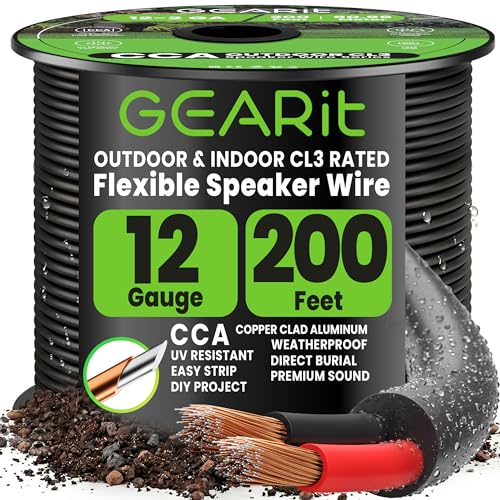 |
GearIT Pro Series 12 Gauge OFC Speaker Wire Best for High Power 12 AWG, oxygen-free copper, 100 ft, dual-color polarity insulation |
9.3 | 🛒 Check Price |
 |
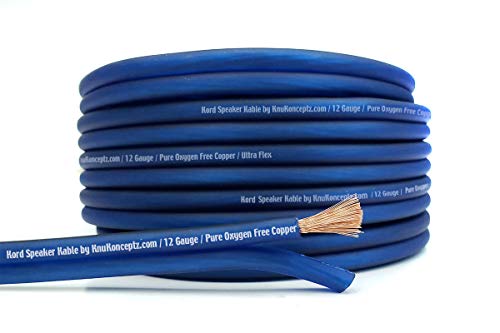
Knukoncepts Kord 16 Gauge Speaker Wire Best for Tight Runs 16 AWG, copper, flexible matte jacket, 100 ft, marked conductor |
9.1 | 🛒 Check Price |
 |
Rockville R14G100 14 Gauge OFC Speaker Wire Best OFC Value 14 AWG, 100 percent OFC copper, 100 ft, clear UV-resistant jacket |
8.9 | 🛒 Check Price |
 |
BOSS Audio Systems BRC18 18 Gauge Speaker Wire Best for Factory Swaps 18 AWG, CCA, 50 ft, slim flexible jacket, polarity marked |
8.6 | 🛒 Check Price |
 |
Mediabridge 12AWG Ultra Series Speaker Wire Best Durability 12 AWG, CCA core, 100 ft, durable jacket with sequential footage markers |
8.4 | 🛒 Check Price |
 |
Sky High Car Audio 16 Gauge CCA Speaker Wire Best Flexible Spool 16 AWG, CCA, fine-strand, 100 ft, soft pliable jacket |
8.2 | 🛒 Check Price |
1. InstallGear 14 Gauge Speaker Wire (CCA): Best Overall
If we had to wire one car with one spool, this is the gauge and the wire we would grab. Fourteen AWG is the goldilocks choice for the overwhelming majority of car audio installs: thick enough to feed an amped pair of 6.5-inch components or coaxials across a full door run without measurable signal loss, yet still flexible enough to fish through door boots and behind kick panels without a fight. The clear jacket with its printed polarity stripe is genuinely useful at install time, because nothing slows a job down like guessing which conductor is positive at the speaker terminal.
The honest weakness is the conductor itself. This is copper-clad aluminum, not oxygen-free copper, which means for the same gauge it carries a touch more resistance than a pure copper wire of identical thickness. In practice, on the run lengths inside a car, that difference is inaudible for most listeners, and the value and flexibility you get in return are excellent. Purists chasing the last fraction of a decibel will want pure copper, but for a clean, reliable, easy-to-run upgrade that covers nearly every speaker in the car, this is the one we recommend first.
- 14 gauge hits the sweet spot for most full-range and component door speakers
- Clear flexible jacket with a printed stripe for fast polarity identification
- Generous 100 foot length covers a full four-speaker car run with margin
Pros: Ideal all-around gauge for typical amped door and rear speakers; Jacket strips cleanly and flexes around door grommets without kinking; Long spool length means you rarely run short on a four-speaker job
Cons: Copper-clad aluminum, not pure copper, so resistance is slightly higher; Overkill thickness for tweeter-only or short dash runs
2. GearIT Pro Series 12 Gauge OFC Speaker Wire: Best for High Power
When the run is long and the power is high, gauge matters more, and this is where 12 AWG earns its place. Running wire from a trunk-mounted amplifier all the way to the front doors is a surprisingly long distance once you account for routing under the sills, and thinner wire on that length starts to add up to real resistance. GearIT’s Pro Series uses genuine oxygen-free copper, so you get the lowest practical resistance per foot, which keeps voltage drop minimal and lets your amp deliver its rated power to the speaker instead of warming the wire. The dual-color insulation is a small touch that pays off on every single connection.
The trade-off is exactly what you’d expect from heavy copper: it’s stiff and it’s bulky. Twelve gauge OFC doesn’t want to make tight bends, and threading it through a door grommet takes patience and sometimes a pull string. For short tweeter leads or a mild factory swap it’s genuine overkill. But if you’re feeding powered components on a long run, or you simply want the most headroom you can install once and forget, this thick copper wire is the confident choice.
- Heavy 12 gauge for long runs and high-wattage subwoofer-adjacent speakers
- True oxygen-free copper for the lowest practical resistance per foot
- Two-tone insulation makes positive and negative obvious in any light
Pros: Real OFC copper delivers clean power on long or high-current runs; Thick gauge keeps voltage drop tiny even from a trunk-mounted amp; Tough jacket resists abrasion under carpet and through metal
Cons: Thick and stiff, so it fights you inside tight door cavities; More wire than light factory-replacement speakers will ever need
3. Knukoncepts Kord 16 Gauge Speaker Wire: Best for Tight Runs
Not every run needs heavy gauge, and forcing thick wire into a tight space is how installs go wrong. Sixteen AWG is the right answer for short and medium runs, tweeter leads up the A-pillar, and modest amped speakers where the distance is reasonable. Knukoncepts Kord shines here precisely because of how easy it’s to handle. The fine-strand conductor and supple jacket let it follow factory wiring loom paths, slip through rubber door boots and tuck behind pillar trim without the wrestling match a heavier wire demands. For installers, that flexibility translates directly into faster, cleaner jobs.
The flip side of that easy handling is that 16 gauge isn’t the wire for a long, high-current pull. On a lengthy run from a powerful amp, the thinner conductor adds enough resistance that you give up a little of the power you paid for, so it’s best kept to shorter distances. Stay inside its lane, which is exactly where most dash speakers and tweeters live, and it’s among the most pleasant wires to work with in the whole roundup.
- 16 gauge is ideal for short to medium runs and tweeter leads
- Very flexible jacket snakes through door boots and pillar trim easily
- Fine-strand conductor stays supple in cold weather installs
Pros: Flexibility makes it the easiest wire here to route in tight panels; Right-sized gauge for dash, pillar and shorter door runs; Clear conductor marking speeds up polarity matching
Cons: Too thin for long high-power runs where voltage drop adds up
4. Rockville R14G100 14 Gauge OFC Speaker Wire: Best OFC Value
This is the wire for the listener who wants real copper but doesn’t want to fight 12 gauge through every door. At 14 AWG in 100 percent oxygen-free copper, the Rockville R14G100 lands on a smart middle ground: it carries the lower resistance of pure copper while staying at a gauge that actually routes through a car without a struggle. For a typical front-and-rear amped system, this is arguably the most technically correct combination of conductor material and thickness you can run, and the UV-resistant jacket is a nice nod to the reality that car wiring sees real heat and sunlight.
It isn’t perfect. Pure copper at 14 gauge is noticeably stiffer than a copper-clad aluminum wire of the same size, so you trade a little of that easy door-boot flexibility for the better conductor. The strand count, while honest and fully copper, isn’t the highest you’ll find, so it’s a touch less limp than some premium audiophile wires. Those are minor quibbles against what is a genuinely strong, low-resistance choice for the gauge most cars actually want.
- 14 gauge in true OFC copper for low resistance without the bulk of 12
- 100 percent copper conductor, individually counted strands
- Clear UV-resistant jacket holds up to heat and sunlight exposure
Pros: Pure copper at a practical gauge for door and rear speakers; Lower resistance than copper-clad aluminum at the same gauge; Durable jacket tolerates cabin heat and sun through glass
Cons: Stiffer than copper-clad wires of the same gauge; Strand count is honest but not the highest in its class
5. BOSS Audio Systems BRC18 18 Gauge Speaker Wire: Best for Factory Swaps
Sometimes you just need to replace tired factory speakers driven straight off the head unit, and reaching for heavy gauge there’s a mistake that only makes the install harder. Eighteen AWG closely matches the wiring most cars left the factory with, which makes the BOSS BRC18 a sensible match for low-power, non-amped speaker swaps. It’s thin, it’s flexible, and it strips and connects in seconds, so a basic four-speaker refresh off the factory deck goes quickly and tucks away neatly behind the trim with no bulk to hide.
The limits are clear and you should respect them. Eighteen gauge has no business on an amped run or a long pull, because the resistance climbs fast enough to rob power and dull the output. It’s also copper-clad aluminum, so even within its gauge it carries a bit more resistance than pure copper. Treat it as exactly what it’s, a clean and tidy wire for modest factory-power speaker replacements, and it does that single job well.
- 18 gauge matches factory wiring for simple non-amped speaker swaps
- Slim and very flexible for the easiest possible routing
- Compact spool suits small jobs without leftover waste
Pros: Thin profile is easy to route and tuck out of sight; Right gauge for low-power factory-style head unit speakers; Easy to strip and connect for quick DIY swaps
Cons: Too thin for any amped or long-run application; Copper-clad aluminum raises resistance versus pure copper
6. Mediabridge 12AWG Ultra Series Speaker Wire: Best Durability
Mediabridge built this one around the install experience, and that focus shows. The standout feature is the sequential footage marking printed right along the jacket, which sounds small until you’re measuring a run from the trunk to the front door and want to cut it once, correctly. Combined with a genuinely tough, abrasion-resistant jacket, this 12 gauge wire is built to be pulled through sharp metal panel gaps and tucked under carpet without nicking, which is exactly the kind of durability a long car run demands. For high-output channels on a long pull, the heavy gauge keeps voltage drop comfortably low.
Where it gives ground is the conductor. At 12 gauge this is copper-clad aluminum rather than pure copper, so it doesn’t match a true OFC 12 gauge wire on raw resistance, even though the thick gauge keeps real-world performance strong. And like any heavy wire, it’s stiff and bulky to wrangle into tight door cavities. If durability and accurate measuring matter more to you than squeezing out the last bit of conductivity, the rugged jacket and footage markers make this a satisfying wire to install.
- Heavy 12 gauge for long runs and high-output speaker channels
- Sequential footage markings printed along the jacket for easy measuring
- Tough abrasion-resistant jacket survives routing through metal edges
Pros: Footage markers make cutting exact runs fast and waste-free; Rugged jacket holds up under carpet and through sharp panel gaps; Heavy gauge keeps voltage drop low on long amp runs
Cons: Copper-clad aluminum, not pure copper, at this gauge; Stiff and bulky to route in tight door cavities
7. Sky High Car Audio 16 Gauge CCA Speaker Wire: Best Flexible Spool
Sky High is a name car audio installers know, and this 16 gauge CCA wire leans hard into being pleasant to work with. The high strand count makes it remarkably soft and pliable, so it bends into tight corners, follows factory loom routes and fishes through panels without kinking or fighting back. For the many short runs in a car, tweeters up the pillars, dash speakers, and shorter amped pairs, that flexibility is genuinely valuable, and it stays supple even when you’re working in a cold garage where stiffer wires turn stubborn.
The compromises are the familiar ones for this category. It’s copper-clad aluminum, so at any given gauge it carries more resistance than pure copper, and 16 gauge already keeps it out of the long high-power run conversation. Asking it to feed a powerful amp across a long distance would give up output you’d notice. Keep it to the short and medium runs it’s designed for, lean on that excellent flexibility, and it’s a reliable, easy-handling spool to have on the bench.
- 16 gauge for tweeters, dash speakers and shorter amped runs
- High strand count keeps the wire soft and easy to bend
- Soft jacket resists kinking when fished through panels
Pros: Very pliable, one of the easiest wires here to route; Fine strands keep it flexible even in cold installs; Right gauge for the many short runs in a typical car
Cons: CCA conductor means higher resistance than pure copper; Not suited to long high-power runs from a strong amp
Frequently Asked Questions
What gauge speaker wire is best for car audio?
For most car audio installs, 14 gauge is the best all-around choice because it comfortably handles amped door and rear speakers across typical run lengths without meaningful signal loss, while still flexing through panels. Step up to 12 gauge for long runs from a trunk-mounted amp or very high-output speakers, and drop to 16 or 18 gauge for short tweeter leads, dash speakers or simple non-amped factory replacements. Match the gauge to the power and the length of the run rather than just buying the thickest wire you can find.
Does thicker speaker wire give better sound in a car?
Thicker wire lowers resistance, which reduces voltage drop on the run, but the audible benefit only shows up when the run is long or the power is high. On a short tweeter lead, going from 16 to 12 gauge changes nothing you can hear and just makes the install harder. The smart move is to use enough gauge to keep resistance low for your specific run length and power level, then stop. Past that point you’re adding bulk and stiffness without adding sound quality.
What is the difference between OFC and CCA speaker wire?
OFC means oxygen-free copper, a pure copper conductor, while CCA means copper-clad aluminum, an aluminum core with a thin copper coating. At the same gauge, pure copper has lower resistance and carries current more efficiently, so OFC is the technically better conductor. CCA is lighter, more flexible and easier on the budget, and over the short run lengths inside a car the resistance difference is often inaudible to most listeners. For long high-power runs OFC is worth it, while for short or modest runs quality CCA is perfectly fine.
How do I know which speaker wire is positive and negative?
Most car speaker wire marks polarity in one of a few ways: a printed stripe down one conductor, a different color on each side, or a faint ridge or rib molded into the insulation of one conductor. Pick whichever marker your wire uses and stay consistent so the same conductor is positive at both the amp and the speaker. Keeping polarity matched across all speakers is important, because a reversed speaker plays out of phase and thins out the bass dramatically even though it still makes sound.
How much speaker wire do I need for a full car install?
A four-speaker car typically needs somewhere around 40 to 60 feet of wire once you account for routing under sills, up pillars and the slack you want at each end, and a full component setup with separate tweeters can use more. A 100 foot spool comfortably covers most four-speaker jobs with margin for mistakes, which is why we favor the longer spools here. Always run a little extra at each connection so you have slack to work with and to redo a termination if needed.
Our Verdict
Our top pick is the InstallGear 14 Gauge Speaker Wire, because 14 AWG is simply the right gauge for the majority of car audio installs and this spool nails the balance of flexibility, clear polarity marking and generous length that makes a clean job easy. If you’re running long pulls from a strong amp or want pure copper, the GearIT Pro Series 12 Gauge OFC is our runner up, trading some flexibility for the lowest practical resistance and the most headroom you can install once and forget. Choose your gauge by run length and power, and either of these will serve a clean, reliable system.