A carburetor needs a steady, low feed of fuel to do its job. Most carbs want somewhere between 4 and 7 psi at the bowl, but a stock mechanical pump or an aftermarket electric pump can easily push 9 psi or more. That extra pressure overwhelms the needle and seat, floods the bowl, and leaves you with a rich bog, fouled plugs, and fuel dripping out of the vents. A dedicated fuel pressure regulator sits between the pump and the carb and holds the pressure exactly where your engine wants it.
We pulled the most popular carbureted regulators on Amazon and judged them on real things that matter: how stable they hold pressure under load, how well they seal, whether the adjustment is smooth and repeatable, port sizing, and how easy they’re to mount and plumb. Below are the seven we trust most, ranked best first, with an honest weakness called out for every single one.
| Photo | Product | Score | Buy |
|---|---|---|---|
 |
Holley 12-804 Carbureted Bypass Fuel Pressure Regulator Best Overall Bypass design, 4.5 to 9 psi adjustable, four -6 AN / 3/8 in NPT ports |
9.5 |
ⓘ We may earn a commission from qualifying purchases made through links on this page, at no extra cost to you.
|
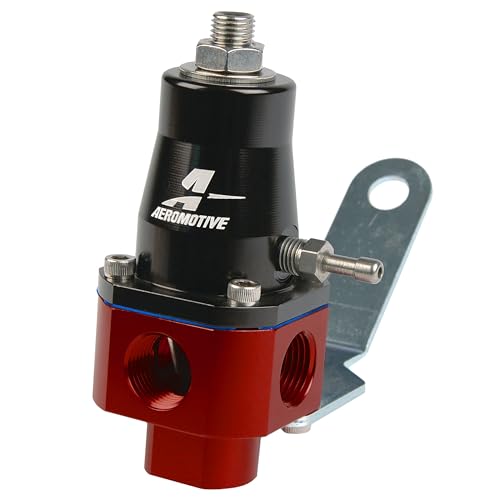 |
Aeromotive 13301 Adjustable Carbureted Fuel Pressure Regulator Best for High Horsepower Dead-head, 3 to 15 psi adjustable, 3/8 in NPT ports, billet aluminum body |
9.3 | 🛒 Check Price |
 |
Edelbrock 1727 Fuel Pressure Regulator Best for Street Carbs Dead-head, 5.5 to 9 psi range, 3/8 in NPT inlet and outlet |
9.1 | 🛒 Check Price |
 |
Mr. Gasket 9701 Universal Fuel Pressure Regulator Best Value Dead-head, 4.5 to 9 psi adjustable, 1/4 in NPT ports, chrome housing |
8.8 | 🛒 Check Price |
 |
Holley 12-803BP Billet Bypass Fuel Pressure Regulator Best Billet Build Bypass, 4 to 9 psi adjustable, -6 AN ports, CNC billet aluminum |
8.6 | 🛒 Check Price |
 |
Quick Fuel 30-803QFT Adjustable Fuel Pressure Regulator Best for Tuners Dead-head, 4 to 9 psi adjustable, 3/8 in NPT ports, gauge port included |
8.4 | 🛒 Check Price |
 |
RYANSTAR Universal Adjustable Fuel Pressure Regulator Kit Best Complete Kit Dead-head, 1 to 5 psi low-pressure carb model, includes gauge and fittings |
8.0 | 🛒 Check Price |
1. Holley 12-804 Carbureted Bypass Fuel Pressure Regulator: Best Overall
The Holley 12-804 is the regulator we reach for when a build matters. Unlike cheap dead-head units that simply choke the line down, this is a true bypass regulator: it routes the fuel the carb doesn’t use back to the tank through a return line. That bypass action is why the pressure barely flinches when you mash the throttle and demand jumps. On the bench it held its set point within a fraction of a psi from idle flow all the way up, which is exactly what a hungry big carb or a pair of carbs needs.
The trade-off is plumbing. To get the full benefit you have to run a return line back to the tank, and not every chassis has an easy spot for it. If you aren’t willing to add that line, you’re paying for capability you won’t use, and a simpler regulator would serve you better. But for anyone running a serious electric pump or a high horsepower combination, the bypass design is the right tool and the four ports make gauge and dual feed plumbing painless.
- True bypass design returns excess fuel to the tank for rock-steady pressure
- Adjustable from 4.5 to 9 psi to cover almost any street or strip carb
- Four ports let you feed dual carbs and run a return line and gauge port
Pros: Bypass design holds pressure dead steady even at high flow; Plenty of ports for gauge, return line and dual feeds; Trusted Holley quality with strong long-term reliability
Cons: Needs a return line plumbed back to the tank, which adds work; Larger footprint than a simple dead-head unit
2. Aeromotive 13301 Adjustable Carbureted Fuel Pressure Regulator: Best for High Horsepower
Aeromotive built its name on feeding thirsty race engines, and the 13301 carries that DNA. The billet body and large internal passages mean it can flow enough to keep a 750 plus cfm carb satisfied without dropping pressure as RPM climbs. The 3 to 15 psi range is genuinely useful too, since it covers everything from a mild Holley up to setups that want a firmer feed. Adjustment is smooth, the lock ring holds your setting, and the unit handles modern ethanol pump gas without weeping at the seals.
Its honest weakness is that it’s overkill for a stock rebuild or a weekend cruiser. This is a dead-head regulator, so it doesn’t use a return line, and at a very low idle demand we saw the pressure sit a touch above the dial compared to a bypass unit. On a high flow combination that’s a non issue, but if your engine sips fuel you’re buying flow capacity you’ll never tap. Match it to the engine and it’s superb.
- Wide 3 to 15 psi range suits carbs and even some boosted setups
- Billet aluminum body shrugs off heat and ethanol blended pump fuel
- Bleeds excess pressure smoothly for clean, repeatable adjustment
Pros: Massive flow capacity for high horsepower carbureted engines; Excellent build quality and ethanol compatibility; Very wide and precise adjustment range
Cons: More regulator than a mild street engine needs; Dead-head design can creep slightly at very low idle flow
3. Edelbrock 1727 Fuel Pressure Regulator: Best for Street Carbs
If you’re running a typical Edelbrock or Holley carb on a street engine, the 1727 is almost purpose built for you. Its 5.5 to 9 psi range lands right in the window those carbs want, so you’re adjusting within a sweet spot rather than hunting across a huge dial. It’s a dead-head unit, meaning no return line to plumb, which keeps installation to a couple of fittings and a gauge port. On a normally aspirated street motor with a stock or mild pump it holds pressure cleanly and quietly.
The limitation is the flip side of that focus. The adjustment range is narrow, so if you ever want to drop below 5 psi for a finicky carb or feed a big race setup, this regulator simply won’t stretch that far. It’s also not the unit for high flow combinations where a dead-head design starts to lose ground to a bypass. For its intended job, a street carb that wants a clean, set-and-forget feed, it’s hard to beat for simplicity.
- Tuned range built specifically for Edelbrock and Holley street carbs
- Compact dead-head design needs no return line
- Includes ports for an inline fuel pressure gauge
Pros: Dialed in for common street carburetors out of the box; Simple to plumb with no return line required; Reliable Edelbrock fit and finish
Cons: Narrow adjustment range limits use on unusual setups; Not ideal for very high flow race applications
4. Mr. Gasket 9701 Universal Fuel Pressure Regulator: Best Value
The Mr. Gasket 9701 is the regulator we point newcomers toward when they just need to tame an aftermarket pump on a street carb. It adjusts from 4.5 to 9 psi, which covers the vast majority of single carb applications, and the compact chrome body tucks into a crowded engine bay with room to spare. For a mild small block or a typical weekend cruiser it does the core job well: it knocks an overzealous pump down to a pressure the needle and seat can actually hold.
Where it shows its limits is flow. The 1/4 in NPT ports are smaller than the 3/8 in passages on the premium units, so on a large displacement engine or a big double pumper carb the regulator can become a restriction at wide open throttle. It also ships without a gauge, and setting any regulator blind is a bad idea, so budget for one. Within its lane, a single street carb that just needs reasonable pressure control, it delivers honest value.
- Adjustable 4.5 to 9 psi covers most common street carburetors
- Compact universal body fits tight engine bays
- Chrome finish looks at home on a show or street build
Pros: Strong everyday performance for the value; Compact and easy to mount almost anywhere; Simple dead-head plumbing
Cons: Smaller 1/4 in ports limit flow on bigger engines; No gauge included, so you must buy one separately
5. Holley 12-803BP Billet Bypass Fuel Pressure Regulator: Best Billet Build
The Holley 12-803BP is the billet, AN ported sibling to our top pick, and it’s aimed at builders who want both the performance of a bypass regulator and the look of a CNC machined part. Functionally it does what every good bypass unit does: it returns unused fuel to the tank so the pressure at the carb stays flat whether you’re idling or flat out. The 4 to 9 psi range covers street and strip carbs, and the billet body handles underhood heat without the pressure wandering as the engine warms.
The honest catch is the same as any bypass regulator, plus a little more. You must run a return line, and the -6 AN ports, while lovely with braided hose, mean you’re committing to AN fittings throughout that part of the fuel system. That raises the total complexity of the install compared to a simple NPT dead-head unit. If you’re already building a braided line setup it slots right in, but for a plain rubber hose street car it’s more than the job calls for.
- CNC machined billet body resists heat soak and looks the part
- Bypass operation keeps pressure flat under heavy demand
- -6 AN ports plumb cleanly with braided fuel line
Pros: Excellent pressure stability from the bypass design; Premium billet construction and finish; AN ports suit a clean braided line build
Cons: Requires a return line back to the tank; AN fittings add to the total plumbing investment
6. Quick Fuel 30-803QFT Adjustable Fuel Pressure Regulator: Best for Tuners
Quick Fuel sits in the carburetor world, so it’s no surprise the 30-803QFT plays nicely with carbureted engines. The standout here’s the adjustment feel. The fine-thread screw lets you nudge pressure in small, repeatable steps, which is exactly what you want when you’re chasing the last bit of tune on a bracket or street car. The integrated gauge port means you can watch the pressure as you set it instead of guessing, and the 3/8 in NPT ports flow enough for most single carb combinations.
As a dead-head regulator it shares the usual ceiling: feed a very large carb on a high horsepower engine and it can’t match a true bypass unit for holding pressure at full demand. We also noted that the lock nut needs a firm snug after setting, because if you leave it loose the adjustment can creep with vibration. Tighten it properly and the setting stays put. For a hands on tuner running a typical Holley style carb, the precise adjustment makes it a pleasure to dial in.
- Fine-thread adjustment screw for precise, repeatable pressure setting
- Built in gauge port makes dialing it in straightforward
- 3/8 in NPT ports flow well on most street and bracket carbs
Pros: Precise and repeatable adjustment for tuning; Good flow for a dead-head unit; Convenient integrated gauge port
Cons: Dead-head design isn’t ideal for very high flow; Lock nut can loosen over time if not snugged properly
7. RYANSTAR Universal Adjustable Fuel Pressure Regulator Kit: Best Complete Kit
The RYANSTAR kit earns its spot because it removes the guesswork for a first time installer. Instead of sourcing a regulator, a gauge, and fittings separately, you get a matched package in one box, including a liquid filled gauge that damps needle flutter so the reading is easy to trust. The key is choosing the correct version: RYANSTAR sells both a high-pressure EFI unit and a low-pressure 1 to 5 psi carburetor unit, and only the carb model belongs anywhere near a carburetor. Get the right one and it controls a mild street carb feed perfectly well.
The honest reality is that the materials and machining don’t feel as refined as a Holley, Edelbrock, or Aeromotive part, and the included fittings are basic. We would inspect every seal and thread before trusting it, and we wouldn’t lean on it for a high value race build. But as an affordable, all-in-one way to get a carbureted street engine running at the right pressure with a gauge already in hand, it’s a sensible starting point that does the fundamental job.
- Kit includes the regulator, a liquid filled gauge and basic fittings
- Low-pressure 1 to 5 psi model is sized for carburetors
- Universal mounting bracket simplifies installation
Pros: Everything to get started comes in the box; Included gauge means no separate purchase; Low-pressure version is correctly matched to carbs
Cons: Fit and finish trails the established brands; Must buy the carb low-pressure version, not the EFI one
Frequently Asked Questions
What fuel pressure does a carburetor need?
Most carburetors run best between 4 and 7 psi at the bowl, though the exact number depends on the carb. Many Holley and Edelbrock street carbs are happy around 5 to 6 psi, while some demand-style carbs want closer to 7. Too little pressure starves the engine at high RPM and causes a lean stumble, while too much pressure overpowers the needle and seat, floods the bowl, and makes the engine run rich and dribble fuel. A good adjustable regulator and a gauge let you set the exact figure your carb’s maker recommends, which is always the safest place to start.
Do I really need a fuel pressure regulator with a mechanical pump?
Sometimes yes. A stock mechanical pump often delivers pressure that’s already in the right window, so a mild factory setup may not strictly need a regulator. The problem is that many aftermarket high volume mechanical pumps and almost all aftermarket electric pumps push well above 7 psi, sometimes 9 psi or more. At that point a regulator becomes essential to bring the pressure back down to where the carb can control it. The simplest way to know is to install an inline gauge and read the actual pressure at the carb. If it sits above what your carb wants, add a regulator.
What is the difference between a bypass and a dead-head regulator?
A dead-head regulator simply restricts the line to hold pressure, and when the carb stops drawing fuel the regulator just closes off. It’s simple and needs no extra plumbing, which makes it perfect for most street cars. A bypass regulator instead routes the unused fuel back to the tank through a return line, so the pump is always moving fuel and the pressure stays extremely steady even under heavy demand. Bypass units, like the Holley 12-804, shine on high horsepower and high flow combinations where holding rock-steady pressure matters, but they require you to run that return line back to the tank.
Where should I mount the fuel pressure regulator?
Mount the regulator in the fuel line as close to the carburetor as is practical, after the fuel pump and after the filter, so it controls the pressure that actually reaches the bowls. Keep it away from extreme heat sources like the exhaust manifold to avoid heat soak and vapor lock, and orient it so the gauge is easy to read. Secure it solidly to the engine or chassis rather than letting it hang on the line, since vibration can loosen fittings over time. Always set the pressure with a gauge connected and the engine running, not by feel.
Can I use an EFI fuel pressure regulator on a carburetor?
No, and this is a common and costly mistake. EFI regulators are designed to hold high pressures, often in the 40 to 60 psi range, which is far beyond anything a carburetor can tolerate. Using one on a carb would flood it instantly. Carburetors need a dedicated low-pressure regulator that adjusts within roughly 1 to 9 psi. Some brands, like RYANSTAR, sell both versions that look similar, so always confirm you’re buying the low-pressure carburetor model. When in doubt, check the stated pressure range on the listing before you buy.
Our Verdict
For most builds our top pick is the Holley 12-804, because its true bypass design holds pressure dead steady from idle to wide open and its four ports make plumbing a gauge, a return line, and even dual carbs simple. If you’re pushing serious horsepower and want maximum flow with billet durability, the Aeromotive 13301 is the runner up worth stepping up to. And if you just have a single street carb that needs a clean, simple feed, the Edelbrock 1727 covers that job without the added work of a return line.