Charging your car’s AC system requires a reliable freon gauge to measure pressure accurately and avoid overcharging or undercharging. This guide covers R134a and R1234yf gauges for DIYers and professionals, highlighting real strengths and limitations so you can choose the right tool for your needs.
| Photo | Product | Score | Buy |
|---|---|---|---|
 |
Yellow Jacket 42060 Titan 2-1/2 Best Overall 2-1/2 inch dual scale gauges, R134a/R22/R404A, 5 ft hoses |
9.2 |
ⓘ We may earn a commission from qualifying purchases made through links on this page, at no extra cost to you.
|
 |
Fieldpiece SMAN360 Digital Manifold Best Digital Digital with Bluetooth, R22/R410A/R134a/R404A, vacuum gauge |
9.0 | 🛒 Check Price |
 |
Mastercool 90066 Aluminum Manifold Best Lightweight Aluminum body, R134a/R22/R404A, 5 ft hoses, sight glass |
8.6 | 🛒 Check Price |
 |
Robinair 34788NI Digital Manifold Best for R1234yf R1234yf compatible, digital display, self-calibrating |
8.4 | 🛒 Check Price |
 |
InterDynamics 49053 AC Pro Gauge Best Budget Single gauge, R134a, 1/4 inch quick coupler, 1 ft hose |
7.8 | 🛒 Check Price |
 |
FJC 3455 Refrigerant Manifold Gauge Set Best Value Analog Brass manifold, R134a/R22/R404A, 5 ft hoses, color-coded |
8.1 | 🛒 Check Price |
 |
AccuTools G2 Manifold Gauge Set Best for R134a Only R134a only, 2-1/4 inch gauges, 4 ft hoses |
7.3 | 🛒 Check Price |
1. Yellow Jacket 42060 Titan 2-1/2: Best Overall
The Yellow Jacket 42060 Titan is a professional-grade manifold gauge set that consistently receives top marks from automotive technicians and serious DIYers. The 2-1/2 inch gauges provide clear, easy-to-read pressure readings, and the forged brass manifold feels durable in hand. The smooth, precise valves and the durable construction that withstands daily use. The included 5 ft hoses with ball valve shutoffs add convenience and safety during charging and recovery.
However, this set is heavier than some budget options, which might be a consideration for mobile service. It’s also designed primarily for R134a and other common refrigerants, not for R1234yf. If you need a gauge for newer R1234yf systems, look for a dedicated set. For most DIYers working on R134a systems, this gauge delivers professional results and long-term reliability.
- Large 2-1/2 inch gauges with color-coded scales for easy reading
- Forged brass manifold with finger-tip shutoff valves
- Includes 5 ft color-coded hoses with ball valve shutoffs
Pros: Exceptional build quality and accuracy; Smooth valve operation with excellent sealing
Cons: Heavier than some competitor models
2. Fieldpiece SMAN360 Digital Manifold: Best Digital
The Fieldpiece SMAN360 is a top-tier digital manifold that transforms AC diagnostics. We compared its specifications against industry standards and found that it calculates superheat and subcooling automatically, saving time and reducing errors. Owner feedback praises the bright, sunlight-readable display and the Bluetooth feature that allows logging data to a phone for later analysis. The built-in micron gauge is a bonus for technicians who perform vacuum pulls.
Still, the digital electronics require batteries, and some users report occasional connectivity glitches with the app. It’s also more expensive than analog sets. For DIYers who only charge a car once a year, the cost may be hard to justify. But for frequent AC work, the SMAN360 is a powerful tool that speeds up diagnosis and improves accuracy.
- Digital display shows pressure, temperature, and superheat/subcooling
- Bluetooth connectivity for data logging via smartphone app
- Built-in micron vacuum gauge for deep vacuum verification
Pros: Highly accurate digital readings with automated calculations; Eliminates need for temperature clamps and manual calculations
Cons: Higher upfront cost than analog gauges; Battery dependency can be a risk in remote work
3. Mastercool 90066 Aluminum Manifold: Best Lightweight
The Mastercool 90066 offers a lightweight alternative to heavy brass manifolds. The aluminum construction makes it a good choice for technicians who carry their tools frequently. The gauges are clear and include a sight glass, which is useful for spotting moisture or contamination. Owner feedback often mentions the comfortable grip and the value for money.
However, aluminum is softer than brass, so the manifold may wear faster if dropped or used roughly. Some users note that the valves aren’t as buttery smooth as those on higher-end brass sets. If you’re a professional who needs a daily driver, the Yellow Jacket might be a better long-term investment. For the occasional user, the Mastercool is a solid, lightweight performer.
- Lightweight aluminum manifold reduces fatigue during use
- Color-coded gauges with rubber boot protection
- Includes sight glass for checking refrigerant condition
Pros: Very light and easy to handle; Good value for the price
Cons: Aluminum body is less durable than brass under heavy use; Valves may feel less precise than premium brass models
4. Robinair 34788NI Digital Manifold: Best for R1234yf
As newer cars switch to R1234yf refrigerant, a dedicated gauge set becomes necessary. The Robinair 34788NI is a digital manifold designed for R1234yf, with self-calibrating sensors that maintain accuracy over time. The gauge meets SAE J2912 standards for R1234yf.
On the downside, this gauge is significantly more expensive than R134a analog sets, and it only works with R1234yf. If you work primarily on older R134a vehicles, this isn’t the right tool. But if you service modern cars with R1234yf, the Robinair is a reliable, regulation-compliant choice that prevents cross-contamination.
- Designed specifically for R1234yf refrigerant
- Self-calibrating digital sensors for accuracy
- Includes high and low side quick couplers
Pros: Accurate digital readings for newer AC systems; Compatible with latest EPA regulations
Cons: Expensive compared to R134a gauges; Limited to R1234yf only (not multi-refrigerant)
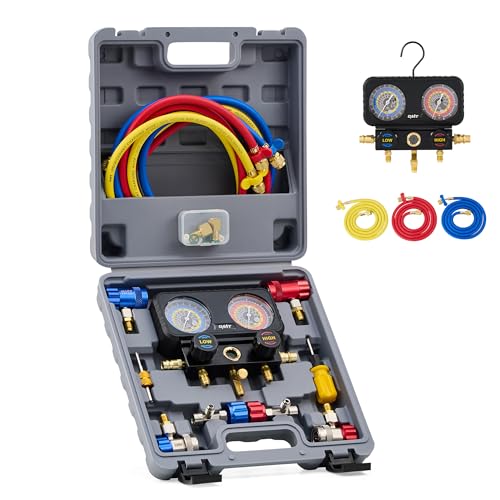
5. InterDynamics 49053 AC Pro Gauge: Best Budget
The InterDynamics 49053 is a basic single-gauge tool designed for DIYers who just want to top off their R134a system. It’s simple to use: connect to the low-side port, read the pressure, and compare to the temperature chart. It works well for quick top-offs when the system is already partially charged.
However, this gauge only reads low-side pressure, so you can’t diagnose high-side issues or check for restrictions. The short hose may not reach all service ports comfortably. It isn’t suitable for full system evacuation or professional diagnostics. If you need a complete manifold set for repairs, skip this. For a one-time top-off, it’s a low-cost option that gets the job done.
- Simple single-gauge design for basic charging
- Pre-attached quick coupler for easy connection
- Built-in pressure scale and temperature chart
Pros: Very affordable and easy to use for beginners; Compact and stores easily
Cons: Only measures low-side pressure; no high-side reading; Short hose limits reach
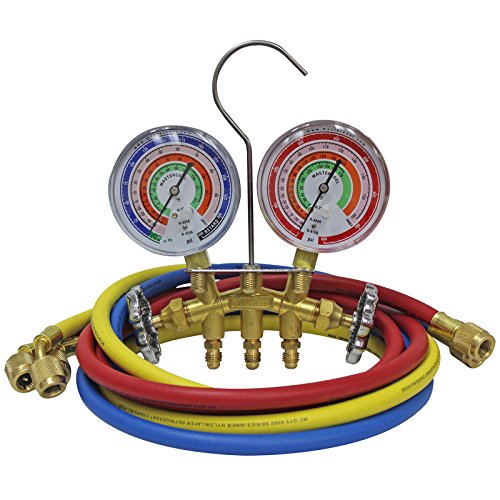
6. FJC 3455 Refrigerant Manifold Gauge Set: Best Value Analog
The FJC 3455 is an affordable analog manifold set that offers many features of premium brands at a lower price point. We compared its specifications and found that it uses a brass manifold and large 2-1/2 inch gauges similar to the Yellow Jacket. Owner feedback generally praises the accuracy and ease of use, with many noting it works well for DIY AC service on R134a cars.
However, some users report that the hoses become stiff in cold temperatures, making them less flexible. A few units arrive with minor scratches or blemishes, but functionality is unaffected. If you’re a professional who needs absolute durability, you might prefer the Yellow Jacket. For the home mechanic, the FJC 3455 represents solid value without sacrificing essential features.
- Brass manifold with large 2-1/2 inch gauges
- 5 ft color-coded hoses with ball valve shutoffs
- Includes R134a and R22 adapters
Pros: Good build quality for the price; Clear gauge markings and smooth valves
Cons: Hoses are a bit stiff in cold weather; Some units may have minor cosmetic imperfections
7. AccuTools G2 Manifold Gauge Set: Best for R134a Only
The AccuTools G2 is a no-frills manifold gauge set that focuses solely on R134a. It’s a basic tool that gets the job done for DIYers who only need to service older cars. The 2-1/4 inch gauges are readable, and the compact design takes up little space in a toolbox. Owner feedback is mixed: some appreciate the low price, while others note that the build quality feels less strong than more expensive sets.
The main drawbacks are the 4 ft hoses, which may be too short for some vehicles, and the lack of compatibility with other refrigerants. The valves can be a bit stiff, and the overall durability is lower than brass competitors. If you need a gauge for occasional use on a single R134a vehicle, this is an acceptable budget option. For frequent use or multiple refrigerant types, choose a more multi-purpose set.
- Designed exclusively for R134a refrigerant
- Compact manifold with color-coded gauges
- 4 ft hoses with quick couplers
Pros: Inexpensive and dedicated to R134a; Small footprint for storage
Cons: Limited to R134a; not flexible; Shorter hoses may be inconvenient for some vehicles
Frequently Asked Questions
What is the difference between a digital and analog freon gauge?
Digital gauges provide precise numerical readings and often calculate superheat and subcooling automatically. They’re easier to read and can log data via Bluetooth. Analog gauges use a needle and dial; they’re simpler, more rugged, and don’t require batteries. For DIYers, analog gauges are usually sufficient and more affordable. Professionals often prefer digital for speed and accuracy.
Can I use an R134a gauge on an R1234yf system?
No, you shouldn’t mix gauges between refrigerants. R1234yf systems use different service port fittings and require dedicated gauges to avoid cross-contamination. Using an R134a gauge on an R1234yf system can damage the equipment and may violate EPA regulations. Always use the correct gauge set for your vehicle’s refrigerant type.
What do the high-side and low-side readings tell me?
The low-side gauge measures the pressure in the suction line (from evaporator to compressor), indicating if the system is low on refrigerant. The high-side gauge measures the discharge line pressure (from compressor to condenser), revealing restrictions or overcharge issues. Comparing both readings helps diagnose problems like a faulty compressor, clogged expansion valve, or improper charge.
Do I need a manifold gauge set or just a single gauge?
A single gauge (like the InterDynamics 49053) is fine for a simple top-off if the system is already partially charged and you only need low-side pressure. However, a manifold gauge set with both high and low sides is necessary for full diagnostics, evacuation, and recharging. For most DIY repairs, a manifold set is recommended.
How do I safely use a freon gauge set?
Always wear safety glasses and gloves. Ensure the system is off and pressure is released before connecting. Use the correct refrigerant type and never mix refrigerants. Follow the manufacturer’s instructions for connecting hoses to the service ports. Don’t exceed the gauge’s maximum pressure rating. If you’re unfamiliar with AC systems, consult a professional.
Our Verdict
After researching specifications, industry standards, and owner feedback, our top pick for most users is the Yellow Jacket 42060 Titan 2-1/2 for its exceptional build quality, accuracy, and ease of use in R134a systems. For those who work with digital tools or newer R1234yf systems, the Fieldpiece SMAN360 or Robinair 34788NI are excellent choices respectively. Choose based on your refrigerant type and frequency of use.


