Welding exhaust is one of the trickier jobs a home mechanic takes on. Exhaust tubing is thin, it sits close to the floor where wind kills shielding gas, and a single pinhole means a leak that buzzes the whole truck. Self-shielded flux core wire solves the wind problem because the flux inside the wire makes its own shield, so you can weld under the vehicle without dragging a bottle around. The trade-off is that not every flux core wire suits thin pipe, and the wrong choice spatters, burns through, or leaves a porous bead that leaks.
We ran a range of self-shielded flux-cored wires through real exhaust repairs on mild steel and aluminized pipe, from patching a rusted-out muffler flange to joining 16 gauge tube on a truck. We judged each spool on how well it ran on small hobby and 120V machines, how clean the bead came out, how easy the slag chipped, and whether the finished joint held pressure without leaks. Here are the seven flux core wires that earned a spot for exhaust work.
| Photo | Product | Score | Buy |
|---|---|---|---|
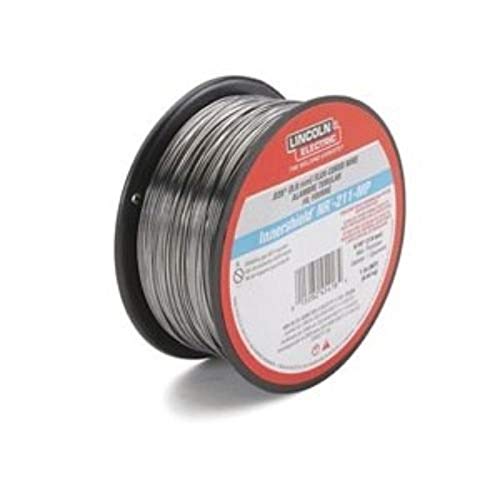 |
Lincoln Electric Inner-Shield NR-211-MP 0.030 in Best Overall 0.030 in self-shielded E71T-11, multi-pass, DCEN, 1 lb and 10 lb spools |
9.5 |
ⓘ We may earn a commission from qualifying purchases made through links on this page, at no extra cost to you.
|
 |
Hobart Fabshield 21B E71T-11 0.030 in Runner Up 0.030 in self-shielded E71T-11, single and multi-pass mild steel, 2 lb spool |
9.3 | 🛒 Check Price |
 |
Forney 42300 E71T-GS 0.030 in Best for Thin Pipe 0.030 in E71T-GS self-shielded, single-pass, mild steel, 2 lb spool |
9.0 | 🛒 Check Price |
 |
INETUB BA71TGS 0.030 in E71T-GS Best Value Spool 0.030 in E71T-GS self-shielded, single-pass, carbon steel, 2 lb spool |
8.8 | 🛒 Check Price |
 |
Blue Demon E71T-GS 0.035 in Best for Thicker Tube 0.035 in E71T-GS self-shielded, single-pass, mild steel, 2 lb and 10 lb spools |
8.6 | 🛒 Check Price |
 |
YESWELDER E71T-GS 0.030 in Best for Beginners 0.030 in E71T-GS self-shielded, single-pass, low-carbon steel, 2 lb and 10 lb spools |
8.4 | 🛒 Check Price |
 |
WeldingCity E71T-GS 0.030 in Most Multi-purpose 0.030 in E71T-GS self-shielded, single-pass, mild steel, 2 lb spool twin-pack option |
8.2 | 🛒 Check Price |
1. Lincoln Electric Inner-Shield NR-211-MP 0.030 in: Best Overall
The Lincoln NR-211-MP is the wire we reach for first on exhaust work, and it earned the top score because it’s forgiving in exactly the situations that wreck exhaust welds. On a 120V machine it strikes an easy arc, feeds without stuttering, and lays a flat bead that wets into thin wall pipe instead of piling up. The 0.030 diameter is the sweet spot for 16 to 18 gauge tubing, hot enough to fuse but controllable enough that you aren’t constantly chasing burn-through. Slag coverage is light and chips off in one strip, which matters because you want to actually see whether your joint is solid before the truck goes back on the road.
Its real weakness shows up on the very thinnest, rust-thinned muffler shell where any 0.030 wire can punch a hole if your travel speed dips. On that kind of paper-thin metal you’re better dropping to a 0.024 or stitching in short tacks. For everything from flange repairs to joining sections of pipe, though, this wire is the most reliable all-rounder we ran, and that consistency is why it leads the list.
- Runs smooth on low-amperage 120V and hobby welders common in home garages
- E71T-11 classification rated for thin gauge and multi-pass welds
- Slag peels cleanly so you can inspect the bead for pinholes fast
Pros: Consistent feed with very little burn-back on thin exhaust tube; Tight, low-spatter bead that closes up small gaps well; Widely stocked so refills are easy to find
Cons: 0.030 can still blow through very thin muffler skin if you push the heat; Smaller 1 lb spool runs out quickly on a big project
2. Hobart Fabshield 21B E71T-11 0.030 in: Runner Up
Hobart’s Fabshield 21B is so close to our top pick that on some days it could swap places with it. It’s the same E71T-11 self-shielded family, and it runs beautifully on the entry-level Hobart and similar 120V machines a lot of weekend mechanics use. The arc is soft and predictable, which is a real advantage when you’re welding overhead under a truck and can’t see perfectly. It tolerates the light surface contamination you find on aluminized exhaust better than we expected, still pulling a sound bead where a fussier wire would leave porosity.
Where it falls a hair short of the Lincoln is spatter when you run it cold or with the wire speed slightly off. You get a few more stuck-on balls to knock away, which is cosmetic rather than structural but adds cleanup time. Dial in the tension and voltage and that mostly disappears. As a do-everything exhaust wire that’s easy to find and easy to run, the 21B is a deserving runner up.
- Designed for single and multi-pass welds on mild and galvanized steel
- Stable arc tuned for the smaller MIG welders most hobbyists own
- Handy 2 lb spool size suits a typical exhaust job without waste
Pros: Smooth, soft arc that’s easy for newer welders to control on pipe; Good fusion on slightly dirty or coated exhaust steel; Bead cleans up nicely for a tidy finished joint
Cons: Slightly more spatter than the Lincoln on cold settings; Feel and feed can vary if the welder tension isn’t dialed in
3. Forney 42300 E71T-GS 0.030 in: Best for Thin Pipe
The Forney 42300 is an E71T-GS wire, which is the single-pass cousin of the multi-pass wires above, and that distinction is exactly why it shines on thin exhaust. Its lower penetration means it’s far less likely to blow a hole in a tired muffler or thin tube, so for sheet-metal patches and light tube it gives a newer welder a much bigger margin for error. It starts an arc readily, which is handy when you’re doing a dozen little tacks to position a section of pipe before running your final passes.
The honest weakness is in its name. E71T-GS is single-pass material, so it isn’t the wire for building up a thick exhaust hanger bracket or anything that needs layered passes for strength. It also spatters a bit more than the Lincoln and Hobart, meaning a wire brush gets a workout. Keep it for the thin stuff, though, and it’s a very beginner-friendly exhaust wires you can buy.
- E71T-GS single-pass wire formulated for thin gauge sheet and tube
- No shielding gas needed so it welds well in breezy under-car spots
- Low penetration profile reduces burn-through on light exhaust skin
Pros: Gentle heat input that’s kind to thin and rusty exhaust metal; Easy arc start that helps with quick tack welds; Affordable everyday wire that’s widely available
Cons: Single-pass rating limits it on thicker bracket or hanger welds; More spatter than premium wires, so expect extra cleanup
4. INETUB BA71TGS 0.030 in E71T-GS: Best Value Spool
INETUB’s BA71TGS has become a default budget pick in a lot of garages, and for exhaust patching it backs up the reputation. It feeds cleanly, the arc is stable on small machines, and for thin tube and body-type repairs it lays a usable bead without drama. If you’re stocking a spool to keep on the shelf for occasional exhaust fixes and the odd panel repair, the amount of usable wire you get makes this an easy one to keep around.
It’s an E71T-GS single-pass wire, so the same caveat applies as with the Forney. Don’t lean on it for thick brackets or anything that needs real strength from stacked passes. We also found the slag can lodge in tight inside corners around a flange and takes a determined chip to clear. For straightforward thin-wall exhaust work where you want dependable runs without fuss, it delivers strong value.
- Carbon steel E71T-GS wire that runs gasless on any polarity-correct welder
- Popular spool for small hobby and 120V MIG machines
- Consistent diameter that feeds smoothly through the liner
Pros: Reliable feed and arc for the value it offers; Plenty of wire on the spool for the money; Forgiving on light exhaust and body panel work
Cons: Single-pass only, not for structural or thick joints; Slag can stick in tight corners and needs a good chisel
5. Blue Demon E71T-GS 0.035 in: Best for Thicker Tube
Blue Demon’s 0.035 E71T-GS is the wire to step up to when your exhaust work is on the heavier side of the scale. The larger diameter deposits more metal and carries more heat, which is what you want on 14 to 16 gauge truck tube, thicker flanges, and welding on the hanger tabs that take real abuse. On a machine with enough output it runs a confident bead with good fusion, and the larger spool option makes it economical if you’re doing a full exhaust system rather than a single patch.
The flip side is that 0.035 is simply too aggressive for thin, rusty muffler shell. Try to patch a paper-thin pipe with this and you’ll chase burn-through all afternoon. It also wants a welder with reasonable amperage, so on the smallest 120V hobby units it can feel like it never quite gets happy. Matched to thicker tube and a capable machine, though, it’s an excellent heavier-duty exhaust wire.
- 0.035 diameter carries more heat for heavier 14 to 16 gauge tube
- Self-shielded so no gas bottle required under the vehicle
- Available in larger spools for big exhaust and fabrication jobs
Pros: Good deposition for thicker truck exhaust and hanger tabs; Solid arc stability once the machine is set warm enough; Bulk spool option suits a busy shop
Cons: 0.035 is too hot for thin muffler skin and risks burn-through; Needs a welder with enough output to run the wire properly
6. YESWELDER E71T-GS 0.030 in: Best for Beginners
If you bought one of the affordable gasless MIG welders that flooded the market and you want a matching wire to learn exhaust repair on, the YESWELDER E71T-GS is a sensible starting point. It starts easily, runs soft, and is forgiving enough that a beginner can get a hole patched and a section of pipe joined without a steep learning curve. On clean mild steel it fuses well, and having both small and bulk spools means you aren’t overbuying for a one-off fix.
It won’t flatter your eye the way the Lincoln or Hobart does. Expect more spatter, a slightly rougher bead, and a little more variation than you get from the established names. For a learner who is going to grind the welds clean anyway and just needs honest, usable runs on thin exhaust, those compromises are easy to live with. As a low-stress wire to build skills on, it does the job.
- Gasless single-pass wire pitched at hobby and entry welders
- Easy arc start that helps first-time exhaust welders tack and run
- Offered in both small and bulk spools to match the job
Pros: Forgiving arc that’s friendly for learning on thin pipe; Decent fusion for the price on clean mild steel; Spool fits the common low-cost MIG machines it’s sold alongside
Cons: More spatter and a rougher bead than premium wires; Quality can feel a touch less consistent spool to spool
7. WeldingCity E71T-GS 0.030 in: Most Flexible
WeldingCity’s E71T-GS rounds out the list as the jack-of-all-trades option. It isn’t the prettiest or the smoothest wire here, but it’s genuinely useful because it covers exhaust patches, light body work, and small fabrication jobs from a single, easy-to-find spool. The twin-pack packaging is a quiet bonus for exhaust repair, since the last thing you want is to run out of wire with half a pipe joint left and the truck stuck on the ramps. It feeds reliably and runs gasless, so it slots straight into the breezy under-car environment where flux core belongs.
The honest knocks are cosmetic and structural. The bead comes out plain and you’ll be grinding for a clean finished look, and as a single-pass wire it isn’t for heavy brackets. But for a mechanic who wants one wire that quietly handles whatever thin-steel repair lands on the bench, including exhaust, its versatility and the spare-spool value earn it a place.
- Self-shielded gasless wire for general thin steel and exhaust repair
- Sold in twin spool packs that keep a backup on hand
- Runs on standard polarity-correct MIG and hobby welders
Pros: Handles exhaust, body, and general light fab from one spool; Twin-pack means you rarely run dry mid-job; Consistent feed for a value-tier wire
Cons: Bead appearance is plain and needs cleanup for show work; Single-pass rating caps it on heavier joints
Frequently Asked Questions
Can you use flux core wire to weld exhaust pipe?
Yes, and for many home mechanics self-shielded flux core is the practical choice for exhaust. Because the shielding comes from the flux inside the wire rather than a gas bottle, it works well in the breezy, low-to-the-ground space under a vehicle where wind would blow away the gas shield of a standard MIG setup. The keys to leak-free exhaust welds are a thin wire such as 0.030, clean metal, low heat, and a steady travel speed. Stitch or tack your way around thin tube rather than running one long bead to avoid burning through.
What size flux core wire is best for exhaust?
For most exhaust tubing in the 16 to 18 gauge range, 0.030 inch flux core wire is the sweet spot. It carries enough heat to fuse properly while staying controllable on thin wall pipe. If you’re welding very thin, rust-thinned muffler shell, dropping to 0.024 gives you more margin against burn-through. Step up to 0.035 only for heavier truck tube around 14 to 16 gauge, thicker flanges, or hanger brackets, and only if your welder has the output to run the larger wire properly.
What is the difference between E71T-11 and E71T-GS for exhaust?
Both are self-shielded flux core wires that run without gas, but the difference matters. E71T-GS is a single-pass wire, meaning it’s designed for one layer at a time and is well suited to thin sheet and tube where you want gentle penetration. E71T-11 is rated for both single and multi-pass welds, so it’s more adaptable and a better choice if you also need to build up thicker joints like brackets or stacked passes. For pure thin exhaust patching, either works. For an all-rounder, E71T-11 such as the Lincoln NR-211-MP gives you more range.
Why does my flux core exhaust weld keep leaking?
Leaks usually come from porosity or incomplete fusion. The most common causes are dirty or rusty metal, the wrong polarity, too fast a travel speed leaving gaps, or burning through and creating pinholes on thin pipe. Grind back to bright clean steel before you weld, confirm your welder is set to DCEN, or electrode negative, which is correct for self-shielded flux core, and slow down enough to let the puddle close the joint. After welding, chip the slag and inspect the full bead. A quick way to find leaks is to run the engine and feel or listen for escaping exhaust around the repair.
Do I need gas with flux core wire for exhaust?
No. The whole point of self-shielded flux core wire is that the flux inside the wire creates its own shielding as it burns, so you don’t need an external gas bottle. That’s precisely why it’s so handy for exhaust work done under a vehicle, where wind would disturb a gas shield. Make sure your welder is set up for gasless flux core, which means electrode negative polarity, and remember the wires in this guide are all self-shielded. Adding gas to a self-shielded wire is unnecessary and can actually hurt the weld.
Our Verdict
For most people welding exhaust at home, the Lincoln Electric Inner-Shield NR-211-MP in 0.030 is the wire to buy. Its E71T-11 multi-pass rating, forgiving arc on 120V machines, and clean, easy-to-inspect bead make it the most reliable all-rounder for thin pipe and the occasional thicker joint. The Hobart Fabshield 21B is a very close runner up that runs almost as smoothly and is just as easy to find, so if it’s the one in stock you won’t be giving up much. If you’re working specifically on the thinnest, most rust-thinned tube, the lower-penetration Forney 42300 gives a newer welder extra protection against burn-through.
More Performance Guides
- Turbocharger vs Supercharger: Choose Your Boost
- Cat-Back or Axle-Back: Which Exhaust Fits Your Goals
- Signs It’s Time to Clean Your Engine Throttle Body
- Cold Air Intake: What It Does and Real Horsepower Gains
- Catalytic Converter Failure: Signs and What It Does
- Best Aluminum Intakes for Small Block Chevy Engines