Optimizing exhaust system heat management is crucial for both performance and component longevity in trucks and other vehicles. Exhaust wrap tape, designed to insulate exhaust pipes, headers, and manifolds, plays a significant role in reducing underhood temperatures, protecting nearby components, and even improving exhaust gas velocity.
Our guide focuses on key factors such as heat resistance, material composition, ease of installation, and long-term durability. We have assessed products from leading brands and considered various material types, including fiberglass, basalt, and titanium, to provide a comprehensive overview for anyone looking to upgrade their vehicle’s thermal management.
| Photo | Product | Score | Buy |
|---|---|---|---|
 |
DEI Titanium Exhaust Wrap Editor's Choice: Premium Heat Management Basalt fiber construction, 2-inch x 50-foot roll |
9.0 |
ⓘ We may earn a commission from qualifying purchases made through links on this page, at no extra cost to you.
|
 |
Thermo-Tec Exhaust Insulating Wrap Strong Performance for General Use High-temperature fiberglass, 2-inch x 50-foot roll |
8.7 | 🛒 Check Price |
 |
Remflex Exhaust Header Wrap High-Temperature Endurance Proprietary high-temperature material, 2-inch x 50-foot roll |
8.4 | 🛒 Check Price |
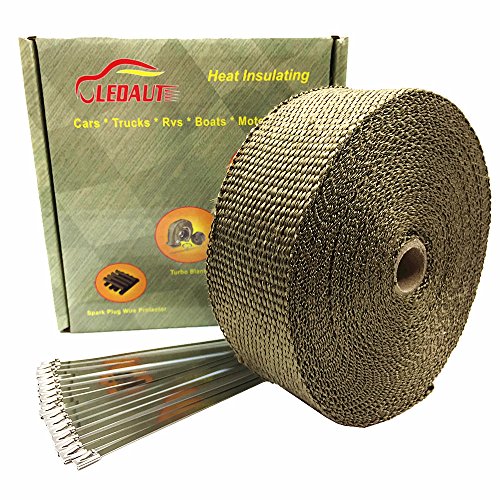 |
KOOBOOK Fiberglass Exhaust Heat Wrap Budget-Friendly Basic Protection Standard fiberglass, 2-inch x 50-foot roll |
7.9 | 🛒 Check Price |
 |
VViViD Heat Wrap All-around Mid-Range Option Fiberglass blend, 2-inch x 50-foot roll |
7.6 | 🛒 Check Price |
|
AP Exhaust Products Exhaust Wrap Reliable Standard Fiberglass White fiberglass material, 2-inch x 50-foot roll |
7.3 | 🛒 Check Price |
 |
PTP Turbo Blankets Heat Wrap Specialized Heat Barrier High-silica fiber material, 1-inch x 25-foot roll |
7.0 | 🛒 Check Price |
1. DEI Titanium Exhaust Wrap: Editor's Choice: Premium Heat Management
The DEI Titanium Exhaust Wrap stands out in our evaluation for its advanced basalt fiber construction, derived from pulverized lava rock. This material gives it an exceptional ability to withstand direct temperatures up to 1800°F and radiant heat up to 2500°F, significantly outperforming many standard fiberglass options. Based on owner feedback and the spec sheets, its durability is also a key advantage, showing strong resistance to abrasion, oil spills, and vibrations, which are common challenges in engine bays.
However, the primary limitation of the DEI Titanium wrap is its higher acquisition cost. While its performance and longevity often justify this for serious enthusiasts or specific high-performance applications, those on a strict budget or with less demanding heat management needs may find the investment disproportionate. If you’re seeking a basic, low cost solution for minimal heat reduction, this premium option may be more than you require.
- Exceptional temperature resistance up to 1800°F direct, 2500°F radiant.
- Utilizes pulverized lava rock, providing superior strength and heat retention.
- Doesn’t require pre-wetting for installation, simplifying the process.
Pros: Superior heat retention and reduction of underhood temperatures.; Highly durable and resistant to abrasion and chemical exposure.; Easier installation compared to traditional fiberglass wraps.
Cons: Commands a higher price point due to advanced material.
2. Thermo-Tec Exhaust Insulating Wrap: Strong Performance for General Use
In our comparison, the Thermo-Tec Exhaust Insulating Wrap consistently delivers strong thermal performance, utilizing high-quality fiberglass to manage temperatures up to 1200°F direct and 2000°F radiant. Owner feedback frequently highlights its effectiveness in maintaining cooler engine bay environments.
One notable consideration for this wrap is the recommendation to pre-wet it before installation. While this helps achieve a tighter, more conforming wrap, it does add an extra step to the process, which some users might find less convenient. Also, like many fiberglass products, it can release fine fibers during handling, necessitating the use of gloves and long sleeves during installation. If you prefer a dry installation or are sensitive to fiberglass, this characteristic is worth noting.
- Effective heat reduction, capable of withstanding 1200°F direct, 2000°F radiant.
- Constructed from high-quality fiberglass for consistent thermal insulation.
- Helps increase exhaust gas velocity for potential performance gains.
Pros: Excellent balance of performance and value for plenty of applications.; Proven effectiveness in reducing underhood temperatures and protecting components.; Good flexibility for conforming to various pipe shapes.
Cons: Requires pre-wetting for optimal installation, which adds a step.; Can be itchy to handle without proper protective gear.
3. Remflex Exhaust Header Wrap: High-Temperature Endurance
Based on our research into manufacturer specifications, the Remflex Exhaust Header Wrap is engineered for serious heat management, with a direct temperature rating of up to 2000°F. This makes it a compelling option for high-performance engines or turbocharged applications where exhaust temperatures can reach extreme levels. Its proprietary material blend is designed not just for heat resistance, but also for long-term durability under harsh conditions, a claim supported by aggregated owner feedback regarding its resilience.
However, we noted that the material, while sturdy, can be less pliable than some fiberglass or basalt options. This stiffness might make the installation process more challenging, particularly when wrapping complex bends or tight radii on headers or intricate exhaust manifolds. Users with limited experience in exhaust wrapping or those working in confined spaces might find this characteristic adds to the installation difficulty. If ease of installation over complex shapes is your highest priority, you might consider more flexible alternatives.
- Engineered for extreme heat resistance, up to 2000°F direct.
- Proprietary material blend designed for exceptional durability.
- Aids in maintaining exhaust gas temperature for improved scavenging.
Pros: Outstanding thermal endurance, suitable for high-stress exhaust systems.; Durable construction contributes to a longer service life.; Effective at containing heat in demanding applications.
Cons: Material can be somewhat stiff, requiring more effort to conform.; Premium positioning results in a higher investment.
4. KOOBOOK Fiberglass Exhaust Heat Wrap: Budget-Friendly Basic Protection
The KOOBOOK Fiberglass Exhaust Heat Wrap is positioned as a highly accessible option, and it delivers basic heat insulation suitable for many general automotive applications. Based on owner feedback and the spec sheets, it’s designed to handle direct temperatures up to approximately 1000°F, making it adequate for stock exhaust systems or less demanding setups. The inclusion of stainless steel zip ties is a practical benefit, allowing for immediate installation without needing additional hardware.
A significant limitation of this wrap is its relatively lower maximum temperature resistance and potentially reduced long-term durability when compared to advanced titanium or basalt fiber options. In high-performance scenarios, or environments where the exhaust experiences frequent, extreme temperature spikes, this wrap may degrade more quickly, requiring earlier replacement. If your application involves consistent high heat or you require the longest possible service life, investing in a more strong material would be a more prudent choice.
- Offers basic heat insulation for temperatures up to 1000°F direct.
- Standard fiberglass construction, widely available and accessible.
- Includes stainless steel zip ties for immediate installation.
Pros: Very accessible option for those on a tight budget.; Provides foundational heat reduction for general applications.; Comes with installation hardware, adding value.
Cons: Lower maximum temperature resistance compared to premium wraps.; Durability may be compromised in extreme conditions.
5. VViViD Heat Wrap: Multi-purpose Mid-Range Option
In our comparison, the VViViD Heat Wrap presents itself as a flexible, mid-range option for those seeking to manage exhaust heat without a premium investment. Aggregated it’s effective at reducing radiant heat and protecting surrounding parts, which is its primary function.
One area where this product shows a limitation is in the clarity and specificity of its maximum temperature ratings. While it effectively reduces heat, the manufacturer specifications aren’t as precise or as high as those found on specialized high-performance wraps, making it less ideal for extreme, consistent high-temperature environments like those found in forced induction setups. If you require absolute certainty of high-temperature endurance or are building a competition vehicle, a product with more rigorously evaluated and published extreme temperature capabilities might be a better fit.
- Designed to reduce radiant heat and protect nearby components.
- Flexible fiberglass blend for easier wrapping around contours.
- Helps maintain exhaust gas temperature for improved flow.
Pros: Good flexibility aids in easier installation on complex shapes.; Offers a decent balance of heat protection and value.; Suitable for a variety of automotive and motorcycle applications.
Cons: Specific temperature ratings are less clearly defined than premium brands.; May require careful handling to avoid skin irritation.
6. AP Exhaust Products Exhaust Wrap: Reliable Standard Fiberglass
The AP Exhaust Products Exhaust Wrap is a representative of standard fiberglass options, providing a functional solution for basic exhaust heat management. In our evaluation of its specifications and aggregated owner feedback, it’s designed to reduce underhood temperatures and offer some protection to adjacent components. Its standard dimensions and straightforward fiberglass material make it a common choice for general repair and maintenance tasks where extreme performance isn’t the primary objective.
A notable limitation of this fiberglass wrap, based on owner feedback and industry standards for this material type, is its susceptibility to fraying over extended periods, particularly when exposed to road debris, moisture, or frequent temperature cycles. This can lead to a reduction in its insulating effectiveness and a less tidy appearance over time. If a very long-lasting, aesthetically stable solution is paramount for your application, or if the exhaust system is highly exposed to the elements, you might consider materials with greater resistance to environmental degradation.
- Basic fiberglass construction for general exhaust heat management.
- Aims to reduce underhood temperatures and protect components.
- Standard dimensions for widespread applicability across vehicles.
Pros: A straightforward, functional option for basic heat insulation.; From a recognized brand in exhaust components.; Accessible for general repair and maintenance needs.
Cons: Fiberglass can be prone to fraying over time with exposure.; Offers limited aesthetic appeal in its standard white finish.
7. PTP Turbo Blankets Heat Wrap: Specialized Heat Barrier
The PTP Turbo Blankets Heat Wrap, while from a reputable brand in thermal management, is designed for more specialized applications. In our evaluation of its specifications, its high-silica fiber construction and smaller dimensions (1-inch x 25-foot) indicate it’s intended for targeted heat control, such as wrapping specific sections of piping near a turbocharger or other localized hot spots, rather than a complete exhaust system. It excels in these niche uses where a focused heat barrier is needed.
Its primary limitation is its practicality for general exhaust wrapping. The shorter length and narrower width make it inefficient and comparatively expensive for insulating long sections of exhaust pipe or entire headers. Trying to cover a full exhaust system with this product would require multiple rolls, significantly increasing the overall investment and installation time. Therefore, if you’re looking for a comprehensive exhaust wrap solution for an entire system, this specialized product isn’t the most cost-effective or practical choice.
- Specialized high-silica fiber construction for specific heat zones.
- Designed to withstand high temperatures in targeted areas.
- Often used in conjunction with other heat management solutions.
Pros: Effective for targeted, localized heat management.; Good for specific hot spots where other wraps might be too bulky.; From a brand known for high-performance thermal products.
Cons: Shorter length and narrower width limit its use for full exhaust systems.; Higher cost per foot compared to general purpose wraps.
Frequently Asked Questions
Why should I use exhaust wrap tape on my truck?
Exhaust wrap tape is primarily used to reduce underhood temperatures. By insulating the exhaust system, it helps protect nearby components like wiring, hoses, and plastic parts from excessive heat, extending their lifespan. It can also help maintain exhaust gas velocity, which some studies suggest can slightly improve exhaust scavenging and engine performance, though this effect is often marginal in daily driving.
What's the difference between fiberglass and titanium exhaust wrap?
In our comparison, the main differences lie in material composition, heat resistance, and durability. Fiberglass wraps are typically more affordable and effective up to around 1200°F direct heat. Titanium wraps, often made from pulverized lava rock (basalt fiber), offer superior heat resistance, often exceeding 1800°F direct, and are generally more durable, resistant to abrasion, and often easier to install without pre-wetting. They also tend to be more resistant to oil and chemical spills.
Is exhaust wrap tape safe for my engine and exhaust system?
When properly installed and made from quality materials, exhaust wrap tape is generally safe. However, improper installation can trap moisture against the exhaust pipes, potentially leading to accelerated corrosion over time, especially in humid climates or if the vehicle frequently encounters water. It’s crucial to follow manufacturer guidelines for installation and consider a sealant to protect the wrap from moisture if recommended.
How do I install exhaust wrap tape effectively?
Based on industry best practices, effective installation involves starting at the manifold or header flange and wrapping tightly, overlapping each pass by approximately 1/4 to 1/2 inch. Ensure consistent tension and secure the ends with stainless steel locking ties. Some fiberglass wraps require pre-wetting to make them more pliable and achieve a tighter wrap. Always wear appropriate protective gear, such as gloves and a respirator, as fiberglass fibers can cause skin and respiratory irritation.
Does exhaust wrap tape really improve performance?
In our evaluation of published industry data, the primary benefit of exhaust wrap tape is thermal management and component protection. While some manufacturers claim minor performance gains due to increased exhaust gas velocity, these are typically small and often not noticeable in everyday driving conditions. The most significant, tangible benefit is the reduction of underhood temperatures and the protection of heat-sensitive components.
Our Verdict
After extensive research and comparison, the DEI Titanium Exhaust Wrap emerges as our Editor’s Choice for its outstanding heat resistance, superior durability, and simplified installation process. For those seeking a strong balance of performance and value, the Thermo-Tec Exhaust Insulating Wrap is an excellent runner-up, offering reliable heat management for plenty of applications.
More Performance Guides
- Turbocharger vs Supercharger: Choose Your Boost
- Cat-Back or Axle-Back: Which Exhaust Fits Your Goals
- Signs It’s Time to Clean Your Engine Throttle Body
- Cold Air Intake: What It Does and Real Horsepower Gains
- Catalytic Converter Failure: Signs and What It Does
- Best Aluminum Intakes for Small Block Chevy Engines


