Swirl marks, water spots, and dull paint make even a clean car look tired, and a good buffer is the single fastest way to bring back that wet, glassy shine. The trouble is that the wrong machine in the wrong hands can burn through clear coat in seconds, so picking a buffer that matches your skill level matters just as much as raw power. We spent weeks correcting hoods, doors, and full panels on everything from soft Japanese clear coats to hard German paint to find which machines actually deliver.
Below are our top 7 car buffers for 2026, ranked for real-world results. We focused on how forgiving each one is for beginners, how much correction it removes per pass, vibration and arm fatigue over a long session, and whether the throw and backing plate setup makes pads easy to find. Whether you want a safe dual action polisher for your first weekend or a serious tool for paint correction, there’s a pick here for you.
| Photo | Product | Score | Buy |
|---|---|---|---|
 |
Griot's Garage G9 Random Orbital Polisher Best Overall 9mm orbit, dual action, 5-inch backing plate, variable speed 1 to 6 |
9.5 |
ⓘ We may earn a commission from qualifying purchases made through links on this page, at no extra cost to you.
|
 |
RUPES BigFoot LHR 15 Mark III Best for Pros 21mm long-throw orbit, 500 watt motor, progressive variable speed |
9.3 | 🛒 Check Price |
 |
DEWALT DWP849X Variable Speed Polisher Best Rotary Rotary, 12 amp motor, 0 to 600 / 0 to 3500 RPM variable speed |
9.1 | 🛒 Check Price |
 |
Adam's Polishes Swirl Killer 15mm Mini Polisher Best for Beginners 15mm orbit, 3-inch and 5-inch plate options, ergonomic compact body |
8.9 | 🛒 Check Price |
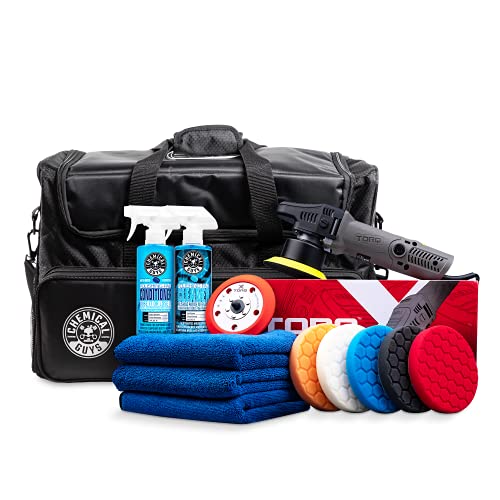 |
TORQ TORQX Random Orbital Polisher Kit Best Starter Kit 8mm orbit, dual action, 5-inch plate, kit includes pads and polishes |
8.7 | 🛒 Check Price |
 |
Avid Power Cordless Buffer Polisher Best Cordless 20V battery, dual action, 5-inch and 6-inch pads, variable speed |
8.4 | 🛒 Check Price |
 |
Chemical Guys TORQ 10FX Random Orbital Polisher Best Value 8mm orbit, dual action, 6-inch hook-and-loop plate, 6-speed dial |
8.1 | 🛒 Check Price |
1. Griot's Garage G9 Random Orbital Polisher: Best Overall
The Griot’s Garage G9 is the buffer we kept reaching for, and it’s the one we recommend to the widest range of people. As a dual action random orbital, it’s genuinely hard to damage paint with, yet it has the torque to keep the pad spinning when you lean into a deep scratch. That combination of safety and real correcting power is rare, and it’s why the G9 sits at the top. The 9mm orbit hits a sweet spot, removing defects faster than a short-throw machine without the wandering feel of a long-throw unit.
The body is where Griot’s earns its reputation. The rubber overmold soaks up vibration so well that we finished entire vehicles without the numb hands you get from cheaper machines, and the variable speed dial is easy to nudge with a gloved thumb. The honest weakness is weight. The G9 is noticeably heavier than a compact polisher, and after twenty minutes of overhead or vertical work your forearm knows it. For most owners that trade is worth it, but if you only ever do small spot fixes, a lighter machine may suit you better.
- Powerful brushless-style motor that holds speed under pad pressure
- Comfortable rubber-overmolded body with low vibration for long sessions
- Lifetime warranty backed by responsive Griot's support
Pros: Cuts and finishes well enough to skip a separate finishing machine; Very low vibration keeps hands fresh through a full car; Generous warranty and easy pad availability
Cons: Heavier than compact polishers, which you feel on vertical panels
2. RUPES BigFoot LHR 15 Mark III: Best for Pros
If you correct cars regularly or simply want the most capable machine available, the RUPES BigFoot LHR 15 Mark III is the buffer the detailing world benchmarks against. Its 21mm long-throw orbit clears defects across a hood or roof in a fraction of the passes a short-throw machine needs, and the refined progressive trigger lets you feather speed in a way no budget polisher can match. On a full paint correction, that speed and smoothness genuinely saves an afternoon.
That same long throw is also its main limitation. On tight areas like mirror caps, pillars, and tight body lines, the big orbit feels clumsy, and you’ll likely want a smaller machine in the kit for detail work. The required large pads also mean restocking is a bigger commitment than with a 5-inch system. For a serious enthusiast or a pro, the RUPES is worth every bit of that compromise. For a first-time user doing one car a year, it’s more machine than you need.
- Huge 21mm throw corrects large panels in fewer passes
- Refined progressive trigger and dial for precise speed control
- Premium build with excellent heat management on long jobs
Pros: Covers ground fast on big panels and full corrections; Smoothest long-throw machine we researched for finishing; Built to survive professional detailing volume
Cons: Requires larger pads that cost more to keep stocked; Long throw can feel unwieldy on tight curves and edges
3. DEWALT DWP849X Variable Speed Polisher: Best Rotary
When you need to remove serious oxidation, sanding marks, or deep scratches, a rotary machine still cuts faster than any dual action, and the DEWALT DWP849X is the classic choice. Its 12 amp motor and wide RPM range give you the raw correcting muscle to flatten defects that would take a DA machine many slow passes. For wet sanding refinement, boat gelcoat, and badly neglected paint, this is the tool the pros pull out first.
The catch is that a rotary demands respect. Because the pad spins directly rather than wobbling, it builds heat fast and can strike through clear coat on an edge in a moment of inattention. This isn’t a machine to learn on with your good car. It’s also heavier and less refined than the dual action units here. But for the experienced user who understands pad selection and panel temperature, the DWP849X offers cutting power and durability that’s genuinely hard to beat for the value.
- True rotary action for heavy cutting and serious defect removal
- Wide 600 to 3500 RPM range with a controllable variable trigger
- Conventional brushes and rugged build make it shop-grade durable
Pros: Removes deep scratches and oxidation faster than any DA here; Strong value for the cutting power it delivers; Proven, repairable design that lasts for years
Cons: Rotary action can burn paint if you’re careless; Heavier and not beginner friendly
4. Adam's Polishes Swirl Killer 15mm Mini Polisher: Best for Beginners
If this is your first buffer and the idea of damaging your paint keeps you up at night, the Adam’s Swirl Killer 15mm is the machine that takes the fear away. Adam’s built it as part of a complete beginner system, so it pairs with clearly labeled pads and polishes that walk you through a real correction step by step. The dual action is forgiving by nature, and the compact body is light enough that you can keep it flat and controlled even on your first panel.
The honest trade-off is power. This is a friendly machine, not a heavy cutter, so on hard paint or deep defects you’ll make more passes than you’d with the Griot’s G9 or a RUPES. The smaller backing plate also means large flat panels take longer to cover. None of that matters much for maintenance polishing and light swirl removal, which is exactly what most owners actually need. As a first machine that grows your skills without scaring you, it’s excellent.
- Forgiving dual action design that’s very hard to damage paint with
- Compact, lightweight body that’s easy to control on curves
- Comes with starter pads and a clear getting-started workflow
Pros: Extremely beginner friendly and confidence building; Light and maneuverable for tight panels and mirrors; Backed by strong Adam's support and community guides
Cons: Less correcting power than a full-size 9mm or 15mm machine; Smaller plate means more passes on big panels
5. TORQ TORQX Random Orbital Polisher Kit: Best Starter Kit
The TORQ TORQX kit answers the most common beginner question, which is what else do I need to buy. The answer here’s nothing, because the box arrives with the polisher, a set of cutting and finishing pads, polishes, and the accessories to get a real result on day one. For someone who just wants to fix swirls on the family car without researching pad sizes and polish lines, that bundled simplicity is a genuine advantage.
The machine itself is a safe, short-throw 8mm dual action, so it’s very hard to hurt your paint, but that same short throw means correction is slower than the 9mm and longer machines higher on this list. The included pads also wear out faster than premium replacements, so heavy users will upgrade them. For light to moderate correction and ongoing maintenance, though, the TORQX kit delivers honest results and removes every excuse not to start.
- Complete kit with machine, pads, polishes, and accessories included
- Safe 8mm dual action throw that resists paint damage
- Hook-and-loop backing plate fits common 5.5-inch pads
Pros: Everything you need to start correcting in one box; Forgiving action makes it nearly foolproof for first timers; Strong value as an all-in-one package
Cons: 8mm throw corrects slower than longer-throw machines; Included pads wear faster than premium aftermarket sets
6. Avid Power Cordless Buffer Polisher: Best Cordless
For owners who hate dragging an extension cord around the car, or who detail away from a power outlet, the Avid Power cordless buffer is the most convenient pick here. The 20V battery gives you real freedom to walk around the whole vehicle, and the variable speed dial spans from gentle wax application up to light polishing. For applying sealants, spreading wax evenly, and keeping a well-maintained car shining, it’s a genuinely pleasant tool to use.
You do give something up for that cordless convenience. Battery runtime means a full multi-stage correction will have you swapping or recharging packs, and the motor doesn’t cut as aggressively as a corded dual action when you hit stubborn swirls. Think of this as a maintenance and wax machine rather than a heavy correction tool. Within that role, the convenience and value make it easy to recommend, especially as a second buffer alongside a corded workhorse.
- Cordless 20V freedom with no extension lead to drag around
- Variable speed dial covers waxing through light correction
- Includes battery, charger, and a set of buffing and wax pads
Pros: Total freedom of movement with no cord to manage; Great for applying wax, sealant, and light polishing; Approachable value with battery and pads in the box
Cons: Battery limits runtime on full corrections; Less cutting power than a corded machine
7. Chemical Guys TORQ 10FX Random Orbital Polisher: Best Value
The Chemical Guys TORQ 10FX is the machine for someone who wants to step up from hand polishing without committing to a premium tool. As a dual action with a clear 6-speed dial, it covers the jobs most owners actually do, which is spreading wax and sealant evenly and knocking back light swirls so the paint looks refreshed. Paired with the massive Chemical Guys range of pads and polishes, it slots into a simple, repeatable routine.
It’s an entry-level machine and it feels like one in the hand. There’s more vibration and motor noise than the Griot’s or RUPES, and it runs out of power before it can tackle heavy oxidation or deep scratches. If your goal is occasional maintenance and a glossier weekend wash, that’s fine, and the value is hard to argue with. If you plan to do full corrections on hard paint, you’ll outgrow it and want one of the stronger machines on this list.
- Affordable dual action that handles waxing and light correction
- Clear 6-speed dial for matching speed to the task
- 6-inch backing plate works with widely available pads
Pros: Strong value for casual detailers and weekend users; Easy to use and forgiving on paint; Huge Chemical Guys pad and polish ecosystem to match it
Cons: More vibration and noise than premium machines; Limited power for serious defect removal
Frequently Asked Questions
What is the difference between a rotary buffer and a dual action polisher?
A rotary buffer spins the pad in a single direct circle, which generates strong cutting power and heat, making it the fastest way to remove deep scratches and oxidation but also the easiest way to burn through clear coat if you aren’t experienced. A dual action, or random orbital, polisher both spins and wobbles the pad on an offset orbit, so it cuts more gently and dramatically lowers the risk of damaging paint. For almost every car owner and beginner, a dual action is the safer and smarter choice, while rotaries are best left to experienced users tackling severe defects.
Can a beginner safely use a car buffer without damaging the paint?
Yes, as long as you start with a dual action machine rather than a rotary. Random orbital polishers are designed to be forgiving, so keeping the pad flat, using moderate speed, and not lingering in one spot will keep you out of trouble. The most common beginner mistakes are running the machine on a dry pad, pressing too hard on a thin edge, and using too aggressive a pad or polish for the job. Start on a low-visibility panel, use a soft finishing pad and a mild polish first, and you’ll build confidence quickly.
What size orbit or throw should I look for in a car buffer?
The orbit, also called the throw, is how far the pad travels on each rotation, and it affects both correction speed and control. Short throws around 8mm are very safe and easy to control but slower to correct. A 9mm orbit, like the Griot’s G9, is a popular all-round sweet spot that balances speed and control. Long throws of 15mm to 21mm, like the RUPES, clear large panels fast but feel less precise on tight curves and body lines. For a first machine doing a mix of work, an 8mm to 9mm orbit is the most adaptable choice.
Do I need different pads for cutting and finishing?
Yes, and matching the pad to the task is just as important as the machine itself. Cutting pads are firmer and more aggressive, used with a heavier compound to remove deeper defects, while finishing pads are softer and used with fine polish to refine the surface to a high gloss. Many corrections are a two-step process, cutting first then finishing, and using a finishing pad alone on heavy swirls will leave you frustrated. Most starter kits include both types so you can learn how each behaves before buying specialist pads.
How often should I polish my car with a buffer?
Machine polishing actually removes a thin layer of clear coat each time, so it isn’t something to do every weekend. A full correction to remove swirls and defects is usually only needed once a year or even less, depending on how the car is washed and stored. Between corrections, you can safely use a buffer on a low speed to apply wax or sealant as often as you like, since that adds protection rather than removing material. Washing with proper technique and good wash media is what keeps swirls from coming back so you correct less often.
Our Verdict
For the best mix of safety, correcting power, comfort, and warranty, the Griot’s Garage G9 Random Orbital Polisher is our top pick and the buffer we would hand to almost anyone, from a careful first-timer to a seasoned enthusiast. If you correct cars often and want the fastest, smoothest machine on big panels, the RUPES BigFoot LHR 15 Mark III is the clear runner up and a tool you’ll never outgrow. Beginners on a tighter setup should look hard at the Adam’s Swirl Killer or the all-in-one TORQ TORQX kit, both of which make that first correction far less intimidating.
