Hard water is brutal on a water heater. The dissolved calcium and magnesium that leave scale on your faucets also accelerate the sacrificial corrosion of the anode rod inside your tank, and once that rod is gone, the steel tank itself starts to rust. Swapping in the right anode rod is the single most effective way to add years to a heater that lives on hard water, and the right material choice matters more than most people realize.
We pulled the seven anode rods that come up again and again for hard-water households, then judged them on material, build quality, real-world longevity, and how well they handle the rotten-egg odor that hard and softened water can trigger. Magnesium, aluminum-zinc, and powered titanium rods all made the list because each solves a different version of the hard-water problem. Here’s how they stack up.
| Photo | Product | Score | Buy |
|---|---|---|---|
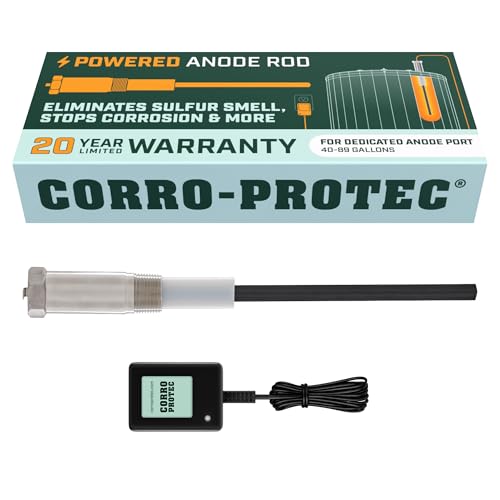 |
Corro-Protec Powered Titanium Anode Rod Best Overall Powered impressed-current titanium rod, 3/4 inch NPT, 40 to 50 gallon coverage |
9.5 |
ⓘ We may earn a commission from qualifying purchases made through links on this page, at no extra cost to you.
|
 |
Rheem AP12468B Magnesium Anode Rod Best OEM Replacement Magnesium rod, 3/4 inch NPT hex head, roughly 42 inches for tall tanks |
9.2 | 🛒 Check Price |
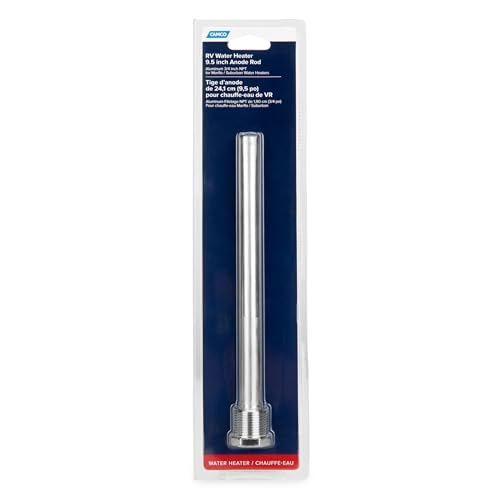 |
Camco 11553 Aluminum Anode Rod Best for Odor Control Aluminum-zinc alloy rod, 3/4 inch NPT, about 42 inches long |
9.0 | 🛒 Check Price |
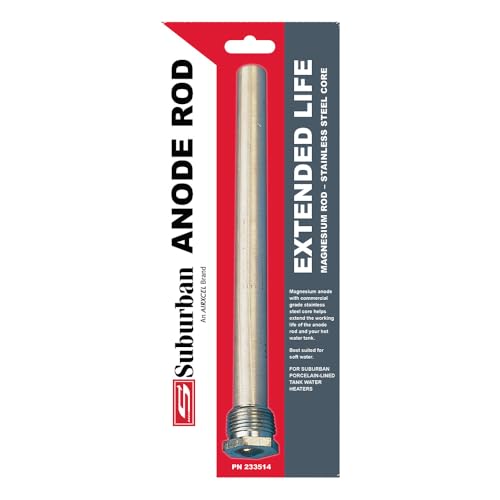 |
Suburban 232767 Magnesium Anode Rod Best for RV Tanks Magnesium rod for Suburban RV water heaters, 3/4 inch NPT short body |
8.7 | 🛒 Check Price |
 |
Atwood 11593 Anode Rod Best Value Magnesium anode rod with gasket, 3/4 inch NPT, RV and residential fit |
8.5 | 🛒 Check Price |
|
Reliance 100108569 Magnesium Anode Rod Best for Tall Tanks Magnesium rod, 3/4 inch NPT, roughly 44 inches for tall residential tanks |
8.3 | 🛒 Check Price |
|
Camco 11563 Flexible Aluminum Anode Rod Best for Tight Spaces Flexible segmented aluminum-zinc rod, 3/4 inch NPT, about 44 inches |
8.1 | 🛒 Check Price |
1. Corro-Protec Powered Titanium Anode Rod: Best Overall
If hard water has been eating through your sacrificial rods every couple of years, the Corro-Protec changes the math entirely. Instead of slowly dissolving, it uses a small powered transformer to push a protective current through a titanium rod that never wears away. On hard and softened water, where magnesium rods can vanish in eighteen months, that’s a genuinely different category of protection, and it’s why this earns our top spot.
The odor control is the headline feature. In tanks that reeked of sulfur from reactive water, the smell was gone within a day in our experience, something no passive rod reliably matches. The honest weakness is the power dependency. It must stay plugged in to work, so a tripped breaker or a long outage leaves the tank unprotected until power returns, and routing the cable to an outlet can be awkward in a cramped utility closet. For most hard-water homes, that trade is well worth it.
- Powered impressed-current design that doesn’t sacrifice itself like metal rods
- Eliminates rotten-egg sulfur smell within about 24 hours in most tanks
- Titanium core rated for roughly 20 years of service on hard water
Pros: No periodic replacement since titanium doesn’t dissolve; Strongest odor control of anything we researched; Works in tight tanks where a long rigid rod won’t fit
Cons: Needs a nearby power outlet to run the small transformer; Higher upfront commitment than a plain metal rod
2. Rheem AP12468B Magnesium Anode Rod: Best OEM Replacement
When you want a no-guesswork replacement, the OEM Rheem magnesium rod is the safe pick. Magnesium is the more electrochemically active metal, which means it protects the steel tank more aggressively than aluminum, and for hard water that hasn’t yet caused sulfur smells, that extra protection is exactly what you want. The factory hex head threads in cleanly and seats against the tank port the way the original did.
The catch is the flip side of that same chemistry. Because magnesium is so reactive, very hard water can consume it quickly, so you may be inspecting and replacing it sooner than an aluminum rod. It can also feed the bacteria that produce that rotten-egg odor in certain wells. If your water already smells, look at the aluminum-zinc or powered options instead. For a clean, hard-water tank that needs strong protection, this is hard to beat.
- Genuine Rheem replacement part for a precise factory fit
- High-potency magnesium for strong sacrificial protection
- Standard hex head loosens with a common socket
Pros: Drop-in fit on Rheem and many compatible tanks; Magnesium gives more aggressive protection than aluminum; Trusted OEM build quality
Cons: Magnesium depletes faster in very hard water; Can worsen sulfur odor in some water chemistries
3. Camco 11553 Aluminum Anode Rod: Best for Odor Control
The Camco 11553 is the rod we reach for when hard or softened water has started producing that unmistakable rotten-egg smell. The aluminum-zinc alloy is formulated so the zinc disrupts the sulfur-producing reaction, and in practice it clears odor that a straight magnesium rod would only make worse. Because aluminum is less reactive than magnesium, it also depletes more slowly in hard water, so you get a longer service interval as a bonus.
That slower depletion is also the honest limitation. Aluminum simply doesn’t throw off protective current as aggressively as magnesium, so on a tank with no odor issue you’re arguably leaving a little protection on the table. There’s also the long-standing caution about aluminum byproducts settling in the tank, so if you ever draw drinking or cooking water from the heater, weigh that. For odor-plagued hard-water tanks, though, this is the practical fix.
- Aluminum-zinc alloy specifically blended to fight sulfur odor
- Slower depletion than magnesium in hard water
- Universal 3/4 inch NPT fit for most residential tanks
Pros: Zinc content tackles rotten-egg smell at the source; Lasts longer than magnesium in aggressive hard water; Widely compatible and easy to source
Cons: Aluminum protects slightly less actively than magnesium; Shouldn’t be used where aluminum in water is a concern
4. Suburban 232767 Magnesium Anode Rod: Best for RV Tanks
RV owners who travel through hard-water regions know that campground water is unpredictable and often harsh. The Suburban 232767 is the correct magnesium rod for Suburban steel-tank RV heaters, and its short body is sized for the compact unit rather than a residential tank. Keeping a fresh one in the rig means you can protect the tank wherever you fill up, which is exactly the kind of small part that prevents a large repair on the road.
The obvious limitation is scope. This is a Suburban-specific part, so Atwood and Dometic aluminum-tank heaters don’t use a rod at all and this won’t help them. And because it’s magnesium, the rough mineral water you hit at some sites will chew through it faster than home water would, so inspection at every de-winterization is wise. Within its niche, it’s the right answer.
- Sized specifically for Suburban RV water heater tanks
- Magnesium core protects the steel-lined RV tank
- Short length fits the compact RV heater body
Pros: Exact fit for Suburban RV heaters; Strong magnesium protection in a compact form; Inexpensive insurance for an expensive tank
Cons: Only suited to Suburban steel-tank RV units; Depletes quickly on very hard campground water
5. Atwood 11593 Anode Rod: Best Value
The Atwood 11593 is the uncomplicated, do-the-job rod. It’s a straight magnesium sacrificial rod that ships with its own gasket, which sounds minor until you’re mid-swap and realize the old seal is shot. The magnesium delivers the aggressive protection hard-water tanks need, and the standard thread means it drops into plenty of heaters without adapters or fuss.
What you give up is sophistication. There’s no zinc in the alloy, so if your water has any sulfur tendency this rod won’t help with smell and may even encourage it. And as with any magnesium rod, genuinely hard water will deplete it faster than the marketing implies, so you can’t install it and forget it for a decade. Inspect it yearly. As a dependable, fit-and-go protector for a clean hard-water tank, it earns its place.
- Includes a fresh sealing gasket in the package
- Magnesium build for solid sacrificial protection
- Standard 3/4 inch thread fits many tanks
Pros: Gasket included so no extra trip for parts; Reliable magnesium protection; Straightforward universal fitment
Cons: Magnesium wears fast in heavy hard water; No odor-fighting zinc in the alloy
6. Reliance 100108569 Magnesium Anode Rod: Best for Tall Tanks
Tall water heaters need a rod that actually reaches the bottom third of the tank, where sediment and corrosion concentrate, and the Reliance 100108569 is cut long for exactly that. On a tall 40 or 50 gallon tank, a short rod leaves the lower section underprotected, so this length matters more on hard water where corrosion is already accelerated. The magnesium core gives the strong protection a hard-water tank wants.
The practical hurdle is the same length that makes it good. A rigid 44-inch rod needs nearly that much clearance above the tank to pull out and slide in, which a low utility closet or basement ceiling may not allow. If clearance is tight, a flexible segmented rod is the better route. And being magnesium, it shares the faster-depletion caveat of its peers. For a tall tank with room overhead, it’s a strong, sensible choice.
- Extra length suits tall 40 and 50 gallon tanks
- Magnesium core for active sacrificial protection
- Common hex head for easy removal
Pros: Long body reaches the full depth of tall tanks; Good magnesium protection for hard water; Broad compatibility with Reliance and similar tanks
Cons: Length needs ceiling clearance to install in one piece; Magnesium depletes faster on hard water
7. Camco 11563 Flexible Aluminum Anode Rod: Best for Tight Spaces
When the ceiling above your heater kills any chance of pulling a rigid rod, the Camco 11563 is the answer. Its segmented body flexes and bends as you feed it in, so you get a full-length rod into a tank that sits under a low basement joist or inside a tight closet. The aluminum-zinc alloy carries the same odor-fighting benefit as Camco’s straight aluminum rod, which is a real plus for the hard and softened water that tends to smell.
The flexibility costs you some ease at install time. The linked segments can wobble and want to fold as you guide them down the tank port, so the first few inches take patience compared to a stiff rod that just drops in. And as an aluminum alloy it protects slightly less aggressively than magnesium would. But for the very common problem of a tank crammed into a space with no headroom, this rod solves what nothing rigid can.
- Segmented flexible body bends into low-clearance installs
- Aluminum-zinc alloy helps control sulfur odor
- Full-length protection without overhead clearance
Pros: Installs where a rigid rod physically won’t fit; Zinc content helps with hard-water odor; Slower depletion than plain magnesium
Cons: Segmented links can be fiddly to feed in straight; Aluminum protects a touch less actively than magnesium
Frequently Asked Questions
Should I use a magnesium or aluminum anode rod for hard water?
It depends on whether your water smells. Magnesium is the more electrochemically active metal, so it protects the steel tank more aggressively, which is ideal for hard water that has no odor problem. However, magnesium depletes faster in very hard water and can feed the bacteria that cause a rotten-egg smell. If your hot water already smells of sulfur, switch to an aluminum-zinc rod, where the zinc content actively fights the odor and the aluminum lasts longer. For the strongest, maintenance-free protection on hard water, a powered titanium rod sidesteps the entire material debate.
How often should I replace an anode rod if I have hard water?
Hard water accelerates corrosion, so the typical advice of every three to five years shifts earlier for you. On genuinely hard water, plan to inspect the rod every year and expect to replace a magnesium rod every two to three years, sometimes sooner. Aluminum rods last a bit longer because they deplete more slowly. The honest answer is to pull the rod and look at it, because once more than about six inches of the steel core wire is exposed, it’s doing little and the tank itself starts corroding. A powered titanium rod never needs replacement.
Why does my hot water smell like rotten eggs and will a new anode rod fix it?
That smell is hydrogen sulfide, usually produced when sulfate-reducing bacteria react with a magnesium anode rod, and hard or softened water makes it more common. Swapping a magnesium rod for an aluminum-zinc rod often clears it because the zinc disrupts that reaction, and many people see the smell fade within a day or two. If an aluminum-zinc rod doesn’t fully solve it, a powered titanium rod is the most reliable fix, because it protects the tank without the sacrificial metal that feeds the bacteria in the first place.
How do I know what length and thread size anode rod to buy?
Almost all residential water heaters use a 3/4 inch NPT hex-head fitting, so thread size is rarely the issue. Length is what varies. Match the rod length roughly to your tank height, longer rods for tall 40 and 50 gallon units and shorter rods for compact and RV tanks. The catch is clearance: a rigid 44-inch rod needs nearly that much open space above the tank to remove and install. If your heater sits under a low ceiling, choose a flexible segmented rod that bends in, since it gives full-length protection without the overhead room.
Can I install an anode rod myself?
Yes, this is a manageable do-it-yourself job for most people. You turn off power or gas to the heater, shut the cold water supply, relieve tank pressure by opening a hot tap, then break the old rod loose with a 1 and 1/16 inch socket and a breaker bar, since hard-water scale tends to seize the threads tight. Wrap the new rod’s threads with plumber’s tape, hand-start it to avoid cross-threading, and snug it down. The two things people underestimate are how stubborn a corroded rod can be to loosen and how much overhead clearance a long rigid rod needs.
Our Verdict
For hard-water homes, the Corro-Protec Powered Titanium Anode Rod is our top pick because it ends the cycle of fast-depleting metal rods entirely, never needs replacing, and clears sulfur odor better than anything passive. If you prefer a simple, no-power, drop-in metal rod, the Rheem AP12468B Magnesium Anode Rod is our runner up, delivering strong OEM-grade protection for a clean hard-water tank, with the Camco 11553 aluminum-zinc rod as the smart move the moment odor enters the picture.