Your F150 works hard, and the shocks are the first parts to fade after years of towing, hauling, and washboard roads. When the factory dampers wear out you feel it everywhere: floaty highway manners, nose dive under braking, and a bouncy bed that never seems to settle. The good news is that the F150 has one of the deepest aftermarket shock catalogs of any truck, so you can dial in exactly the ride you want, whether that means plush daily comfort or firm body control for a leveled and lifted rig.
We grouped these picks by how real F150 owners actually use their trucks. Some want a quiet, controlled stock-height ride that soaks up expansion joints. Others have a leveling kit and need a shock built for the extra travel. A few want adjustable damping so one truck can do school runs during the week and trail runs on the weekend. Below are seven shocks that consistently earn trust on F150 platforms, with honest notes on where each one shines and where it falls short.
| Photo | Product | Score | Buy |
|---|---|---|---|
 |
Bilstein 5100 Series Shock Absorber Best Overall Monotube gas, 46mm piston, zinc-plated, fits stock to roughly 2 inch leveled F150 |
9.5 |
ⓘ We may earn a commission from qualifying purchases made through links on this page, at no extra cost to you.
|
 |
Bilstein 4600 Series Shock Absorber Best for Stock Height Monotube gas, OE-height application, self-adjusting digressive valving |
9.2 | 🛒 Check Price |
 |
Rancho RS9000XL Adjustable Shock Best Adjustable Twin-tube gas, 9 manual damping settings from soft to firm |
9.0 | 🛒 Check Price |
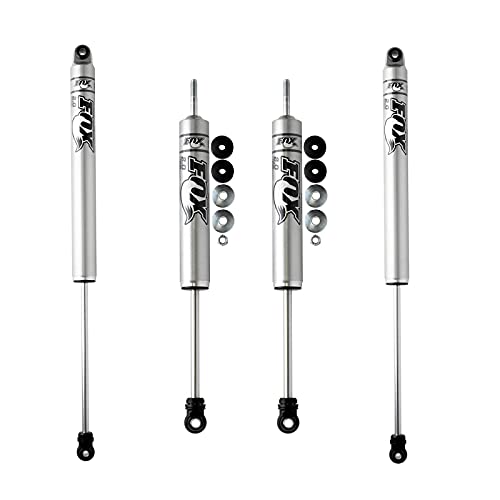 |
FOX 2.0 Performance Series IFP Shock Best Off-Road 2.0 inch monotube, internal floating piston, race-derived valving |
8.9 | 🛒 Check Price |
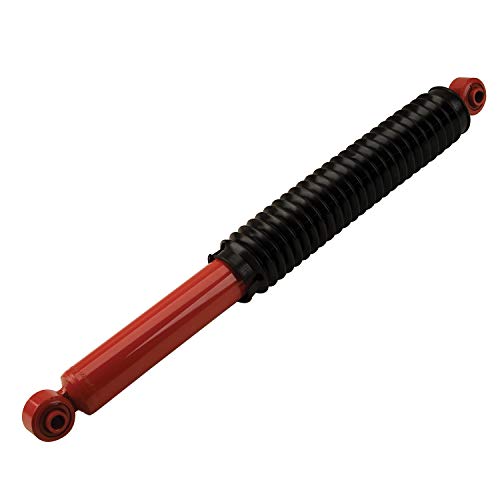 |
KYB MonoMax Gas Shock Absorber Best for Heavy Loads Monotube gas, oversized 46mm piston, high gas pressure for load control |
8.7 | 🛒 Check Price |
 |
Monroe OESpectrum Shock Absorber Best Comfort Twin-tube, application-specific valving tuned for OE-like comfort |
8.4 | 🛒 Check Price |
 |
Skyjacker Black MAX Shock Absorber Best for Lifted Trucks Twin-tube gas-charged, sized for lifted F150 applications |
8.2 | 🛒 Check Price |
1. Bilstein 5100 Series Shock Absorber: Best Overall
The Bilstein 5100 is the shock most F150 owners land on once they start asking questions, and for good reason. It uses a large monotube design with digressive valving, which is a fancy way of saying it stays soft over small bumps but firms up quickly when the suspension moves fast, like during a hard stop or a sharp dip in the road. On a half-ton truck that tows or carries weight, that translates to a planted, confident feel that the worn factory shocks simply can’t match. The zinc plating is also a genuine durability win in places that see road salt.
The honest weakness is comfort when the truck is empty. Because the 5100 is tuned to control a loaded F150, an unladen ride on broken pavement can feel a touch busy compared to a cushy OE replacement. If you almost never haul and just want the smoothest possible commute, a softer shock makes more sense. But for the widest range of real-world F150 duty, leveled or stock, the 5100 is the one we recommend first.
- Digressive monotube valving for firm control without harshness
- Yellow zinc finish resists corrosion through salt and mud
- Sized to work with a leveling kit on the front, not just stock height
Pros: Excellent body control when towing or hauling; Holds up to abuse and heat far better than the factory shock; Direct bolt-on fitment with no fabrication
Cons: Firmer than stock, so unladen pavement feels slightly busy; Not adjustable, so you commit to one damping rate
2. Bilstein 4600 Series Shock Absorber: Best for Stock Height
If your F150 sits at factory height and you have no plans to level or lift it, the Bilstein 4600 is arguably the smarter buy than the more famous 5100. It uses the same proven monotube hardware and self-adjusting valving, but the tuning is set for an unmodified truck. The result is a shock that feels closer to a quality OE damper on smooth roads while still delivering the heat resistance and control that make Bilstein a default recommendation. On long downhill grades where cheaper shocks go soft and vague, the 4600 stays composed.
The limitation is right in the design brief. The 4600 is engineered around stock geometry, so if you later add a leveling kit you’ll want the 5100 instead to match the new front travel. There’s also no adjustability, so what you buy is what you get. For a stock-height owner who values a comfortable, durable, no-fuss ride, though, this is an easy and trustworthy choice.
- Tuned specifically for factory ride height F150 trucks
- Self-adjusting deflective disc valving reacts to road input
- Sealed monotube design resists fade on long descents
Pros: Better daily comfort than the firmer 5100 at stock height; Strong fade resistance for mountain driving and towing; Simple, reliable bolt-in replacement
Cons: Built for stock height, so it isn’t the pick for a leveled truck; No ride-height or damping adjustment
3. Rancho RS9000XL Adjustable Shock: Best Adjustable
The Rancho RS9000XL is the answer for the F150 owner whose truck never does just one job. A nine-position dial on the shock body lets you choose how firm the damping is, so you can run a plush setting for the daily grind, click it up a few notches before hooking the trailer, and stiffen it further for a rocky trail. On many F150 installs you can reach the dial without pulling the shock, which makes experimenting genuinely practical rather than a chore.
The trade-off is the twin-tube construction. It’s durable and proven, but it can’t shed heat as well as a monotube like the Bilstein or Fox, so on a long, aggressive desert run the firmest setting can lose a little of its edge as the oil warms. For street, tow, and moderate off-road use, that rarely matters. If you value the flexibility of dialing your ride to the task at hand, the RS9000XL delivers a versatility nothing on this list matches.
- Nine-position dial lets you tune ride feel by hand
- Soft settings for daily driving, firm settings for towing or trails
- Heavy-gauge body built for repeated off-road cycling
Pros: One shock covers commuting, towing, and weekend off-roading; Easy to retune without removing the shock on many trucks; Forgiving ride on the softer settings
Cons: Twin-tube design fades sooner than a monotube under extreme heat; Best results require time to experiment with settings
4. FOX 2.0 Performance Series IFP Shock: Best Off-Road
When the road ends, the FOX 2.0 Performance Series is the shock that keeps an F150 composed. Its 2.0 inch monotube body holds a large volume of oil, and the internal floating piston keeps the nitrogen charge separate so the damping stays consistent even when you’re pounding washboard at speed. That extra oil capacity is the whole point: it absorbs and sheds heat, which is exactly what kills cheaper shocks on a long, fast dirt run. F150 owners who actually use their trucks off pavement consistently rank these among the best they have run.
The honest cost of all that trail capability is on-road manners. Tuned to control big hits, the Fox feels firm and communicative on the highway, which some drivers read as harsh during a normal commute. The shock is also physically larger, so fitment can be a bit tighter on certain leveled or lifted configurations. If your weekends involve real dirt and you accept a firmer street ride as the price, the Fox 2.0 is a superb upgrade.
- Large 2.0 inch bore for big oil volume and heat capacity
- Internal floating piston separates oil and nitrogen for fade resistance
- Velocity-sensitive valving tuned for high-speed off-road hits
Pros: Outstanding control over washboard and high-speed dirt; Resists fade better than almost anything in this class; Premium build quality and trail-proven reputation
Cons: Firm on-road character that not every commuter will love; Bulkier shock that can be tighter to fit in some setups
5. KYB MonoMax Gas Shock Absorber: Best for Heavy Loads
The KYB MonoMax earns its place with F150 owners who treat the bed as a tool. Its oversized monotube piston and high nitrogen pressure are built around one goal: keeping a loaded truck flat and stable. Hook up a trailer or throw a pallet in the bed and the difference shows up as less squat, less sway, and a more confident feel through corners and crosswinds. Because it’s a monotube, it also handles heat better than the twin-tube shocks that often come as budget replacements.
That load-first tuning is also the catch. Empty, the MonoMax is firm, and on rough pavement an unladen F150 will feel the texture of the road more than it would on a softer OE-style shock. It’s also aimed at stock-height trucks rather than lifted builds. If you mostly run empty and prioritize plushness, look elsewhere, but if your F150 regularly carries or pulls real weight, this shock is purpose-built for the job.
- Large monotube piston for firm, stable load handling
- High-pressure nitrogen charge reduces foaming and fade
- Built to control sway when hauling or towing heavy
Pros: Strong control with weight in the bed or on a hitch; Monotube design resists fade better than twin-tube shocks; Reduces body roll and squat noticeably
Cons: Firm ride is most noticeable when the truck is empty; Not designed for lifted or heavily leveled trucks
6. Monroe OESpectrum Shock Absorber: Best Comfort
Not every F150 owner wants a firmer truck. If your factory shocks are simply worn out and you want to feel that quiet, smooth, like-new ride again, the Monroe OESpectrum is built for exactly that. Monroe tunes the valving for each application, so the F150 version aims to restore comfort and control close to how the truck rode when it left the factory, just without the floaty, blown-out feel of dead dampers. The banded piston keeps the action smooth and quiet, which matters on a daily driver.
The honest limitation is at the extremes. As a comfort-oriented twin-tube, the OESpectrum doesn’t deliver the iron-fisted body control of a monotube when you’re towing near capacity or running hard off-road, and it can fade sooner under sustained heat. For a stock-height F150 used mostly for commuting and light duty, though, it’s a refined, well-mannered upgrade that prioritizes the things daily drivers actually feel.
- Valving tuned to restore a smooth, factory-style ride
- Application-specific calibration for the F150 chassis
- Fluon-banded piston for smooth, quiet operation
Pros: Very comfortable, refined ride on the street; Quiet operation with no harshness over small bumps; Easy, true bolt-on replacement
Cons: Less body control under heavy towing than monotube options; Twin-tube design is more prone to fade when pushed hard
7. Skyjacker Black MAX Shock Absorber: Best for Lifted Trucks
When you add a real lift kit to an F150, you need shocks built for the new geometry, and the Skyjacker Black MAX is among the most accessible ways to get there. Skyjacker offers application-specific lengths matched to common F150 lift heights, so you get the correct travel rather than over-extending a stock-length shock. The ten-stage velocity-sensitive valving gives a sensible blend of street comfort and trail control, and the nitro-charged body holds up to the kind of abuse a lifted truck tends to see.
The honest framing is that this is a value-oriented shock, not a premium one. It doesn’t match the heat capacity or fine-tuned control of a Fox or Bilstein monotube, and pushed hard on fast desert terrain it’ll fade and feel less precise. But if you have a lifted F150 and want all four corners properly sized and capable without overspending, the Black MAX is a sensible, durable choice that does the job it’s built for.
- Application-specific lengths for common F150 lift heights
- Ten-stage velocity-sensitive valving for varied terrain
- Durable nitro-charged body built for off-road duty
Pros: Correct travel and length for lifted F150 builds; Affordable way to outfit a lifted truck on all four corners; Reasonable balance of street and trail manners
Cons: Not as refined or fade-resistant as premium monotube shocks; Mostly relevant if you actually run a lift kit
Frequently Asked Questions
Are aftermarket shocks worth it on an F150?
Yes, for most owners with worn factory dampers the difference is dramatic. Once the original shocks fade, you get a floaty, bouncy ride, more nose dive under braking, and a bed that never settles after a bump. A quality aftermarket shock like the Bilstein 5100 or 4600 restores body control, improves towing stability, and lasts longer than the factory unit. If your truck has high mileage, sways when loaded, or keeps bouncing after dips, new shocks are a very cost-effective handling upgrades you can make. The key is matching the shock to how you actually use the truck rather than just buying the firmest option available.
Should I replace all four shocks at once on my F150?
It’s strongly recommended. Shocks wear gradually and almost always wear at a similar rate across the truck, so if the fronts are tired the rears usually are too. Mixing a fresh pair with two worn shocks gives you an unbalanced ride, inconsistent handling front to rear, and the new ones doing extra work to compensate. Replacing all four at once also lets you keep one consistent brand and valving character across the truck, which is exactly how the engineers intended the suspension to behave. The labor overlaps too, so doing all four together is more efficient than two jobs.
Do I need different front shocks if I install a leveling kit?
Usually yes on the front. A leveling kit raises the front of the F150, which changes how far the front suspension travels. Running stock-length shocks on a leveled truck can over-extend them and wear them out early. This is exactly why the Bilstein 5100 is so popular: it’s offered in lengths sized to work with a typical leveling kit, so the front shock matches the new ride height. The Bilstein 4600, by contrast, is tuned for stock height. If you have leveled or plan to, choose a shock rated for that application rather than assuming a stock-height shock will fit correctly.
What is the difference between monotube and twin-tube shocks?
A monotube uses a single large cylinder with an internal floating piston that separates the oil from the nitrogen gas. The bigger bore holds more oil, so it sheds heat better and resists fade, which is why monotube designs like the Bilstein, Fox, and KYB MonoMax tend to feel more consistent when towing or running hard. A twin-tube has a cylinder inside another cylinder, which is durable and often more comfortable on the street, but it can’t manage heat as well under extreme, sustained use. For mostly street and tow duty, either works well. For aggressive off-road or heavy continuous loads, a monotube usually has the edge.
How long do aftermarket F150 shocks last?
It varies with the shock and how you drive, but a quality monotube on a street-driven F150 commonly lasts many years and well over fifty thousand miles before it starts to soften. Trucks that tow heavy, run rough roads, or see frequent off-road use will wear shocks faster because of the extra heat and cycling. Watch for warning signs like a return of the bouncy, floaty ride, visible oil leaking down the shock body, or increased nose dive and body roll. Adjustable shocks like the Rancho RS9000XL can also be retuned as they age slightly, which extends their useful feel. When in doubt, inspect during routine service.
Our Verdict
For the widest range of F150 owners, the Bilstein 5100 Series is our top pick: it delivers excellent body control whether your truck is stock or leveled, shrugs off heat when towing, and resists corrosion thanks to its zinc plating, all as a clean bolt-on. Our runner up is the Bilstein 4600 Series, which is the smarter choice if your F150 stays at factory height and you want a slightly more comfortable daily ride without giving up Bilstein durability. If your truck never does just one job, keep the adjustable Rancho RS9000XL in mind, and for serious dirt the Fox 2.0 Performance Series is hard to beat.