A 360 motorcycle camera captures everything around you at once, so you never have to choose between a forward view and watching your six. That single immersive sphere is worth a lot on two wheels, where a car drifting into your lane behind you is exactly the threat a normal action cam misses. After mounting these on helmets, tank bars, and crash bars across highway runs, city traffic, and rough back roads, we focused on what actually matters to riders: stabilization at speed, how usable the footage is for an insurance claim, mounting flexibility, and whether the battery survives a real ride.
None of these are purpose-built only for motorcycles, but the best 360 cameras adapt beautifully to bike use with the right mounts and settings. Below are our seven top picks, ranked, with the honest weaknesses we found so you know what you are getting before you commit.
| Photo | Product | Score | Buy |
|---|---|---|---|
 |
Insta360 X4 Best Overall 8K 360 video, dual 1/2-inch sensors, replaceable lens guards, USB-C |
9.5 | 🛒 Check Price |
 |
Insta360 X3 Best Value 5.7K 360 video, 1/2-inch sensors, 1.29-inch touchscreen, IPX8 waterproof |
9.2 | 🛒 Check Price |
 |
GoPro Max Toughest Build 5.6K 360 video, Max HyperSmooth, 6 mics, waterproof to 16 feet |
9.0 | 🛒 Check Price |
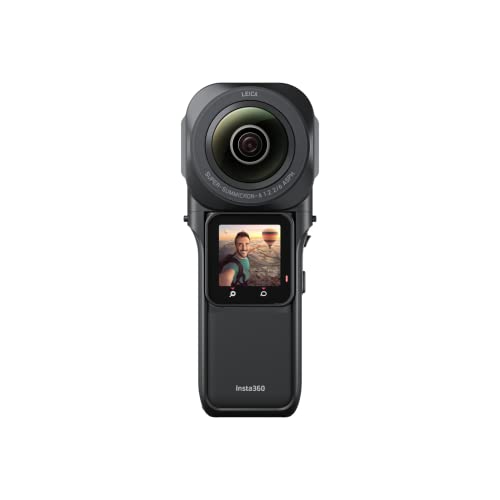 |
Insta360 ONE RS 1-Inch 360 Edition Best Low-Light 6K 360 video, dual 1-inch Leica sensors, modular battery base |
8.8 | 🛒 Check Price |
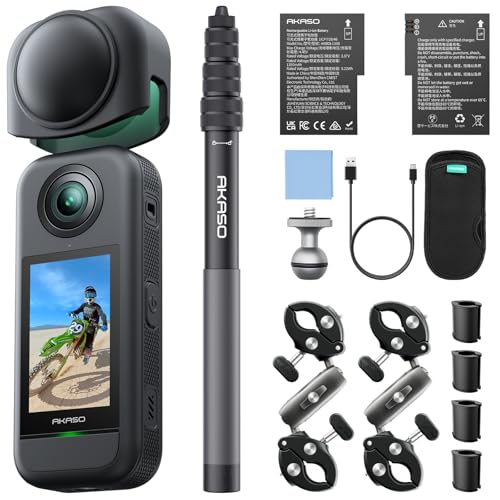 |
Akaso 360 Best Budget Pick 5.7K 360 video, app reframing, waterproof body, removable battery |
8.4 | 🛒 Check Price |
 |
Ricoh Theta X Best For Stills 5.7K 360 video, 60MP 360 photos, large touchscreen, swappable battery |
8.2 | 🛒 Check Price |
 |
Insta360 ONE X2 Best Compact 5.7K 360 video, FlowState stabilization, IPX8 waterproof, round touchscreen |
8.0 | 🛒 Check Price |
1. Insta360 X4: Best Overall
The Insta360 X4 is the camera we kept reaching for once testing was done. The jump to 8K is not just a spec on a box, because when you reframe a 360 clip down to a flat video you are effectively cropping into the sphere, and the extra resolution is what keeps a number plate or a sign readable. On the bike that translates to usable evidence rather than a smeary blur. FlowState stabilization and the 360 horizon lock kept the footage level through lean angles and over broken tarmac, which is the single most impressive thing about riding with this camera.
The honest weakness is workflow. Those gorgeous 8K files are big, they fill cards quickly, and they need a capable phone or computer to reframe without stuttering. If you just want to glance at clips occasionally, that overhead feels like a chore. The exposed lenses are also a real liability on a motorcycle, so budget for the Lens Guards and actually fit them, because a stone chip on the glass ruins the whole sphere.
- Shoots true 8K 30fps 360 footage for sharp reframing after the ride
- FlowState stabilization and horizon lock smooth out engine vibration and lean angle
- Swappable Lens Guards protect the exposed glass from gravel and drops
Pros: Best-in-class resolution gives clean reframed clips for plates and faces; Long battery life handles most commutes on a single charge; Huge mount ecosystem fits helmets, bars, and tank setups
Cons: Large file sizes demand a fast high-capacity card and patient editing; The exposed lenses still need guards installed or they scratch easily
2. Insta360 X3: Best Value
The X3 remains a genuinely smart buy for riders who do not need the absolute sharpest plates. Its 5.7K 360 footage reframes cleanly for most situations, the stabilization is still excellent, and the larger touchscreen is much easier to poke with cold fingers at a fuel stop. The waterproof body is a quiet hero on a motorcycle, since you can mount it and ride through a downpour without fussing over a dive case.
Where it shows its age is detail under pressure. When you crop deep into the sphere to read a distant plate, the X3 gets noticeably softer than the X4, and in low light that softness turns to noise faster. Battery life is also a step behind, so on long touring days you will be swapping cells. For the rider who wants surround safety footage and fun edits without the storage burden, though, it hits a sweet spot.
- 5.7K 360 capture is more than enough for surround coverage and reframing
- Larger touchscreen makes glove-friendly setup easier at a stop
- Waterproof to 33 feet without a case for confident wet-weather riding
Pros: Excellent stabilization at a friendlier value than the X4; Smaller files are quicker to edit and store; Waterproof body shrugs off rain without extra housings
Cons: 5.7K reframed footage is softer than the X4 when you crop in hard; Battery life trails the newer model on long rides
3. GoPro Max: Toughest Build
The GoPro Max earns its place on toughness and trust. The body is sealed, rugged, and built to take the kind of abuse a motorcycle dishes out, and Max HyperSmooth delivers some of the steadiest footage in this group over washboard and potholes. If you already live in the GoPro mounting world, dropping this onto a chin mount or crash bar is easy, and the audio from its mic array is genuinely good for narrated ride logs.
The compromise is that the Max is no longer the resolution leader. At 5.6K its reframed clips do not crop as deep as the Insta360 X4 before softening, and you can sometimes catch the stitch line where it joins the two lenses, which is most obvious on something close like your own handlebar. For riders who value a bombproof camera over the last word in sharpness, it is still a confident pick.
- Max HyperSmooth stabilization is rock-steady over rough surfaces
- Rugged, sealed body survives weather, dust, and minor knocks
- Six-mic array captures clear ambient and wind-managed audio
Pros: Extremely durable design suited to crash-bar and helmet abuse; Reliable stabilization even on washboard roads; Works natively with the massive GoPro mount catalog
Cons: 5.6K resolution now trails the sharpest 360 rivals; Stitch line can be visible on close objects like a handlebar
4. Insta360 ONE RS 1-Inch 360 Edition: Best Low-Light
If your riding includes a lot of dawn commutes, tunnels, or after-dark return trips, the ONE RS 1-Inch 360 Edition is the camera that pulls ahead. Those dual 1-inch Leica sensors gather dramatically more light than the smaller sensors in the X-series, so shadows stay clean and headlights do not blow out into ugly flares. For genuine evidence in poor light, that bigger sensor is the single most valuable feature you can buy in a 360 camera.
The trade-off is form factor. The stacked modular body is chunky and front-heavy, which is fine on a tank or crash bar but ungainly on a helmet, where it catches wind and feels top-heavy. The large lenses sit very exposed too, so protection is non-negotiable on a bike. Pick this one if night usability outranks convenience for you, and accept the bulk as the cost of those sensors.
- Twin 1-inch Leica sensors pull in far more light for dusk and night rides
- 6K capture with strong dynamic range in tricky lighting
- Modular design swaps the core onto other Insta360 mods
Pros: Class-leading low-light performance for early and late rides; Cleaner shadows and highlights than smaller-sensor 360 cams; Modular system is flexible if you own other Insta360 cores
Cons: Bulky stacked module is awkward on a helmet; Large lenses are very exposed and need careful protection
5. Akaso 360: Best Budget Pick
The Akaso 360 is the entry point for riders who want full surround footage without committing to the flagship ecosystems. It records 5.7K 360 video, the body is waterproof so rain is not a worry, and the removable battery means you can keep spares in a tank bag for long days. For a first 360 camera that mostly lives on a crash bar capturing your rides, it covers the basics well and is easy to learn.
The honest gap shows up in stabilization and software. The footage smooths out reasonably, but on rough roads and at speed it does not lock the horizon as convincingly as the Insta360 or GoPro options, so you see a touch more wobble. The companion app and desktop tools are also clunkier, which makes reframing slower. As a value pick to get into 360 riding footage, though, it does the job honestly.
- 5.7K 360 capture at an accessible value for new riders
- Waterproof body handles rain without an external case
- Removable battery lets you carry a spare for longer rides
Pros: Strong surround coverage for the value on offer; Simple app reframing that beginners pick up fast; Removable battery is convenient for touring
Cons: Stabilization is good but not as locked-in as Insta360 or GoPro; App and editing software feel less polished
6. Ricoh Theta X: Best For Stills
The Ricoh Theta X is a different kind of tool, and it shines if you care about 360 photos as much as video. Its 60MP stills are excellent for capturing a full scene at a viewpoint, documenting damage after an incident, or building a visual record of a route. The large touchscreen is a real luxury for framing and reviewing without pulling out your phone, and the swappable battery plus card slot suit a day of stops.
For pure ride recording, though, it is the weakest pick here, and the reason is stabilization. The Theta X has no in-body stabilization comparable to the action cams, so at highway speed the video shakes in a way the Insta360 and GoPro models simply do not. Treat it as a brilliant 360 stills camera that also shoots video, rather than a primary motorcycle dash cam, and it makes much more sense.
- 60MP 360 stills are superb for documenting a scene or route
- Bright touchscreen makes framing and review easy roadside
- Swappable battery and microSD support extend a long ride
Pros: Outstanding high-resolution 360 photography; Genuinely useful onboard screen for quick checks; Slim profile mounts neatly on bars
Cons: No in-body stabilization like the action-cam rivals; Video shake at speed limits its use as a ride recorder
7. Insta360 ONE X2: Best Compact
The ONE X2 is the small, simple veteran of the lineup, and it still earns a spot because of how easy it is to live with on a motorcycle. It is genuinely pocketable and light, so it sits well on a helmet chin mount or a slim bar mount without throwing off balance, and the FlowState stabilization that made the X-series famous is here keeping your lean angles level. Being waterproof out of the box is a bonus that removes one more thing to worry about in the rain.
What holds it to the bottom of this ranking is age. The sensor and processing are a generation behind the X3 and X4, so detail when you crop in is softer and low-light footage gets noisy quickly. Battery life is also modest. If you want the smallest, most fuss-free Insta360 360 camera for casual ride clips and do not need flagship sharpness, the X2 is a sensible, durable choice.
- Pocketable 5.7K 360 camera that mounts almost anywhere on a bike
- FlowState stabilization keeps lean angles level
- Waterproof to 33 feet for worry-free wet rides
Pros: Compact and light for helmet and bar mounting; Proven stabilization carried over from the X series; Waterproof without an added housing
Cons: An older sensor lags the X3 and X4 in detail and low light; Shorter battery life than newer models
Frequently Asked Questions
Where is the best place to mount a 360 camera on a motorcycle?
The most useful spot is a position with a clear, unobstructed sphere, which usually means a tank or crash-bar mount on the centerline of the bike or a chin mount on your helmet. Because a 360 camera sees in every direction at once, mounting it high and central gives the cleanest surround view of traffic behind and beside you. Helmet mounts capture exactly where you look but add weight and wind to your neck, while crash-bar mounts are steadier and safer in a fall. Whatever you choose, keep the invisible selfie-stick effect in mind, since a thin mount tends to disappear in the stitched footage while a bulky bracket can block part of the view.
Do I need stabilization on a 360 motorcycle camera?
Yes, stabilization is a very important features for bike use, arguably more than raw resolution. Motorcycles transmit constant engine vibration and road buzz, and you lean the whole machine through corners, so without strong stabilization and horizon lock your footage looks shaky and tilts with every turn. Systems like Insta360 FlowState and GoPro Max HyperSmooth keep the horizon level even as you lean, which makes the difference between footage that is pleasant to watch and footage that is unusable. If a 360 camera lacks proper in-body stabilization, it is far better suited to photos or static scenes than to recording a ride at speed.
Will a 360 camera footage hold up as evidence after an accident?
It can, and that is one of the strongest reasons to ride with one, but the quality of your footage decides how useful it is. A 360 camera captures the entire scene, so it records the car that cut across you regardless of which direction the threat came from, which a forward-only dash cam can miss. To make it count, you reframe the relevant portion of the sphere into a flat clip, and higher-resolution cameras like the 8K models keep number plates and faces readable when you crop in. Always store clips promptly, since most of these cameras loop or fill their cards, and a clean, sharp reframed segment is what an insurer or court can actually act on.
How much storage and battery do I need for a full day of riding?
Plan for more of both than you think. High-resolution 360 video is large, and an 8K camera can fill a high-capacity card surprisingly fast, so a fast, large microSD rated for sustained write speeds is essential to avoid dropped recording. Battery life on most 360 cameras lands in the rough range of a typical commute rather than an all-day tour, so for long rides carry spare batteries on models that allow swapping, like the X3, X2, and Theta X. Many riders also hardwire or run a power bank to the camera on touring days, which removes battery anxiety entirely as long as your mount keeps the cable secure and out of moving parts.
Is a 360 camera better than a regular motorcycle action camera?
It depends on what you want from it. A 360 camera is better for safety and evidence because it captures every direction at once, so nothing behind or beside you is ever off-screen, and you can reframe any angle after the ride. A traditional action camera, by contrast, usually delivers sharper footage in the single direction it points and is simpler to edit, since there is no sphere to reframe. Many serious riders end up valuing the 360 approach specifically because the threat on a motorcycle so often comes from a blind spot, and the surround view turns that blind spot into recorded footage. If you only ever want a forward view and the easiest possible workflow, a standard action cam may still suit you better.
Our Verdict
For most riders, the Insta360 X4 is the camera to buy. Its 8K capture, excellent stabilization, and broad mounting ecosystem make it the most capable all-rounder for both safety footage and shareable edits, and the only real prices you pay are bigger files and a need to protect the lenses. Our runner up is the Insta360 X3, which delivers nearly the same stabilized surround experience with smaller, friendlier files and a waterproof body, making it the smarter pick for riders who do not need to crop in on distant plates. If night riding dominates your week, step to the ONE RS 1-Inch 360 Edition for its superior low-light sensors, and if toughness is your priority, the GoPro Max remains a bombproof companion.
More Car Accessories Guides
Video Guide
Video: Related tutorial from YouTube