The 1156 bulb (also called BA15S, 7506, P21W or 1141 in its near twin) is a very common single-filament sockets on the road. It runs your turn signals, reverse lights, tail lights and a lot of trailer and RV markers. Swapping the dim factory incandescent for a quality 1156 LED is one of the cheapest upgrades that actually makes your car safer, because brighter, faster-reacting signals get you noticed sooner.
The catch is that not all 1156 LED bulbs are created equal. Cheap ones cause hyperflash (that rapid blinking that tells the car a bulb is out), throw a dull amber instead of a clean color, or simply won’t survive the heat inside a sealed taillight housing. We looked at projector lenses, true CANbus-ready designs, polarity, beam pattern and real-world brightness to pick seven 1156 LED bulbs that are worth installing.
| Photo | Product | Score | Buy |
|---|---|---|---|
 |
Auxbeam 1156 LED Bulbs (3030 SMD, 2-Pack) Best Overall 30x 3030 SMD chips, 360-degree, CANbus-ready, 6000K white or amber |
9.5 |
ⓘ We may earn a commission from qualifying purchases made through links on this page, at no extra cost to you.
|
 |
SEALIGHT 1156 7506 LED Bulbs (6000K, 2-Pack) Best Brightness 27x 3030 SMD, 6000K xenon white, 1156/7506/1141 fit |
9.3 | 🛒 Check Price |
 |
Philips Ultinon LED 1156 (White) Best Color Accuracy AirCool heatsink, 6000K, brand OEM-grade build, X-tremeUltinon series |
9.2 | 🛒 Check Price |
 |
Sylvania ZEVO 1156 LED Best for OEM Look ZEVO series, available white, amber and red, premium driver |
9.0 | 🛒 Check Price |
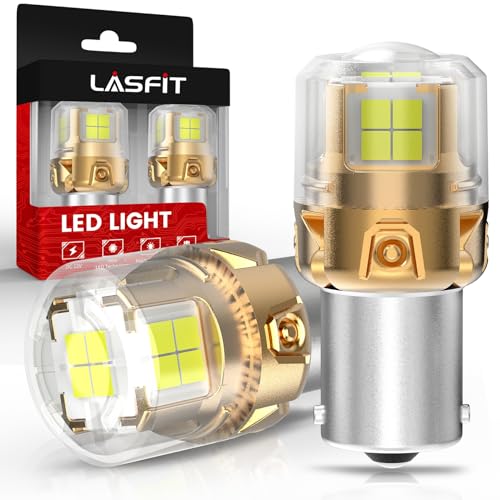 |
Lasfit 1156 LED Bulbs (BA15S, 2-Pack) Best CANbus Fit CANbus integrated, 3020 SMD, error-free on many models, white or amber |
8.8 | 🛒 Check Price |
 |
AUXITO 1156 LED Bulbs (3030 SMD, 2-Pack) Best Value 24x 3030 SMD, 360-degree, white/amber/red, non-polarity |
8.6 | 🛒 Check Price |
 |
JDM ASTAR 1156 LED (3020 SMD, 2-Pack) Best Brightness Per Watt Polarity-free 3020 SMD, xenon white, extreme bright series |
8.4 | 🛒 Check Price |
1. Auxbeam 1156 LED Bulbs (3030 SMD, 2-Pack): Best Overall
The Auxbeam 1156 is the bulb we kept coming back to because it nails the boring fundamentals. The chips wrap around the body so you get genuine 360-degree light instead of one bright face and two dim sides, which matters in a reflector housing where the light has to bounce. In a reverse light it actually lit up the ground behind the car, and as a tail or brake bulb it punched through daylight far better than the orange-tinted factory incandescent.
Its honest weakness is physical size. The heatsink that keeps it cool also makes it longer than a stock 1156, so in a few sealed or shallow taillights you may have to wiggle the housing closed or skip it entirely. It’s also marketed as CANbus-ready, which handles dash warnings on many cars, but that doesn’t always cure turn-signal hyperflash. On some vehicles you’ll still need to add a load resistor or a flasher relay to get a normal blink rate.
- Dense 3030 SMD array for even 360-degree output with no dark spots
- Built-in CANbus resistor logic reduces error lights on many vehicles
- Aluminum body with extended fins to pull heat out of the chips
Pros: Strong, consistent brightness front and side; Plug and play on a broad selection of cars and trucks; Available in white, amber and red to match the function
Cons: Taller than stock, so it can be tight in shallow housings; Some vehicles still need a separate load resistor for turn signals
2. SEALIGHT 1156 7506 LED Bulbs (6000K, 2-Pack): Best Brightness
If your main goal is a backup light that turns night into something usable, SEALIGHT is the bulb to beat. The 6000K output is a clean xenon white with none of the blue or purple tint cheaper bulbs drift toward, and the beam spreads wide rather than firing a single hot pencil beam. As a reverse bulb it genuinely improved how far we could see backing into a dark driveway, and it held that brightness steadily instead of dimming at idle.
The trade-off is that this bulb is built for white-light jobs. If you’re trying to replace an amber turn signal, the white version is the wrong tool, and even SEALIGHT’s amber can hyperflash on cars that monitor bulb resistance, especially many European models. Plan on adding a load resistor or a compatible LED flasher for signal use. For reverse, tail and white running lights, though, it’s hard to fault.
- High-output 3030 SMD chips tuned for a crisp 6000K white
- Wide beam spread for reverse and daytime running duty
- Constant-current driver to hold brightness as voltage dips
Pros: Noticeably whiter and brighter than stock for backup lights; Even output with no flicker at idle; Solid build quality for the price tier
Cons: Not the best choice if you want a warm amber turn signal; Can trigger hyperflash without a resistor on European cars
3. Philips Ultinon LED 1156 (White): Best Color Accuracy
Philips earns its spot for buyers who care about doing it right rather than doing it loudest. Because Philips bins its LEDs, every bulb in a pair matches the next, so your two reverse lights or two tail lights look identical instead of one running slightly bluer than the other. The filament-style chip placement also keeps the light where the reflector expects it, which gives a clean, controlled pattern rather than a messy glow.
The honest downside is that this is a focused product line, not a catalog. You won’t find the same wide menu of amber, red and dual-color options that the value brands offer, and the raw brightness is tuned to look factory-correct rather than to blow away the competition on a light meter. If you want maximum lumens for show, look elsewhere. If you want a bulb that simply works for years and looks like it belongs on the car, Philips delivers.
- Philips chip binning for consistent color bulb to bulb
- AirCool internal heatsink design for long life
- Tight, controlled output that mimics a proper filament position
Pros: Color and brightness are reliable and repeatable; Trusted name with strong durability; Clean light with no rainbow fringing
Cons: Fewer color and function options than budget brands; Output is refined rather than the absolute brightest
4. Sylvania ZEVO 1156 LED: Best for OEM Look
Sylvania’s ZEVO line is the pick when you want the upgrade to look completely stock and use the right color for each job. Unlike many sellers who only push 6000K white, Sylvania offers proper amber for turn signals and red for tail and brake duty, so you aren’t trying to fake amber through an orange lens. The compact body also fits housings that reject the taller heatsink bulbs, which makes it an easy choice for older sedans and trucks with tight taillights.
Where ZEVO gives ground is outright punch. It’s clearly brighter than incandescent and very even, but it won’t out-shine the high-density 3030 SMD bulbs from Auxbeam or SEALIGHT on a meter. And like nearly every LED in an 1156 signal socket, it can trigger fast hyperflash on cars that watch for bulb resistance, so budget for a load resistor or LED flasher if you’re using it as a turn signal.
- Color options matched to tail, signal and reverse functions
- Quality voltage regulation for stable, flicker-free light
- Compact form that fits most stock housings
Pros: Genuine amber and red versions for correct signal color; Reputable brand with consistent quality; Fits cleanly where larger bulbs won’t
Cons: Brightness is solid but not class-leading; Still may need a resistor to stop hyperflash
5. Lasfit 1156 LED Bulbs (BA15S, 2-Pack): Best CANbus Fit
Lasfit built this 1156 specifically for the headache that ruins most LED swaps, the dashboard warning light. The integrated CANbus circuitry tells the car the bulb is drawing a normal load, so on a long list of vehicles you can drop these in without a bulb-out error popping up. The compact heatsink also fits inside covers and shallow housings where bigger bulbs simply won’t seat, which makes Lasfit a smart first try before you start cutting in resistors.
The caveat with any CANbus bulb is that compatibility is never universal. Lasfit covers a lot of cars, but some still flag an error or hyperflash anyway, so it’s worth confirming your make and model before ordering a four-pack. Brightness is also good rather than exceptional. It comfortably beats stock and looks clean, but the SMD-dense brightness kings still pull ahead if raw output is your only priority.
- Onboard CANbus circuitry to cut dashboard error warnings
- Even side-emitting chip layout for reflector housings
- Compact heatsink that clears most stock covers
Pros: Reduces or eliminates bulb-out errors on many cars; Good fit in housings that reject taller bulbs; Reliable, steady output
Cons: CANbus support varies, so check your model first; Mid-pack brightness rather than the brightest option
6. AUXITO 1156 LED Bulbs (3030 SMD, 2-Pack): Best Value
AUXITO is the bulb we recommend when you want to do every 1156 socket on the car without overthinking it. The non-polarity design is the standout feature for DIY installs, because it lights up no matter which way you seat it, so you aren’t pulling the bulb back out to flip it. The 360-degree chip layout fills a reflector evenly, and with white, amber and red options plus multi-packs, you can match every function in one order.
The honest limitation is that AUXITO keeps the price reasonable by leaving out CANbus circuitry. On simpler vehicles that’s no problem, but on anything that monitors bulb load you can expect a dash warning or turn-signal hyperflash, which means adding resistors. Long-term durability is also good rather than Philips-grade. For the value, though, it’s a lot of clean, even light for the money.
- Non-polarity design installs either direction first try
- 360-degree chip wrap for even reflector fill
- Multiple color and quantity packs for whole-car swaps
Pros: Easy, foolproof install with no polarity guessing; Good brightness for an everyday upgrade; Color options cover signal, tail and reverse
Cons: Not CANbus, so error lights and hyperflash are common; Heatsink life is fine but not premium-brand long
7. JDM ASTAR 1156 LED (3020 SMD, 2-Pack): Best Brightness Per Watt
JDM ASTAR has been a long-time favorite for buyers chasing a lot of light from a small draw, and the 1156 version keeps that reputation. The 3020 SMD chips are efficient, so you get a bright, clean xenon white that works especially well in reverse lights and white running positions. The polarity-free design also makes installation a non-event, since you don’t have to worry about orientation when you push the bulb in.
Its weakness shows up in the beam shape. ASTAR concentrates output toward the front faces rather than wrapping fully around the body, so in a reflector housing that relies on side light you can get a slightly less even fill than the true 360-degree bulbs. There’s also no CANbus circuitry, so on cars that watch bulb load you should plan on load resistors to avoid hyperflash and warning lights. As a bright, efficient white bulb, though, it still earns its place.
- High-efficiency 3020 chips for strong output on low draw
- Polarity-free wiring for quick installation
- Crisp xenon white tone for reverse and running lights
Pros: Bright output relative to power draw; Simple polarity-free install; Clean white with no off-color tint
Cons: Limited side output compared to 360-degree designs; No CANbus, so resistors are often needed
Frequently Asked Questions
What is a 1156 LED bulb used for?
The 1156 is a single-contact bayonet bulb (BA15S base) used most often for turn signals, reverse or backup lights, tail lights and brake lights, plus a lot of RV, trailer and marker applications. It’s a single-function bulb, meaning it has one brightness level, which is different from the dual-filament 1157 that handles both running and brake duty. Swapping the 1156 to LED makes those lights brighter and react faster, which improves how quickly other drivers notice you.
Is a 1156 the same as a 7506, 1141 or P21W bulb?
For most purposes, yes. The 1156, 7506, 1141 and P21W all share the same BA15S single-contact bayonet base and are cross-compatible in the vast majority of vehicles, which is why sellers list them together. There can be minor differences in rated wattage or country of origin labeling, but physically they drop into the same socket. If your manual lists any of these numbers, an 1156 LED labeled with the matching codes will fit.
Why does my turn signal blink fast after installing an 1156 LED?
That fast blink is called hyperflash, and it happens because LEDs draw far less current than the incandescent bulb the car was designed for. The vehicle reads that low draw as a burned-out bulb and speeds up the flasher to warn you. The fix is to restore the expected load, either with a CANbus-ready LED bulb, an inline load resistor wired across the signal, or an LED-compatible electronic flasher relay. Reverse and tail circuits usually don’t hyperflash, only the turn signals do.
Do I need CANbus 1156 LED bulbs?
You need CANbus-ready bulbs if your car has a bulb-monitoring system that throws a dashboard warning when it senses low current, which is common on newer and European vehicles. CANbus bulbs include circuitry that mimics a normal load to suppress that error. Many older or simpler vehicles don’t monitor bulbs and work fine with standard LEDs. When in doubt, a CANbus bulb is the safer first choice, but it doesn’t always cure turn-signal hyperflash, which may still need a resistor.
Are LED 1156 bulbs legal and safe in reverse and tail lights?
For reverse and tail use, a quality LED in the correct color is generally fine and often safer because it’s brighter and lights instantly. The key rules are color and pattern: keep reverse lights white, tail and brake lights red, and signals amber, and make sure the bulb fills the housing evenly rather than glaring as a single hot spot. Choosing a 360-degree or filament-style bulb made for reflector housings keeps the beam legal and avoids dark gaps. Local regulations vary, so match the original color for each function.
Our Verdict
For most drivers, the Auxbeam 1156 LED is our top pick because it blends genuine 360-degree brightness, sensible CANbus-ready circuitry and color options for every function, so it handles reverse, tail and signal duty without fuss. If your priority is the brightest possible white backup light, the SEALIGHT 7506 is the runner up and a fantastic reverse-light choice, while buyers who want flawless color matching and long-term durability should spend up for the Philips Ultinon. Whichever you choose, plan ahead for hyperflash on turn signals by adding a resistor or LED flasher, and you’ll end up with brighter, faster, safer lighting all around the car.


